Compliance, documented to the asset
Routine testing and tagging of portable appliances and RCDs to AS/NZS 3760, with barcoded asset registers and audit-ready reporting.
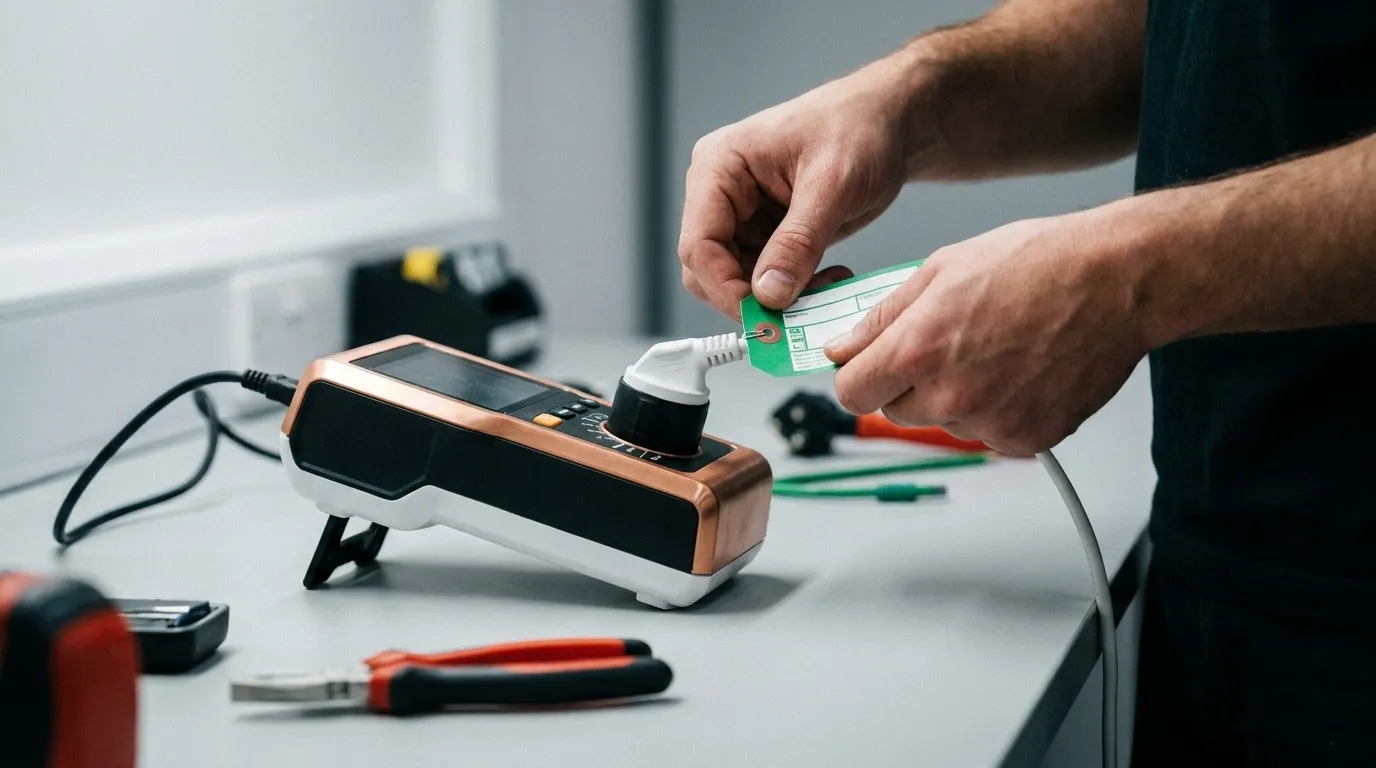
Electrical safety in the workplace does not begin and end with the fixed wiring. Portable appliances and flexible leads introduce risk that the switchboard and RCDs alone cannot fully mitigate. Australian Standard AS/NZS 3760 provides the framework for managing that risk systematically: visual inspection and electrical testing of in-service equipment at intervals calibrated to the environment in which that equipment is used. Lumen & Wire delivers test and tag services that are thorough, well-documented, and structured to make compliance straightforward for asset owners and managers.
Our testing technicians are trained and competent to AS/NZS 3760, and every test is conducted with calibrated instrumentation — not consumer-grade equipment with uncertain accuracy. We issue barcoded tags for every tested item, and the results feed into a digital asset register that gives you a clear, searchable record of what was tested, when, what the results were, and when the next test is due. That record is your evidence of due diligence, and it needs to be accurate.
Appliance and Lead Testing: What the Standard Requires
AS/NZS 3760 requires visual inspection and electrical testing of portable electrical appliances and flexible leads in commercial, industrial, and construction environments. Visual inspection covers the condition of plugs, cords, strain relief, outer insulation, and the appliance body for damage that would compromise safety. Electrical testing includes earth continuity measurement for Class I equipment, insulation resistance testing for all relevant equipment, and polarity verification.
Testing intervals under AS/NZS 3760 are not one-size-fits-all. The standard distinguishes between environments — a construction site demands more frequent testing than a low-risk office environment — and within each environment, the type of equipment and its usage pattern inform the appropriate interval. We apply a risk-based approach to scheduling, working with your team to establish intervals that satisfy the standard without creating unnecessary testing overhead on low-risk items.
- Visual inspection of plugs, cords, strain relief, insulation, and equipment bodies
- Earth continuity testing for all Class I portable appliances
- Insulation resistance testing to AS/NZS 3760 pass thresholds
- Polarity verification for all tested items
- RCD testing: push-button functional test and timed trip testing
- Barcoded digital asset register with individual item test history and next-due dates
RCD Testing
Residual current devices are the last line of protection against electric shock from earth-fault currents. AS/NZS 3760 requires both push-button functional testing and timed trip testing of RCDs at intervals prescribed by the standard. Push-button testing confirms the device will operate, but timed trip testing verifies it operates within the maximum disconnection time specified for its class. RCDs that fail timed trip testing may provide a false sense of protection while offering inadequate response to a genuine fault current.
We test all RCDs within scope — fixed switchboard RCDs, plug-in portable RCDs, and RCD-protected power boards — and record individual test results against each device. Defective RCDs are clearly flagged with a recommendation for immediate replacement. We do not simply tag and move on when a device has failed; we communicate the defect, explain the implications, and coordinate repair or replacement as required.
Digital Asset Registers and Audit-Ready Reporting
The value of test and tag is only as good as the records it produces. A folder of paper tags does not constitute a compliant asset register. Our digital system generates individual records for every tested item, including a unique barcode identifier, the test date, technician identity, test results for each measurement taken, the pass or fail outcome, and the next scheduled test date. Reports can be exported in formats suitable for your WHS management system, your property manager, or an insurance or regulatory audit. When a WorkSafe inspector or a certifier asks for evidence that your electrical equipment program is being managed, you can produce it within minutes.
At a glance
Test & Tag — your questions answered
AS/NZS 3760 specifies testing intervals based on the environment in which equipment is used. Equipment on a construction site or in a hostile industrial environment is tested more frequently — in some cases every three months — while equipment in a low-risk office environment may be tested every five years. The standard provides guidance tables, and we apply a risk-based assessment to ensure your testing schedule is both compliant and proportionate.
Test and tag under AS/NZS 3760 primarily addresses portable electrical equipment and flexible leads. Fixed wiring is inspected under different regulatory frameworks, including periodic verification inspections under AS/NZS 3000 and state-specific electrical safety regulations. Switchboard and outlet RCDs fall within scope for AS/NZS 3760 RCD testing requirements in addition to any fixed installation verification. We can clarify which compliance obligations apply to your specific premises and equipment inventory.
Failed items are immediately tagged with a clearly marked 'out of service' tag, removed from the compliant asset register, and documented in the test report with the nature of the failure. We will advise on repair or replacement options. Equipment that has failed testing must not be returned to service until it has been repaired and retested by a competent person and shown to pass all required tests.
Yes. We regularly conduct test and tag programs outside standard business hours — including evenings and weekends — for businesses where operational continuity makes daytime access difficult. We coordinate access arrangements in advance and work systematically through the agreed scope so that any disruption to your team is kept to an absolute minimum.
Related services
Emergency Electrician
24/7 rapid response for power outages, faults, and hazards — made safe, fast.
Learn more
Security & CCTV
IP cameras, access control, alarms, and intercoms — installed, networked, and remotely viewable.
Learn more
Fire Alarm Systems
Detection, alarm, and emergency lighting designed, installed, and certified to AS 1670.
Learn moreNeed test & tag done properly?
Talk to a licensed Lumen & Wire electrician for honest advice and a clear, itemised quote — with no obligation.