Cutting Commercial Energy Costs Without Cutting Output
12 February 2026 · 7 min read
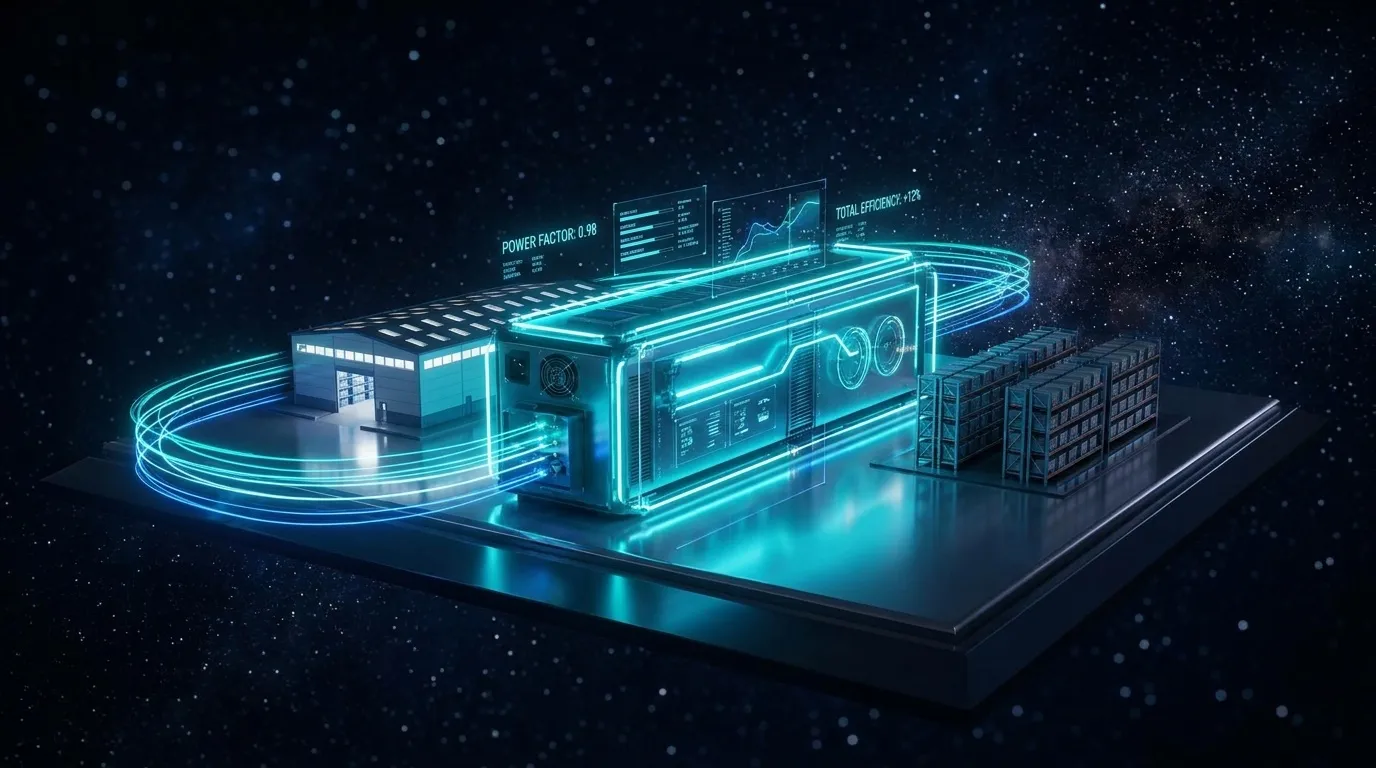
Energy is a cost that compounds. For a commercial or industrial facility operating 250 days a year across multiple shifts, a five per cent reduction in the electricity bill is not a rounding error — it is tens of thousands of dollars that falls directly to the bottom line, year after year. The good news is that most commercial facilities are carrying efficiency opportunities that have nothing to do with turning off lights or reducing output. They are structural — baked into the electrical installation — and fixing them requires engineering, not sacrifice.
Power factor correction: paying for power you cannot use
Inductive loads — motors, compressors, HVAC systems, fluorescent lighting with magnetic ballasts — draw current that lags the supply voltage. That phase displacement means the facility's apparent power (what the network must deliver) is higher than its active power (what does useful work). The ratio between the two is the power factor, and a facility with a power factor of 0.75 is drawing 33 per cent more current from the network than its productive load requires.
Network distributors charge commercial customers for this reactive power demand through a power factor penalty, or embed the cost in maximum demand tariff components. Power factor correction capacitor banks — installed at the main switchboard and, in larger facilities, at major motor loads — supply the reactive current locally, reducing import from the network. For manufacturing, cold storage, retail HVAC-heavy environments and data centres, power factor correction routinely delivers a payback period of two to four years on the capital investment, with zero impact on output.
LED retrofits: the still-underestimated opportunity
Industrial and commercial lighting accounts for a disproportionate share of electricity spend in warehousing, manufacturing and retail — and the gap between a metal halide or T8 fluorescent installation and a modern LED equivalent is not marginal. High-bay LED luminaires typically operate at 50 to 60 per cent of the wattage of the metal halide fittings they replace, while delivering equivalent or superior lumen output and dramatically improved colour rendering. In a warehouse running 150 metal halide high-bays for twelve hours a day, the reduction in lighting energy alone commonly exceeds $40,000 per year.
Motion and daylight harvesting controls compound the saving. A warehouse aisle that is unoccupied for four hours per shift draws nothing if the luminaires are controlled by occupancy sensors. Dimming in response to available daylight further flattens the consumption curve. The capital cost of a well-specified LED retrofit with controls is typically recovered within two to three years; the luminaires themselves carry a rated life of 50,000 hours or more.
Sub-metering and demand management
You cannot manage what you do not measure. Most commercial facilities have a single utility meter at the point of supply — useful for billing, but useless for identifying where energy is actually being consumed. Installing sub-meters at major loads and sub-boards — HVAC, compressed air, lighting circuits, process equipment — creates the visibility that drives genuine management decisions.
Demand management takes that data and acts on it. Maximum demand charges on commercial tariffs are levied against the highest 30-minute demand interval recorded in a billing period — a single thermal runaway event during a summer afternoon can inflate the demand charge for the entire quarter. A demand management system monitors real-time consumption against the site's demand threshold and curtails pre-agreed non-critical loads automatically when the threshold is approached. Combined with an energy management dashboard that puts consumption data in front of facility managers in real time, these systems routinely reduce maximum demand by 10 to 20 per cent.
Building the business case
Starwatt Systems approaches commercial energy efficiency as an engineering project with a financial output. We conduct a metered baseline assessment, model each measure's projected saving against the actual tariff structure the facility is on, calculate simple payback and net present value for each initiative, and sequence the programme so the highest-return measures fund subsequent stages.
The result is a costed, prioritised programme with credible financial projections — not a brochure. For most commercial facilities, a structured efficiency programme improves the electrical installation while the numbers justify every dollar of capital invested in it.
More insight
 Future Tech
How Smart Buildings Think: Automation, Sensors and the Connected Grid
KNX, C-Bus, IoT sensors and building management systems are turning commercial buildings into intelligent, self-optimising energy nodes on the grid.
Read Future Tech
EV Charging at Scale: Powering the Electric Future
From home wall boxes to commercial charging hubs, the electrical demands of widespread EV adoption require a fundamentally different approach to grid planning and load management.
Read Future Tech
The Electrician's Guide to Future-Proofing Your Home Wiring
Smart cabling, spare switchboard capacity, continuous conduit runs and EV or battery readiness — how to wire a home that is ready for the next thirty years.
ReadReady to unlock infinite power potential?
Tell us about your home, site or portfolio. Our engineers will scope the work, size the load and map your path to power without limits.