How Smart Buildings Think: Automation, Sensors and the Connected Grid
10 June 2026 · 7 min read
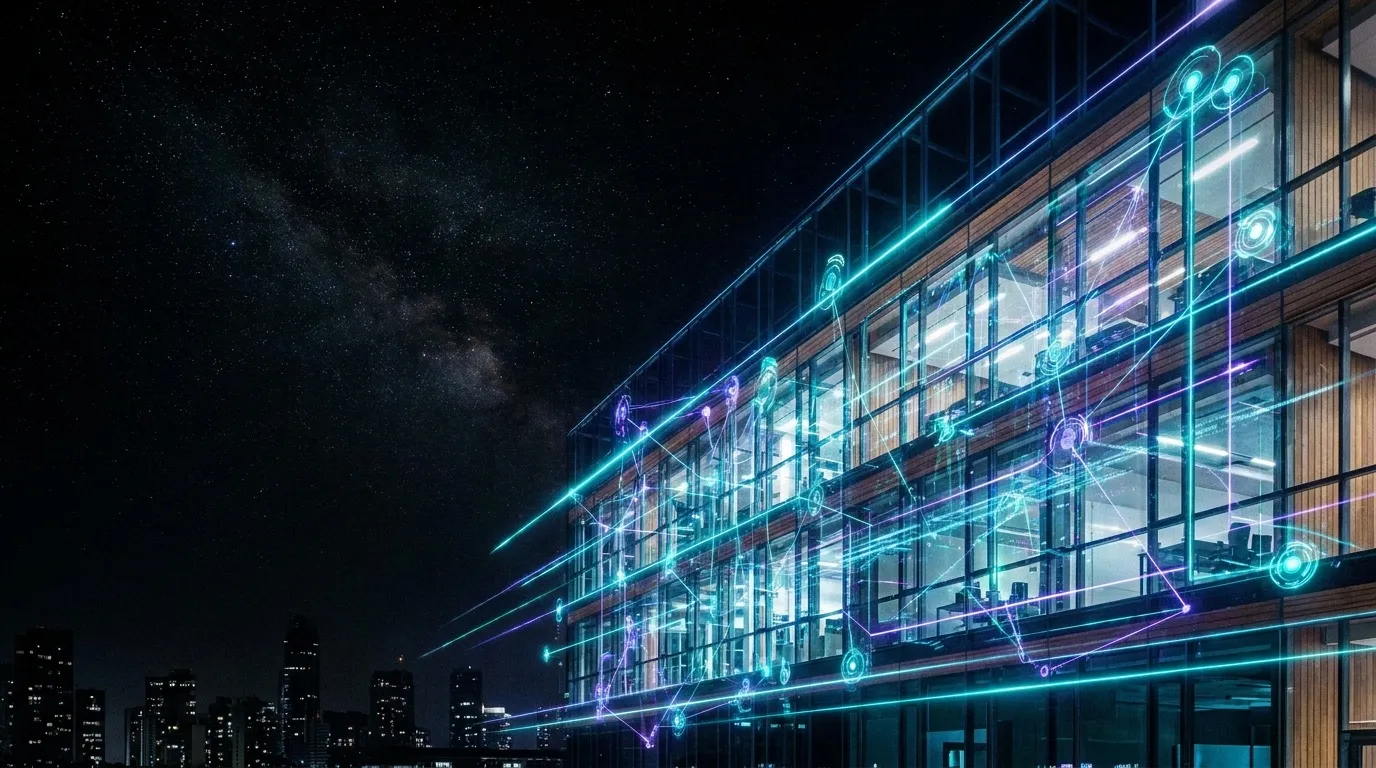
A building used to be passive infrastructure — pipes, wires and concrete waiting to be told what to do by the people inside it. That era is ending. Today, a well-engineered commercial building monitors its own energy flows, anticipates demand, responds to the grid in real time and learns from every cycle it runs. It does not merely house activity; it thinks.
The protocols underpinning building intelligence
At the electrical and automation layer, two protocols dominate serious commercial builds in Australia: KNX and C-Bus. KNX is an open, internationally standardised protocol that allows lighting, HVAC, blinds, access control and metering to communicate on a single certified backbone. Clipsal's C-Bus is widely deployed across Australian commercial, retail and educational facilities and excels in lighting control and integration with third-party building systems. Both eliminate the siloed, system-by-system wiring that made older buildings expensive to operate and nearly impossible to optimise holistically.
Where KNX and C-Bus govern the fixed infrastructure, IoT sensors fill the granular layer. Wireless occupancy sensors, CO2 monitors, sub-metering clamps on individual circuits and smart switchboards feed a continuous stream of operational data upward to the building management system (BMS). The BMS is the brain: it reconciles sensor data against programmed rules and machine-learned baselines, then issues commands back down to the physical layer — dimming a lighting zone, staging a chiller, or clamping a non-critical load during a demand-charge window.
Predictive maintenance: catching faults before they become failures
One of the highest-value applications of building intelligence is predictive maintenance. Conventional maintenance runs on a calendar — systems are inspected and serviced at fixed intervals regardless of actual condition. Predictive maintenance replaces the calendar with data. Current signatures on motor circuits reveal bearing wear weeks before failure. Thermal imaging integrated into periodic inspection cycles flags hot spots in switchboards before an arc-fault event occurs. Vibration sensors on pumps detect imbalance the moment it develops.
For a facility manager, the shift is profound: unplanned downtime drops dramatically, parts are replaced when needed rather than on schedule, and the electrical infrastructure's effective lifespan extends. For a building owner, that translates directly to lower maintenance spend and higher net operating income.
Grid connectivity and demand response
The connected building's relationship with the grid is no longer one-directional. Under demand response programmes operated by Australian energy market participants, a BMS-controlled building can receive a curtailment signal and automatically shed pre-agreed loads within seconds — without interrupting core operations. The building earns payment for that flexibility, and the grid avoids the need to fire a peaking generator.
As rooftop solar, battery storage and EV charging loads are integrated into commercial sites, the BMS becomes an energy orchestrator: charging the battery when tariff rates are low, dispatching it during peak demand windows, managing EV charger load to prevent switchboard overload and exporting surplus to the grid when the economics favour it. This is not theoretical — Starwatt Systems is commissioning exactly these integrated sites across south-east Queensland right now.
Where automation is heading
The trajectory is toward buildings that are fully participating grid assets — nodes that generate, store, consume and trade energy intelligently, coordinated by software that operates faster and more precisely than any manual control ever could. The electrical infrastructure underpinning that future needs to be designed for it from the ground up: dedicated conduit for data cabling, switchboards with communications-capable circuit protection, metering at every sub-board, and EV and storage connections built into the original design rather than bolted on as afterthoughts.
At Starwatt Systems, we design and install the electrical backbone that makes intelligent buildings possible. The technology overhead is compelling. The electrical engineering beneath it has to be flawless.
More insight
 Future Tech
EV Charging at Scale: Powering the Electric Future
From home wall boxes to commercial charging hubs, the electrical demands of widespread EV adoption require a fundamentally different approach to grid planning and load management.
Read Future Tech
The Electrician's Guide to Future-Proofing Your Home Wiring
Smart cabling, spare switchboard capacity, continuous conduit runs and EV or battery readiness — how to wire a home that is ready for the next thirty years.
Read Compliance
Switchboard Safety: When Your Home Is Running on Borrowed Time
Ceramic fuses, absent RCDs and overloaded circuits are not nostalgic quirks — they are genuine electrical hazards that AS/NZS 3000 exists to prevent.
ReadReady to unlock infinite power potential?
Tell us about your home, site or portfolio. Our engineers will scope the work, size the load and map your path to power without limits.