The Electrician's Guide to Future-Proofing Your Home Wiring
22 April 2026 · 6 min read
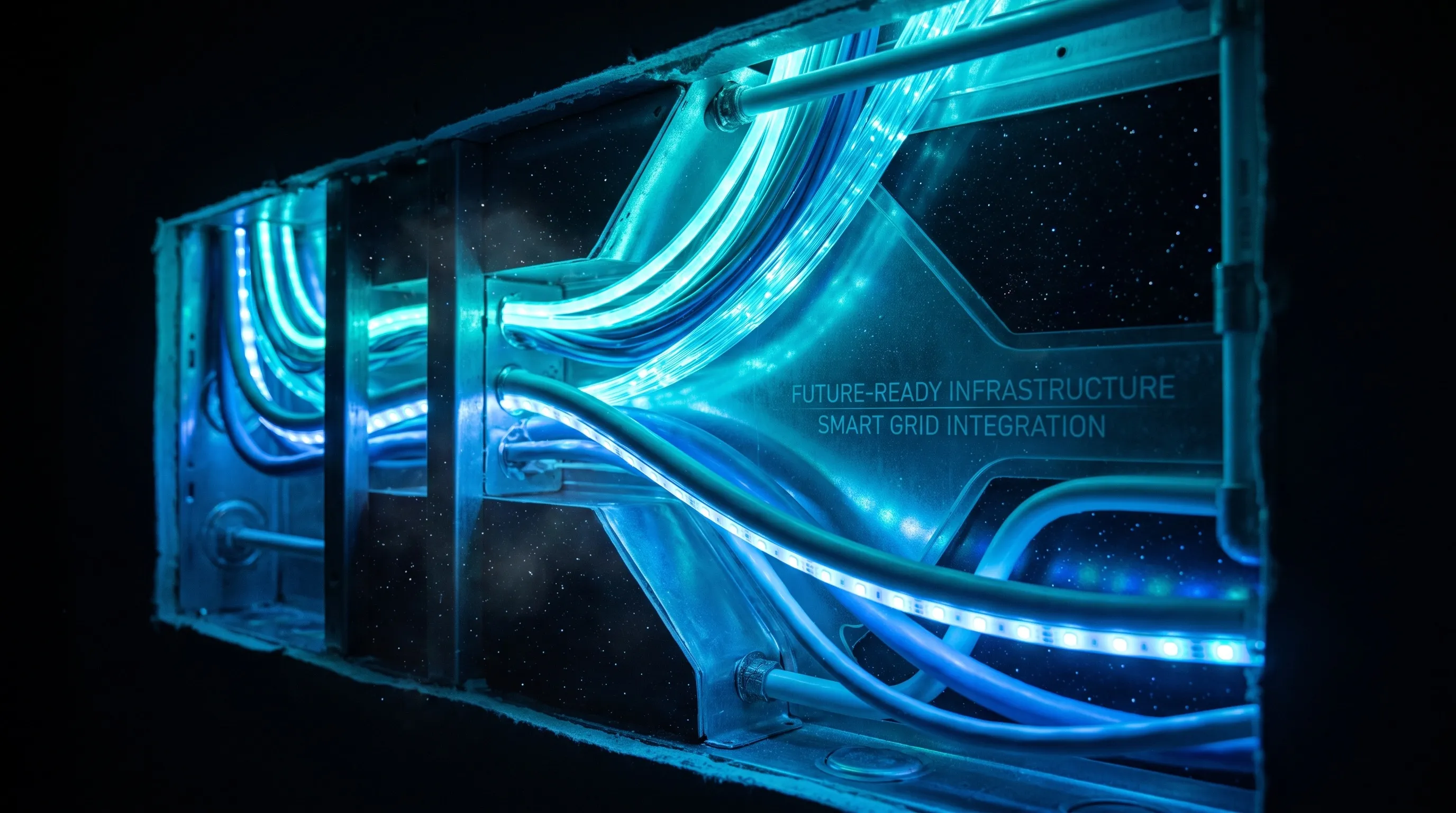
Most Australian homes were wired for a world that no longer exists. A kitchen circuit designed for a kettle and a toaster, a garage circuit sized for a fluorescent tube — the electrical skeleton of the average home reflects the consumption assumptions of its construction era. As EV chargers, solar inverters, battery systems and smart home devices become standard rather than exceptional, those assumptions are expiring fast.
Designing for capacity, not just current load
The most important principle in future-proof wiring is to design for the maximum foreseeable load, not the load you have today. That means specifying cable sizes with thermal headroom, installing a switchboard with at least six to eight spare circuit breaker positions, and ensuring the incoming mains supply is large enough to accommodate the site's long-term peak demand without requiring a costly network augmentation in five years' time.
In practice, this often means upgrading from a 63A single-phase service to a 100A service during a major renovation — an incremental cost at the time of construction that avoids a far more disruptive and expensive upgrade later. For homes where EV charging, battery storage and induction cooking are all realistic near-term additions, a three-phase supply upgrade deserves serious consideration. Three-phase allows each large load to be distributed across phases, reducing the current demand on any single phase and enabling faster EV charging via a three-phase wall box.
Smart-ready cabling and conduit
Cat 6A ethernet to every room is no longer a luxury specification — it is a future-proofing investment that pays for itself the first time a wireless access point fails to reach a home office, or a smart home controller needs a wired backbone for reliability. Running conduit alongside power and data cabling during construction or renovation is the highest-leverage decision available: a 25mm conduit installed in a wall cavity costs almost nothing relative to the labour of opening that cavity later.
For new builds and major renovations, Starwatt Systems recommends a conduit run from the main switchboard to the garage — large enough to accommodate the EV charger circuit and solar inverter DC isolator cabling that will almost certainly follow. The cable itself can wait; the conduit cannot, once the walls are closed.
EV and battery readiness
A dedicated 32A circuit from the switchboard to the garage, terminated at a weatherproof outlet or wall box enclosure, costs a fraction of the retrofit version — and guarantees that adding an EV charger later is a one-hour job rather than a half-day cable pull. Similarly, reserving space and cabling in the switchboard for a battery system's isolation switch and inverter circuit means the storage upgrade is straightforward when the economics are right.
Smart home integration adds another dimension. Wiring for home automation controllers, running data cable to lighting control positions and installing additional circuits for future sensor and actuator loads allows the home's intelligence to grow over time without invasive retrofits.
The cost case
Future-proofing electrical infrastructure during initial construction or renovation typically adds two to four per cent to the electrical contract value. Retrofitting the same capability after the fact routinely costs five to ten times as much, because the labour is overwhelmingly in access — cutting, patching and repainting — rather than in the materials themselves. The economic case for doing it right the first time is unambiguous.
Starwatt Systems brings this forward-looking approach to every residential installation we undertake. We ask not just what the home needs today, but what it will need in 2035 — and we wire for that answer.
More insight
 Future Tech
How Smart Buildings Think: Automation, Sensors and the Connected Grid
KNX, C-Bus, IoT sensors and building management systems are turning commercial buildings into intelligent, self-optimising energy nodes on the grid.
Read Future Tech
EV Charging at Scale: Powering the Electric Future
From home wall boxes to commercial charging hubs, the electrical demands of widespread EV adoption require a fundamentally different approach to grid planning and load management.
Read Compliance
Switchboard Safety: When Your Home Is Running on Borrowed Time
Ceramic fuses, absent RCDs and overloaded circuits are not nostalgic quirks — they are genuine electrical hazards that AS/NZS 3000 exists to prevent.
ReadReady to unlock infinite power potential?
Tell us about your home, site or portfolio. Our engineers will scope the work, size the load and map your path to power without limits.