Switchboard Safety: When Your Home Is Running on Borrowed Time
18 March 2026 · 5 min read
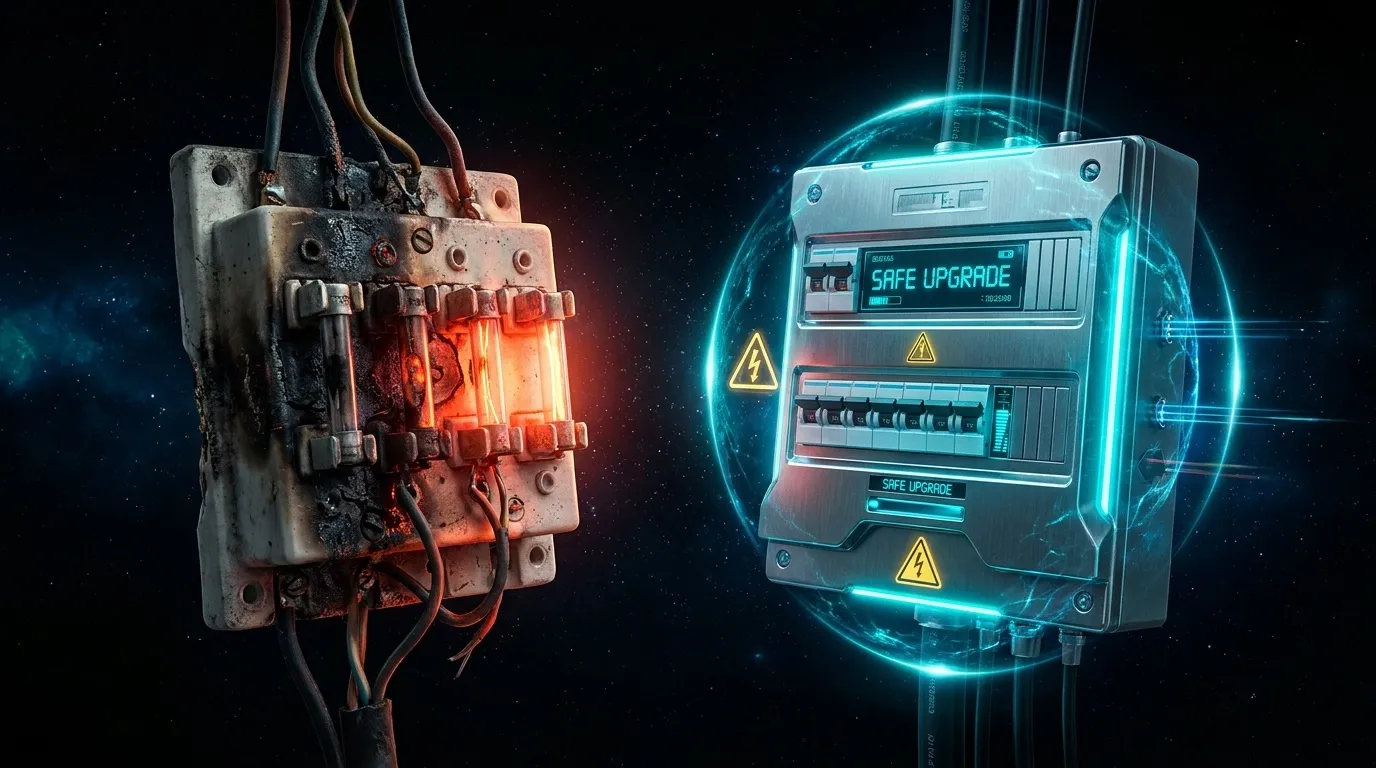
The switchboard is the central nervous system of your home's electrical installation, and for hundreds of thousands of Australian homes built before the 1990s, that nervous system is operating well outside the standards current electrical codes require. This is not a technicality. Outdated switchboards are a leading contributor to residential electrical fires and electrocution fatalities in Australia, and the hazard compounds every time a new load is added to a board that was never designed to carry it.
Ceramic fuses: protection that does not protect
Ceramic rewireable fuses were the standard overcurrent protection device in Australian homes built through the 1970s. In principle, the fuse wire melts when current exceeds a safe threshold. In practice, fuse wire that has been repeatedly replaced — or substituted with wire of the wrong rating — may fail to operate correctly at all. A fuse rewired with too-heavy wire will carry a fault current indefinitely, allowing cables to overheat to the point of ignition without ever blowing. There is no reliable way to know the condition of a rewired ceramic fuse from the outside. AS/NZS 3000, the Wiring Rules that govern Australian electrical installations, mandates the transition to circuit breakers for good reason.
RCDs and RCBOs: the life-saving standard
A residual current device detects the difference between current flowing out of the active conductor and current returning on the neutral — a difference that indicates current is taking an unintended path, very possibly through a person. An RCD trips in under 30 milliseconds at a leakage threshold of 30 mA, a combination that is fast enough and sensitive enough to prevent electrocution in the vast majority of fault scenarios.
AS/NZS 3000 requires RCD protection on all final subcircuits in new and significantly modified residential installations. The practical implication for older homes: if your switchboard does not have RCDs protecting your power and lighting circuits, your installation does not meet the current standard and you are not protected. RCBOs — combination devices that integrate a circuit breaker and RCD in a single unit — are the preferred solution in modern switchboard upgrades, providing both overcurrent and earth leakage protection on individual circuits without a tripping event on one circuit knocking out protection on others.
Signs your switchboard is overloaded
Physical warning signs include circuit breakers that trip repeatedly under normal loads, a switchboard enclosure that feels warm to the touch, scorch marks or discolouration around terminals or cables, a burning or hot plastic smell near the board, or flickering lights when large appliances cycle on. Any of these warrants an immediate licensed electrical inspection — they are symptoms of a board operating beyond its safe design parameters.
Less visible but equally significant: if your home's electrical load has grown materially since the switchboard was installed — through the addition of split-system air conditioners, a dishwasher, induction cooktop, EV charger or solar inverter — and the switchboard has not been assessed for that additional demand, the board is carrying a load it was never rated for.
Your compliance obligations
When licensed electrical work is carried out on an existing installation, the Wiring Rules require that the work complies with current standards and that any non-compliant conditions identified in the immediate vicinity of the work are rectified. This means a switchboard assessment is a standard part of any Starwatt Systems service call, not an upsell. If your board is non-compliant, we document what we found and what is required — clearly, honestly and without pressure.
Upgrading a residential switchboard to current standards is a straightforward piece of work for a qualified electrical contractor. It is also one of the most significant safety investments a homeowner can make. The homes that burn are overwhelmingly the ones where the switchboard was running on borrowed time — and nobody knew it until they ran out.
More insight
 Future Tech
How Smart Buildings Think: Automation, Sensors and the Connected Grid
KNX, C-Bus, IoT sensors and building management systems are turning commercial buildings into intelligent, self-optimising energy nodes on the grid.
Read Future Tech
EV Charging at Scale: Powering the Electric Future
From home wall boxes to commercial charging hubs, the electrical demands of widespread EV adoption require a fundamentally different approach to grid planning and load management.
Read Future Tech
The Electrician's Guide to Future-Proofing Your Home Wiring
Smart cabling, spare switchboard capacity, continuous conduit runs and EV or battery readiness — how to wire a home that is ready for the next thirty years.
ReadReady to unlock infinite power potential?
Tell us about your home, site or portfolio. Our engineers will scope the work, size the load and map your path to power without limits.