Understanding Three-Phase Power: The Backbone of Industrial Capacity
20 January 2026 · 6 min read
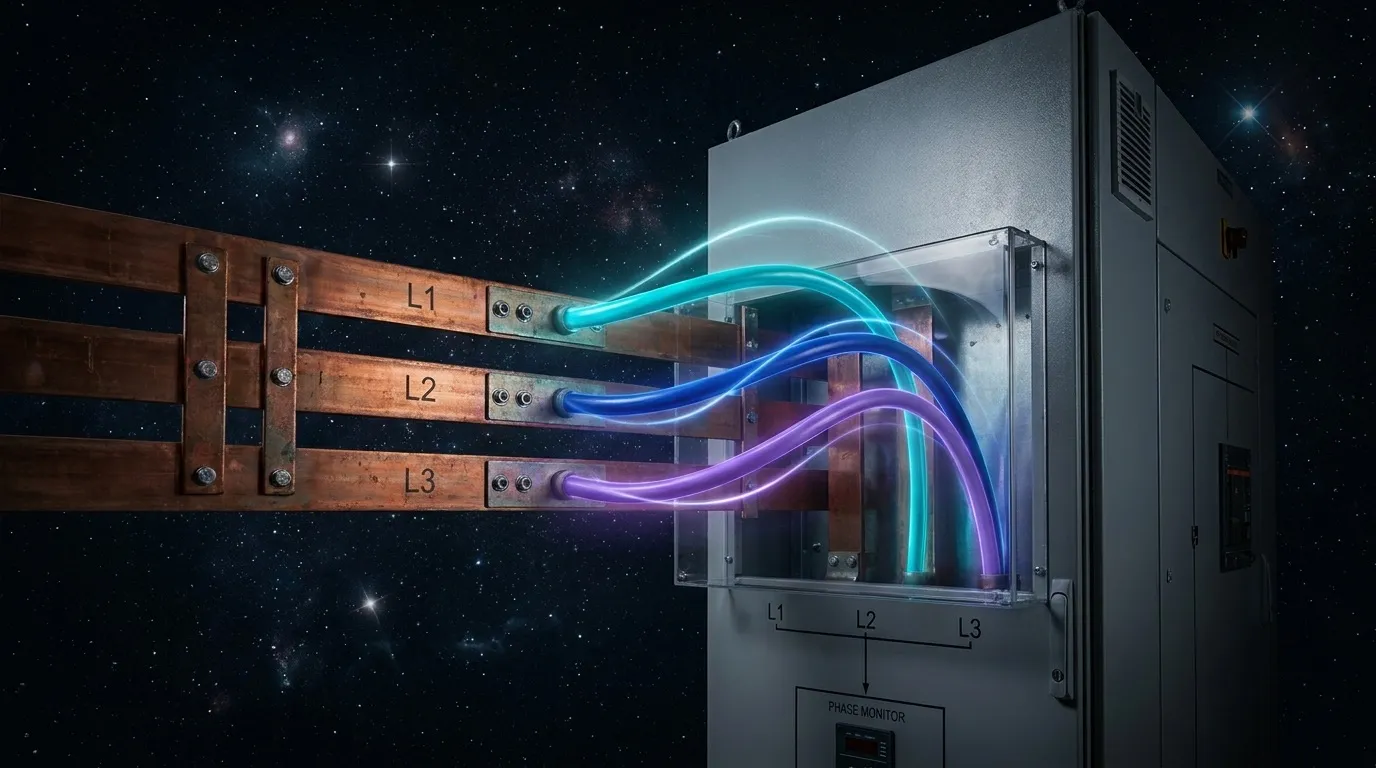
Walk into any manufacturing plant, data centre, commercial kitchen or large HVAC plant room and the electrical infrastructure you find will almost certainly be three-phase. This is not incidental. Three-phase power delivers substantial engineering advantages over single-phase supply — advantages that become decisive as load sizes increase, as motor-driven equipment dominates the electrical profile, and as the need to distribute power efficiently over distance grows. Understanding what three-phase actually is, and why it exists, is foundational to understanding modern electrical engineering.
What three-phase power is
A single-phase supply delivers alternating current on one active conductor, oscillating between positive and negative voltage at 50 Hz. Three-phase supply delivers three separate alternating currents on three active conductors, each displaced 120 degrees from the others in their oscillation cycle. At any instant, the three currents together sum to zero — which is why the neutral conductor carries minimal current in a balanced three-phase system, and why three-phase transformers and cables can deliver substantially more power for a given conductor size than equivalent single-phase infrastructure.
Australian standard three-phase voltage is 400V between active phases (line-to-line) and 230V between any active phase and neutral (line-to-neutral) — the same 230V that single-phase circuits use, drawn from one phase of the three-phase system. This means single-phase loads can be connected to a three-phase supply simply by distributing them across the three phases.
Why industry runs on three-phase
Three-phase induction motors are the workhorses of industrial process. They are simpler in construction than single-phase motors — no capacitors, no start windings, no centrifugal switches — and they produce smooth, continuous torque across all operating speeds rather than the pulsating torque characteristic of single-phase motors. The absence of torque ripple matters enormously for precision machinery, compressors and pumps where smooth rotation is operationally critical.
Power delivery is also smoother in a three-phase system. Because each phase reaches its voltage peak 120 degrees apart, the instantaneous power delivered to a balanced three-phase load is constant rather than pulsating. This is why three-phase welders produce cleaner welds, three-phase VFDs provide finer motor speed control and three-phase UPS systems switch seamlessly — the underlying power waveform contains no moments of zero delivery.
Balancing loads across phases
A three-phase installation's efficiency depends on load balance. When the current drawn on each of the three phases is equal, the neutral conductor carries virtually no current and the system operates at maximum efficiency. When loads are unbalanced — one phase carrying substantially more current than the others — neutral current increases, voltage distortion can appear on lightly loaded phases, and the upstream transformer operates less efficiently.
In commercial and industrial switchboard design, distributing single-phase loads evenly across all three phases is a fundamental design discipline. Lighting circuits, power outlets, HVAC condensers and small appliance circuits should be allocated thoughtfully across the three phases to maintain balance across operating conditions. In facilities where load profiles are complex or variable, power quality monitoring at the main switchboard provides the data needed to identify persistent imbalance and correct it.
Upgrading to three-phase supply
For residential properties, three-phase supply is increasingly relevant as EV chargers, battery inverters and solar installations push single-phase current levels toward their practical limits. A 22 kW three-phase EV charger draws approximately 32A per phase — a manageable load on each phase of a 63A three-phase service. The same charger on a single-phase connection would require a 100A service that many residential network supply agreements do not accommodate.
Upgrading from single-phase to three-phase supply requires a network application to the local distribution business, a licensed electrical contractor to install the three-phase switchboard and upgrade internal wiring as required, and a meter exchange by the relevant metering coordinator. For residential properties with significant generation, storage and EV loads, the upgrade is frequently the most cost-effective way to unlock the full capacity of the electrical installation.
Starwatt Systems designs and installs three-phase electrical systems across industrial, commercial and residential sectors — from initial supply upgrade applications through to full switchboard replacement and sub-board distribution. If your facility's electrical capacity is limiting what your operation can become, the constraint is almost always solvable. The engineering just needs to match the ambition.
More insight
 Future Tech
How Smart Buildings Think: Automation, Sensors and the Connected Grid
KNX, C-Bus, IoT sensors and building management systems are turning commercial buildings into intelligent, self-optimising energy nodes on the grid.
Read Future Tech
EV Charging at Scale: Powering the Electric Future
From home wall boxes to commercial charging hubs, the electrical demands of widespread EV adoption require a fundamentally different approach to grid planning and load management.
Read Future Tech
The Electrician's Guide to Future-Proofing Your Home Wiring
Smart cabling, spare switchboard capacity, continuous conduit runs and EV or battery readiness — how to wire a home that is ready for the next thirty years.
ReadReady to unlock infinite power potential?
Tell us about your home, site or portfolio. Our engineers will scope the work, size the load and map your path to power without limits.