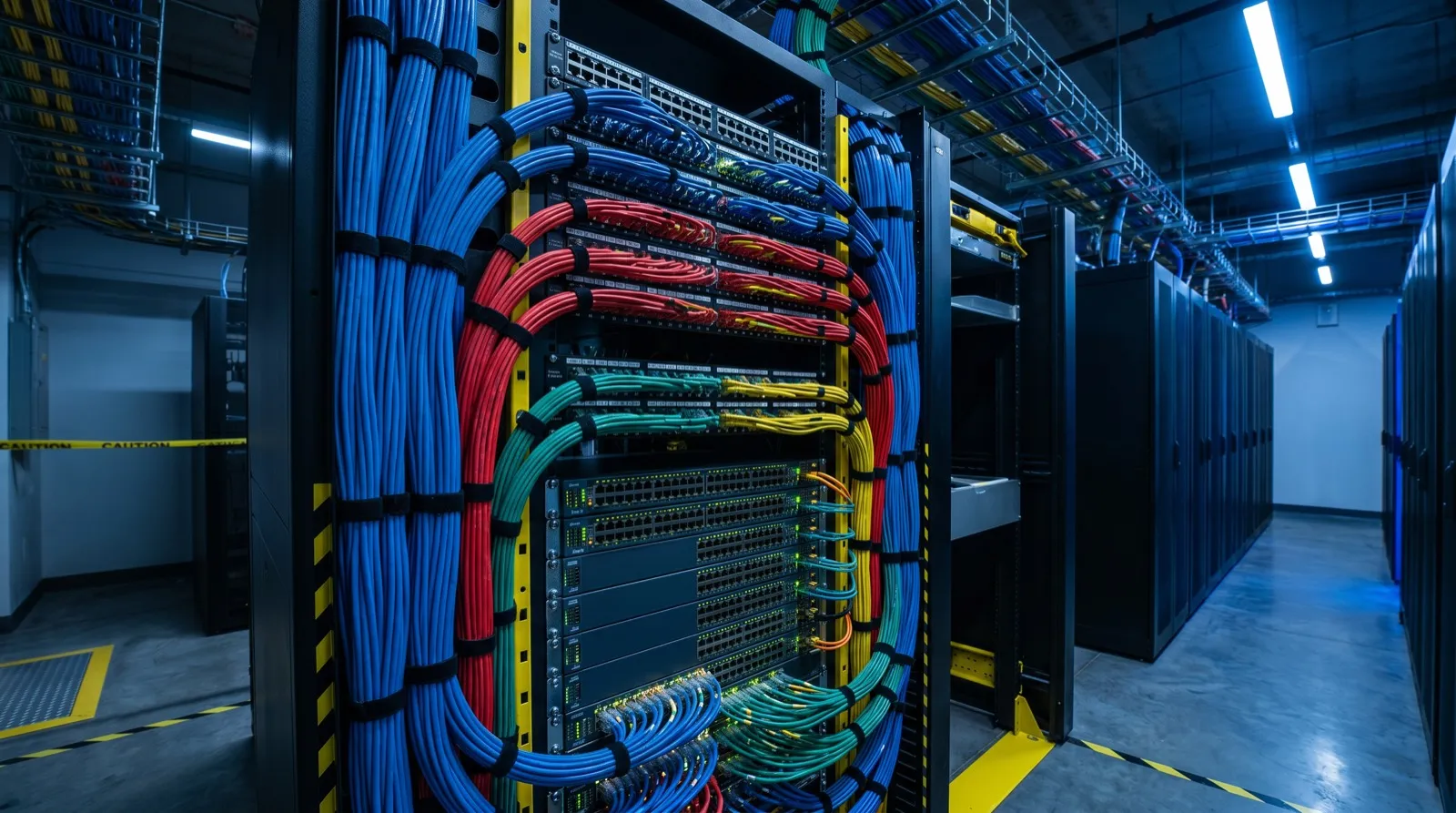
Structured cabling is the nervous system of every modern building. Done correctly, a Cat6A or Cat7 installation delivers 10 Gbps Ethernet to every outlet with headroom for Power over Ethernet (PoE) devices including IP cameras, access points, VoIP handsets, and building management sensors. Done badly, it throttles performance at 100 Mbps and introduces crosstalk that causes intermittent faults that are expensive and time-consuming to diagnose. Ironclad Electrical installs structured cabling to AS/CA S009 using ACMA-registered cablers. Every outlet is tested with a Fluke DSX CableAnalyzer and the test report is included in your handover documentation.
Cable Selection: Cat6A, Cat7, and Fibre
Cat6A (augmented Category 6) supports 10GBASE-T at 100 metres and provides sufficient power handling for 802.3bt PoE++ at 90 W per port. It is our default specification for new commercial and residential installations. Cat7 uses individually shielded pairs (SSTP or PIMF construction) and offers superior alien crosstalk performance in dense cable bundles, making it the preferred choice for server rooms and trading floor environments where many parallel runs share the same pathway. For backbone connections between communications rooms, and for campus links beyond 100 metres, we install multimode or single-mode fibre optic cable with LC or SC connectors terminated and tested with an OTDR. Fibre eliminates ground loop and EMI problems common in industrial environments and is increasingly specified for building management system backbones.
- Cat6A and Cat7 horizontal cabling to AS/CA S009, tested and certified per outlet
- Fibre optic backbone installation: OM4 multimode and OS2 single-mode, OTDR tested
- 19-inch or wall-mount comms rack installation with patch panels, cable management, and labelling
- PoE infrastructure planning: switch selection, power budget calculation, and cable derating for PoE heat
- Wireless access point cabling with correct ceiling plenum cable and recessed back boxes
- Consolidation point and zone cabling for open-plan office and industrial floor reconfigurations
Rack and Patch Panel Installation
Structured cabling terminates at a telecommunications room or comms cabinet that houses patch panels, network switches, and the incoming internet service. Ironclad installs 19-inch open-frame racks or fully enclosed wall-mount cabinets depending on the site security requirements. Patch panels are punched down with the correct 568B or 568A wiring sequence and each port is labelled with a scheme that matches the outlet labels and the as-built floor plan. Cable management arms, horizontal and vertical managers, and correct bend radius adherence are not optional finishes: they are the difference between a rack that can be serviced in five minutes and one that takes an afternoon to trace a single fault. We install the physical layer and can also supply and configure managed network switches, configure VLANs, and hand the network over ready for your IT administrator.
Certification Testing and As-Built Documentation
Every outlet we install is tested against the AS/CA S009 channel or permanent link performance limits using a Fluke DSX CableAnalyzer. The analyser measures insertion loss, return loss, NEXT, FEXT, and alien crosstalk against the Cat6A or Cat7 standard and generates a pass or fail result for each parameter. We do not accept verbal pass claims. You receive a PDF test report for every outlet, every fibre span, and every backbone link as part of the handover package. This report is your proof of performance and your baseline for any future fault diagnosis. As-built floor plans are delivered in PDF showing outlet locations, cable IDs, patch panel port assignments, and rack layout.