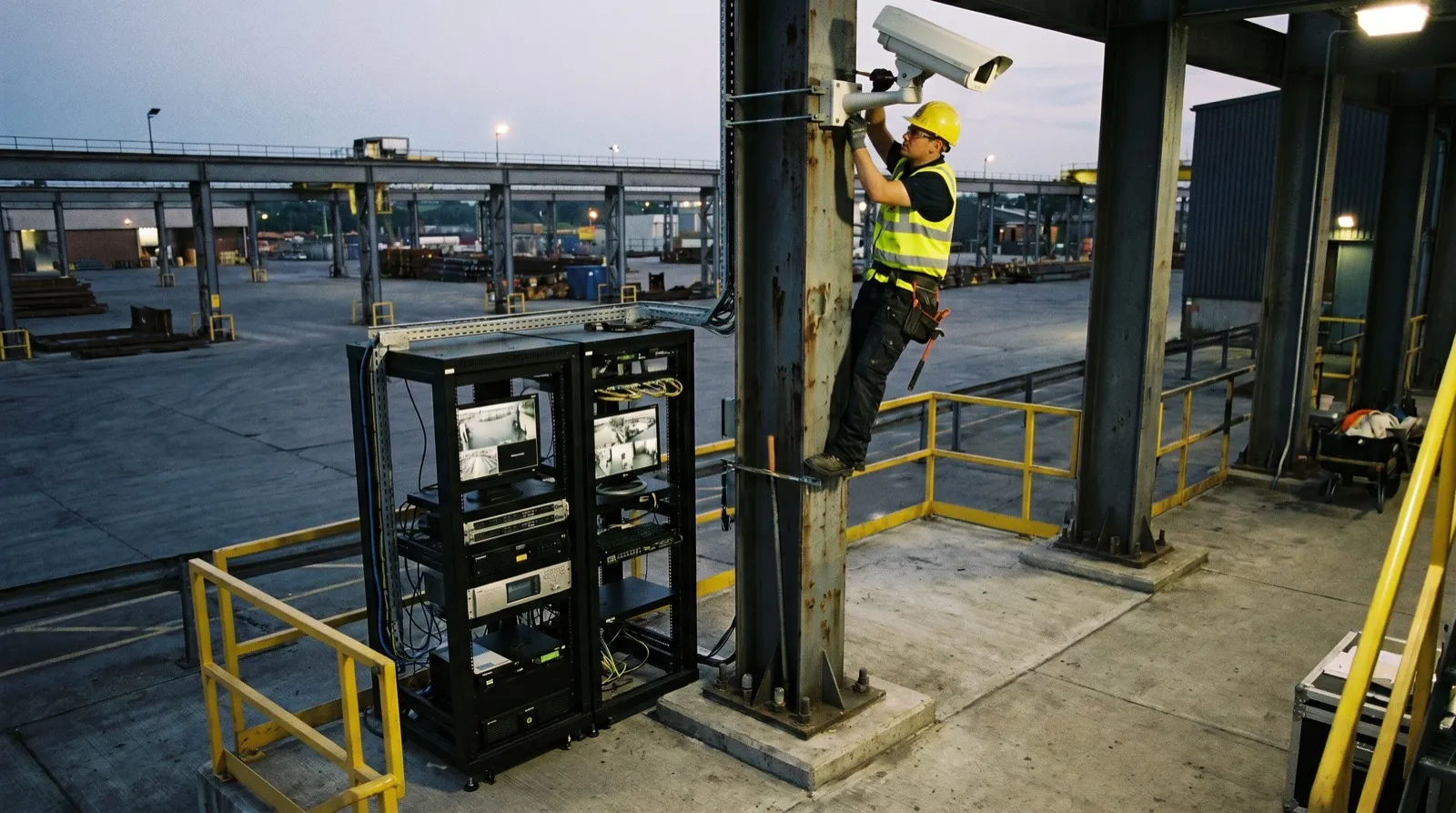
Security and CCTV infrastructure on an industrial site must survive operating conditions that would destroy consumer-grade equipment within months. Dust ingress, vibration, chemical spray, extreme temperature cycling, high-current electromagnetic interference from variable speed drives and welding equipment, and the mechanical risk of forklift traffic and falling objects — these are the realities of the environments Ironclad designs security systems for. We specify equipment rated for the conditions, install it with the cable management and power conditioning that industrial environments demand, and commission it to perform reliably without the constant maintenance calls that characterise cheap security installations.
IP CCTV Systems for Industrial Sites
Ironclad specifies IP-based CCTV systems using cameras rated to a minimum of IP66 (dust-tight, jet-water resistant) for all external and industrial interior applications, with IP67 and IP68 ratings specified for wash-down areas, food processing environments and external perimeter applications in high-rainfall zones. We use cameras with true wide dynamic range (WDR) processing for locations where high-contrast lighting conditions — dock doors, factory entrances with overhead floodlights — would blind a standard camera. For large-span interior spaces such as warehouse bays and manufacturing floors, we use varifocal cameras with motorised lenses that allow focal length adjustment without physical access to the camera mounting position. Cameras are powered via Power over Ethernet (PoE) where cable runs permit, with dedicated DC power supplies on longer runs. All network video recorders (NVRs) are mounted in locked, ventilated enclosures with UPS backup to ensure recording continuity during power fluctuations.
- IP66/67/68-rated camera supply and installation for exterior, industrial interior and wash-down environments
- 4K resolution IP cameras with true WDR for high-contrast and back-lit locations
- Network video recorder (NVR) installation in locked, ventilated enclosures with UPS backup
- Structured cabling and conduit installation to AS/NZS 3000 with EMI separation from power wiring
- Electronic access control including card reader, PIN and biometric systems on entry points and server rooms
- Remote viewing configuration for authorised management access via encrypted connection
Electronic Access Control
Controlling who can access which areas of your facility — and maintaining a tamper-proof audit trail of who accessed what and when — is both a security requirement and, for many industrial operations, a WHS obligation. Ironclad installs electronic access control systems ranging from standalone card readers on individual doors to enterprise-grade networked systems that manage access across multiple entry points and integrate with HR systems for credential provisioning. For industrial applications we specify vandal-resistant card reader housings, electromagnetic door holds and releases that fail-safe to the open position on power loss in accordance with fire egress requirements, and controller hardware with onboard battery backup to maintain access logging and control during power outages. We also install video intercom systems for vehicle gate control and delivery dock management where visitor access needs to be monitored without placing a staff member at the gate.
Integration with Electrical Infrastructure
Security and CCTV systems on industrial sites share electrical infrastructure with high-current equipment that creates significant electromagnetic interference if cabling is not correctly separated and shielded. AS/NZS 3000 requires that low-voltage data and signal cabling be routed and separated from power wiring to prevent interference and safety risks. Ironclad designs security cable routes that maintain the separations required by both AS/NZS 3000 and the security system manufacturer specifications, uses shielded cable in high-EMI zones, and specifies surge protection devices on all external camera connections to protect network equipment from lightning-induced transients. Because we are a full-service electrical contractor, we can also power-condition the security system from a dedicated circuit with appropriate surge and EMI filtering — a capability that a security-only installer without an electrical licence cannot provide.