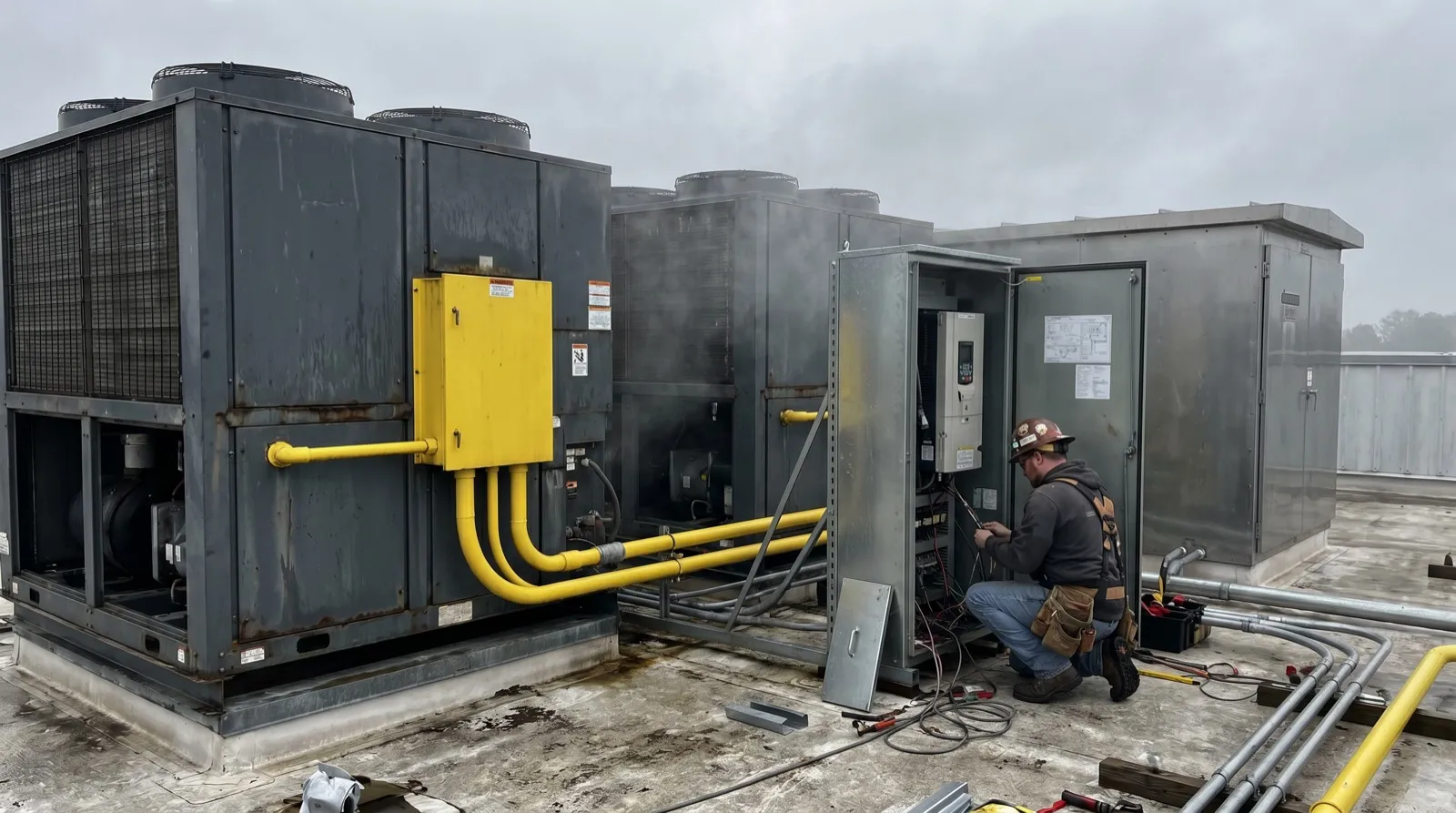
Heating, ventilation, and air conditioning systems are among the largest electrical loads in commercial and industrial buildings. A rooftop packaged unit serving a medium-sized commercial tenancy can draw 30 A to 60 A of three-phase current at full load. A chiller serving an industrial process may draw several hundred amps. Getting the electrical supply wrong on HVAC equipment means nuisance tripping, premature motor failure, voided equipment warranties, and in serious cases, cable fires in ceiling spaces. Ironclad Electrical has been supplying and wiring HVAC systems since 2004. We read mechanical schedules, calculate full-load currents from motor data plates, apply the correct derating factors for installation method and ambient temperature, and size every sub-main and protection device to AS/NZS 3000 requirements.
Three-Phase Motor Circuit Supply and Protection
Three-phase HVAC compressors and fan motors require dedicated circuit protection that is matched to the motor's locked-rotor current, full-load current, and starting method. A direct-online motor starter imposes a starting current of typically six to eight times full-load current for three to five seconds, demanding a protection device with the correct time-delay characteristic rather than a standard MCB. Ironclad selects motor circuit breakers with adjustable thermal and magnetic trips calibrated to the specific motor data, installs overload relays set within ten per cent of the motor full-load current, and runs the sub-main in correctly sized conduit with verified earth loop impedance at the motor terminal. For compressors with electronic expansion valves and variable-speed scroll compressors, we also wire the control transformer, safety interlocks, and BACnet or Modbus communication interface to the building management system, coordinating the commissioning sequence with the mechanical contractor.
- Three-phase sub-main supply to rooftop units, split systems, and chillers
- Variable speed drive (VSD/VFD) supply, installation, and parameter commissioning
- Motor circuit breaker and overload relay selection per AS/NZS 3000 and motor data
- Control transformer, safety interlock, and BMS communication wiring
- Condenser and compressor terminal box wiring with phase rotation verification
- Fault diagnosis on motor circuits: insulation resistance, phase balance, and earth continuity
Variable Speed Drives: Installation, Wiring, and Commissioning
Variable speed drives, also called variable frequency drives or VSDs, reduce energy consumption in HVAC fan and pump applications by running motors at the speed actually required by the load rather than at fixed synchronous speed. Installing a VSD correctly requires more than simply connecting L1, L2, L3 in and U, V, W out. The supply-side cable must be short and screened to contain the high-frequency switching noise the drive generates on the supply bus. The motor cable must also be screened, with the screen terminated at both the drive output and the motor frame to provide a low-impedance path for common-mode currents. RCDs on VSD circuits must be Type B to handle DC leakage components. Ironclad commissions VSDs with the correct motor nameplate data entered, acceleration and deceleration ramp rates set to suit the driven load, and speed reference inputs wired from the BMS or pressure transducer as specified by the HVAC designer. We also configure drive bypass contactors and handoff-auto switching where operational redundancy is required.
Fault Diagnosis on Commercial HVAC Electrical Systems
HVAC electrical faults in commercial buildings are frequently misattributed to the mechanical side of the system. A compressor that fails to start is immediately assumed to be a refrigerant or mechanical fault, when the actual cause is a phase failure due to a loose termination, an overload relay set too tight, or a VSD fault code that has not been read and interpreted. Ironclad attends HVAC fault callouts with a structured diagnostic method: we retrieve VSD and PLC fault histories, measure three-phase supply voltage under load to detect phase imbalance, check overload relay settings against motor name plate data, and test insulation resistance on motor windings to detect incipient winding failures before they become total motor replacements. Our written fault reports document root cause, remediation completed, and recommended preventive actions, giving building owners and facilities managers the information they need to plan maintenance rather than just react to it.