Electric vehicle uptake in Australia has crossed the tipping point where charger installation is now a mainstream trade job rather than a specialist curiosity. But mainstream demand does not mean simplified work. An EV charger draws continuous high current for hours on end, and that sustained load exposes every weakness in an aging sub-main, an undersized neutral, or a switchboard that was never designed for it. Ironclad Electrical approaches every EV charger installation the same way we approach an industrial machine connection: with a load analysis, a full review of the existing electrical installation under AS/NZS 3000, and a cabling design that handles the actual duty cycle rather than just the nameplate rating.
AC Charging: 7kW Single-Phase and 22kW Three-Phase
Most residential EV charger installations use a 7.4kW single-phase Type 2 unit drawing approximately 32 A continuous from a 240 V supply. That single circuit already demands a dedicated sub-main, a correctly rated RCD and MCB in the switchboard, and cabling sized to handle the full load without the 80 per cent derating typically applied to non-continuous circuits. For sites with three-phase 415 V supply available, a 22kW three-phase AC charger dramatically reduces charge times and is the preferred solution for dual-EV households, commercial car parks, and light fleet depots. Ironclad designs the three-phase sub-main, installs the Type 2 charge post with IP65 or better enclosure ratings, and commissions the unit against the vehicle to verify correct communication via the Type 2 pilot signal. Where the existing switchboard cannot accommodate additional load, we upgrade the main switchboard or install a dedicated sub-board at the charger location, complete with surge protection and AS/NZS 3000 compliant earthing.
- Single-phase 7kW and 7.4kW Type 2 wall-box installation to AS/NZS 3000
- Three-phase 22kW Type 2 charge post supply and installation
- DC fast-charging infrastructure supply including civil conduit coordination
- OCPP-compliant load management and demand response configuration
- Sub-main upgrades and switchboard capacity assessment prior to installation
- Multi-bay commercial and fleet charging arrays with energy metering
DC Fast Charging and Commercial Infrastructure
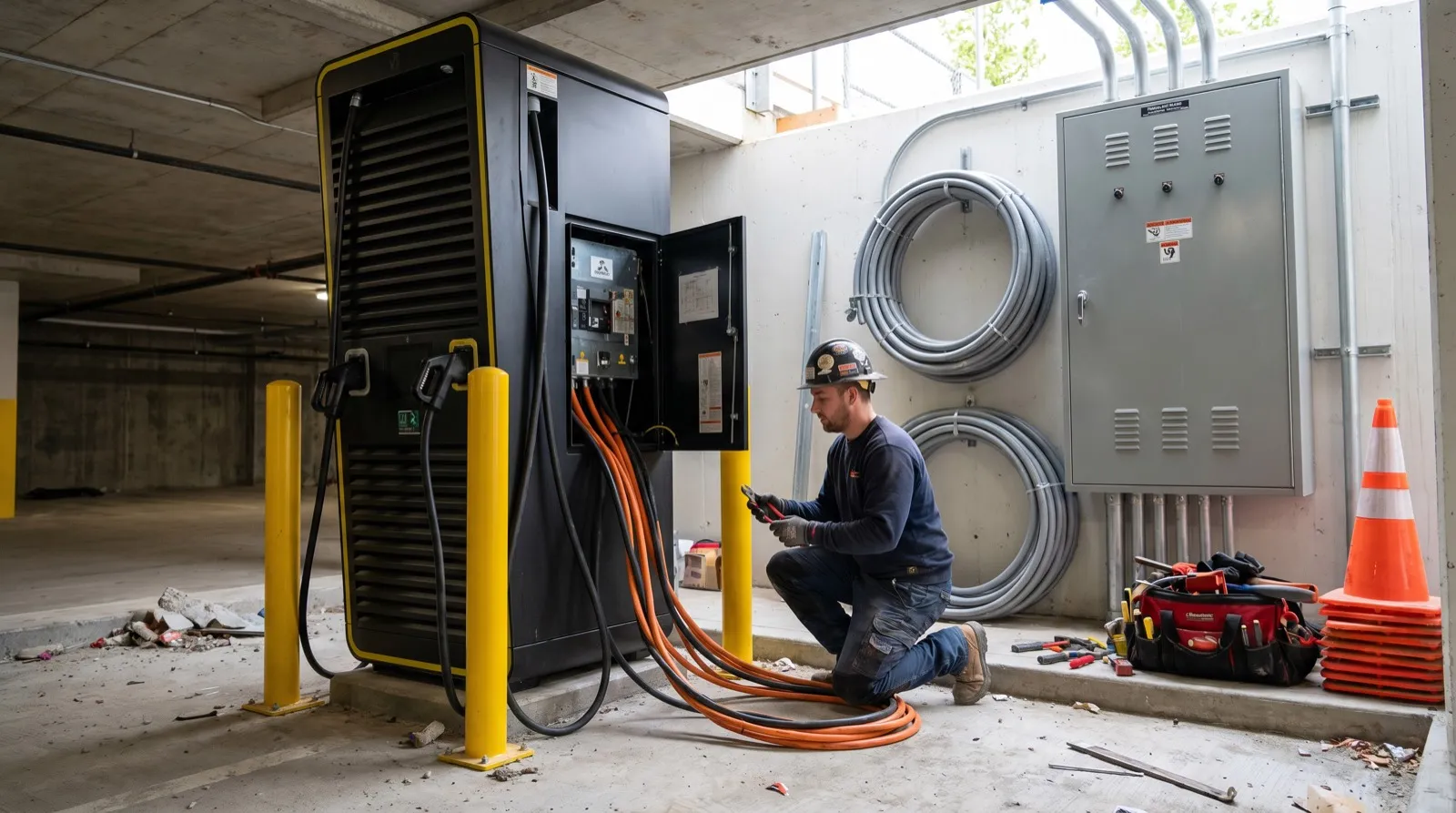
DC fast chargers, including 50kW CCS Combo and 150kW-plus high-power chargers, draw directly from the grid via an on-board rectifier and bypass the vehicle's onboard AC charger entirely. Installing this infrastructure requires coordinating a high-capacity three-phase supply, often a new metered supply from the distributor, alongside conduit pathways, cable pits, and a dedicated protection and metering switchboard at the charger output. Ironclad manages the electrical design and AS/NZS 3000 compliance documentation, coordinates with the distribution network service provider for supply augmentation, and handles the certified electrical installation from switchboard to charge point. We have installed commercial charging infrastructure for logistics depots, car dealerships, and local government sites across the region.
OCPP Load Management and Smart Charging
On sites with multiple chargers or limited grid capacity, OCPP-based load management prevents nuisance tripping by dynamically sharing available current across active charge sessions. Ironclad configures OCPP 1.6 and OCPP 2.0.1 backends, sets up scheduled charging to align with off-peak tariffs, and integrates charger output data into building energy management systems where required. For solar PV sites, we configure solar surplus charging so that the charger draws preferentially from PV generation rather than the grid, maximising self-consumption without compromising the integrity of the earthing and protection system. Every installation is completed with a Certificate of Electrical Safety and a test report confirming insulation resistance, earth continuity, and RCD trip time.