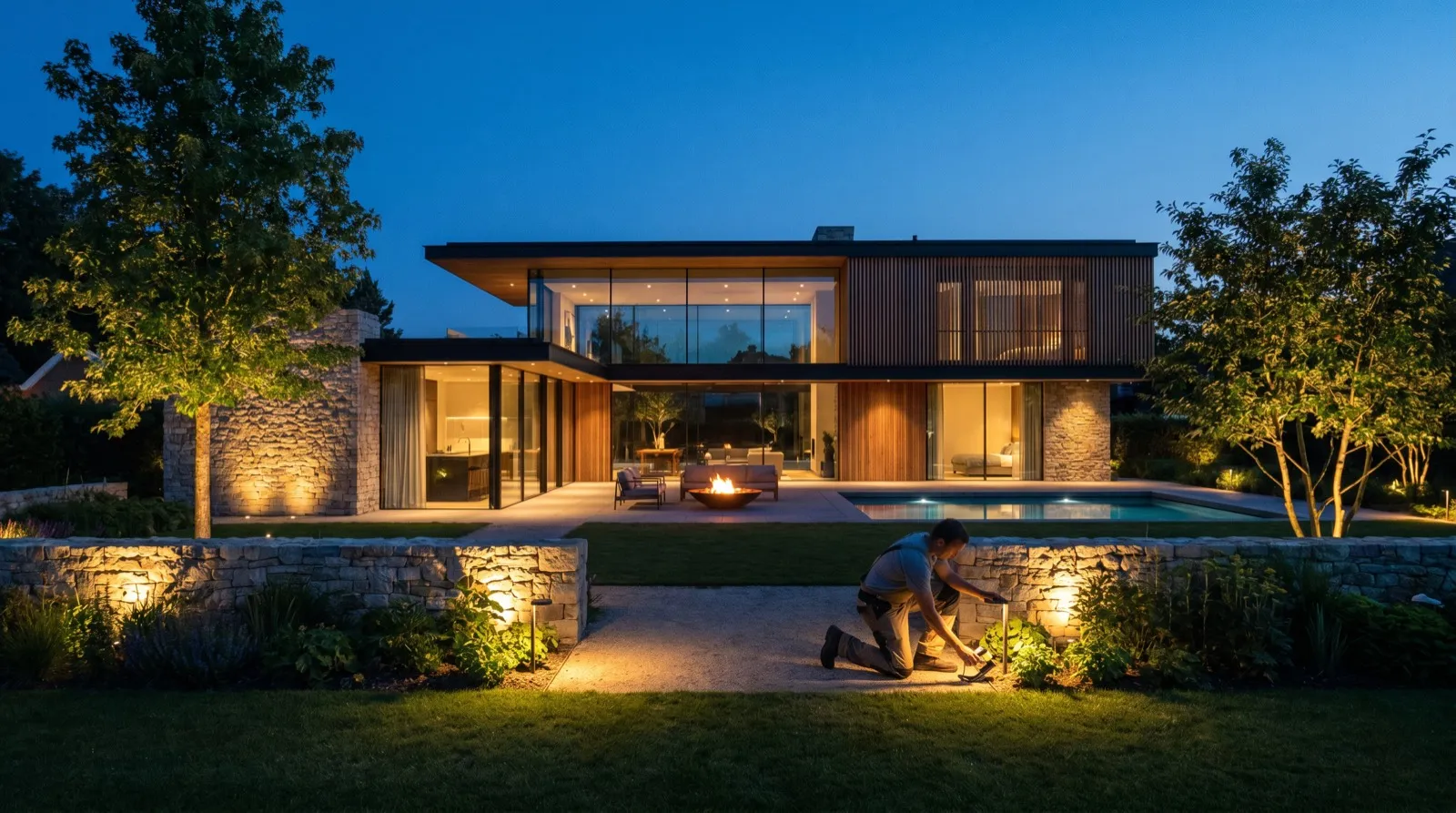
Outdoor and landscape lighting is one of the most failure-prone categories of residential and commercial electrical work, and the reason is straightforward: it is routinely installed by people who treat it as a low-risk, simple job. It is not. Outdoor electrical circuits face UV degradation, soil contact, moisture ingress, thermal cycling, insect intrusion, and in coastal areas, salt-laden air that corrodes unprotected terminals within months. Ironclad Electrical installs outdoor and landscape lighting with the same material selection discipline we apply to industrial sites. That means correctly rated buried cable in UV-resistant conduit, luminaires specified with genuine IP65 or IP67 ratings and not just marketing claims, and every 230 V outdoor circuit protected by a dedicated RCD with appropriate fault loop impedance to guarantee fast disconnection.
12 V and 24 V Extra-Low-Voltage Landscape Systems
Extra-low-voltage landscape lighting systems operating at 12 V or 24 V DC offer significant safety advantages in areas accessible to children and in wet zones such as water features, pond perimeters, and pool surrounds. The transformer that converts 230 V mains to 12 V or 24 V must be correctly rated for the total connected load plus a 20 per cent margin to prevent overheating on long run cycles. The low-voltage cable connecting luminaires must be sized for the cable run length, because voltage drop across long ELV runs directly reduces luminaire output and can cause LED drivers to operate outside their rated voltage range. Ironclad calculates the correct transformer rating, specifies cable cross-section for each branch run using the voltage drop formula in AS/NZS 3000, and terminates all connections in IP67-rated terminal enclosures rather than twist-and-tape joiners that will fail within two wet seasons. All ELV systems are powered from a Class II double-insulated safety isolating transformer located in a protected, ventilated enclosure.
- 230 V mains outdoor circuit supply with dedicated RCD and weatherproof outlets
- 12 V and 24 V ELV landscape lighting with correctly rated safety-isolating transformers
- Underground cable installation in conduit to AS/NZS 3000 burial depth requirements
- IP65, IP67, and IP68 luminaire selection for in-ground, path, and water-feature applications
- Automated control via smart relays, dusk-to-dawn sensors, and programmable timer circuits
- Pool and water feature lighting to AS/NZS 3000 zone requirements and isolation standards
230 V Outdoor Circuits: IP Ratings, RCDs, and Burial Depths
Mains-voltage outdoor lighting circuits carry specific requirements under AS/NZS 3000 that are frequently ignored by unlicensed or underskilled installers. Underground cable must be a type rated for direct burial or installed in conduit at a minimum depth of 500 mm for normal areas or 300 mm under a slab or concrete. Outdoor power outlets and luminaire fittings must have an IP rating appropriate to their exposure zone: IP44 minimum for protected outdoor areas, IP65 for exposed areas subject to rain, and IP67 or IP68 for in-ground or temporary immersion applications. Every outdoor circuit must be protected by a 30 mA RCD, and the fault loop impedance at the most remote point on the circuit must be low enough to guarantee that the protection device operates within the disconnection time required by AS/NZS 3000. Ironclad measures fault loop impedance with a calibrated instrument at every outdoor installation, records the result, and adjusts the circuit design if the impedance is too high.
Automation, Smart Control, and Long-Term Reliability
A landscape lighting system is only as good as its control system, and a control system installed in an outdoor switchboard enclosure with inadequate IP rating and no surge protection will fail within a few years of outdoor service. Ironclad installs outdoor lighting controls in correctly rated enclosures, specifies surge protection on circuits exposed to long cable runs that act as aerials for lightning-induced transients, and programs smart relay and timer systems with logical fallback behaviour so that a communication fault does not leave the property in darkness. Where the client requires integration with a smart home or building management system, we wire the relay outputs and sensor inputs to the correct communication interface and coordinate programming with the automation contractor. We specify LED luminaires from suppliers who provide genuine photometric data and five-year-minimum warranties, because the running cost savings of LED are only realised if the fittings last. In coastal environments we specify luminaires with marine-grade stainless steel or Grade 316 hardware as standard, because grade 304 stainless corrodes visibly within two years in a salt-air environment.