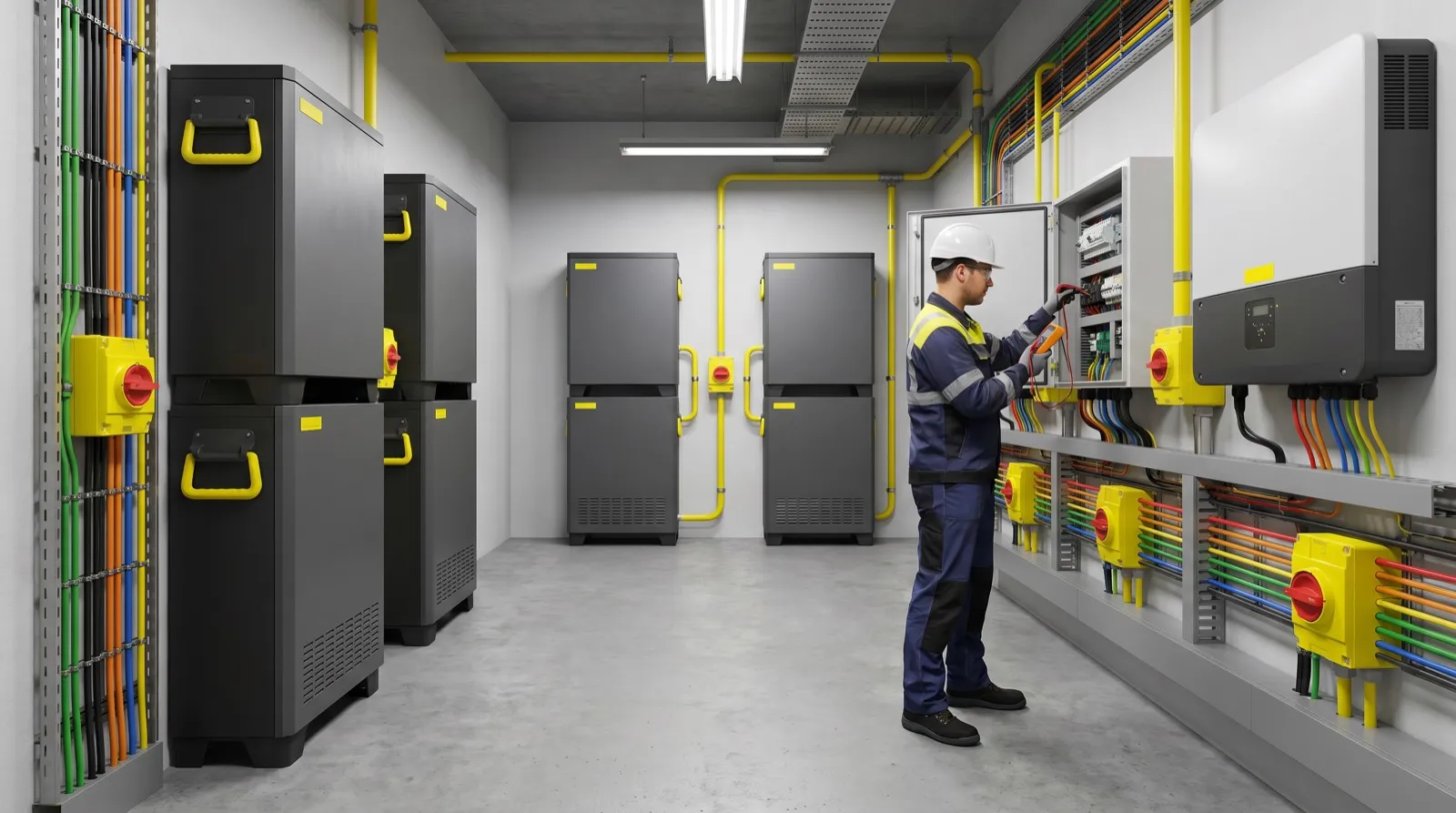
A solar PV system that leaves the installer's hands in perfect condition will not stay that way indefinitely. String inverters age, isolators develop high-resistance connections, DC cable insulation degrades in UV exposure, and battery management systems accumulate firmware faults that silently reduce capacity. The signs are subtle at first: a slight drop in daily yield, an occasional error code that clears itself, a battery that no longer reaches its rated state of charge. Left unattended, these small issues become expensive ones. Ironclad Electrical provides scheduled and reactive maintenance for solar PV and battery energy storage systems across residential, commercial, and light-industrial sites, applying the same systematic fault-finding discipline we use on three-phase industrial plant.
Solar PV Inspection and Performance Testing
A proper solar PV maintenance inspection is more than a visual check and a glance at the inverter display. Ironclad completes a documented inspection protocol that covers DC string open-circuit voltage and short-circuit current testing against the panel specification, insulation resistance testing of DC cables to detect degraded insulation before it becomes a ground fault, infrared thermal scanning of connectors and combiner boxes to identify high-resistance joints before they cause fires, and inverter performance data logging to compare actual yield against modelled output for the site. We clean panels with deionised water to remove soiling without leaving mineral deposits, inspect all roof penetrations and racking for corrosion or movement, and verify that all AC isolators and DC isolators operate correctly under load. The output is a written report with a condition rating per component, a prioritised defect list, and a recommended maintenance interval.
- DC string IV curve tracing to identify underperforming panels or shading faults
- Insulation resistance testing of DC cabling to AS/NZS 3000 and IEC 62446
- Infrared thermal scan of all MC4 connectors, combiner boxes, and isolators
- Inverter fault history retrieval, firmware update, and yield data analysis
- Battery SOC calibration, cell balancing check, and BMS fault log review
- AS/NZS 5139 compliance check for battery storage installation clearances and ventilation
Battery Storage Maintenance Under AS/NZS 5139
Lithium battery storage systems introduce a specific set of electrical and safety considerations that differ substantially from the solar array above them. AS/NZS 5139, the Australian standard for battery storage for use with solar PV systems, mandates specific clearances, ventilation requirements, fire separation distances, and signage. Many battery systems installed before 2021 do not fully comply with the current standard. Ironclad inspects all battery installations against AS/NZS 5139, checks that the Battery Management System is operating within the manufacturer's specified voltage and temperature limits, retrieves fault logs via the BMS communication port, and verifies that the isolator, fusing, and protection devices between the battery and the inverter-charger meet the short-circuit current ratings required. For hybrid inverters, we also verify that the grid interaction protection settings comply with AEMO's requirements and the local distribution network service provider's connection agreement.
Inverter Fault Diagnosis and Replacement
Inverter faults are the most common cause of total system shutdown, and the most commonly misdiagnosed. String inverter error codes are rarely self-explanatory, and an inverter that appears to be faulty is frequently responding correctly to a fault elsewhere in the system, such as a high DC voltage event from a failed panel bypass diode, an earth leakage event from degraded cable insulation, or a grid voltage event from local distribution network variation. Ironclad traces every inverter fault to its root cause before recommending inverter replacement. When replacement is the correct answer, we source inverters from approved Australian distributors, complete the installation to AS/NZS 3000, update the system compliance documentation, and submit any required network connection notifications to the DNSP. We work with string inverters, hybrid inverters, and three-phase commercial inverter systems from all major manufacturers.