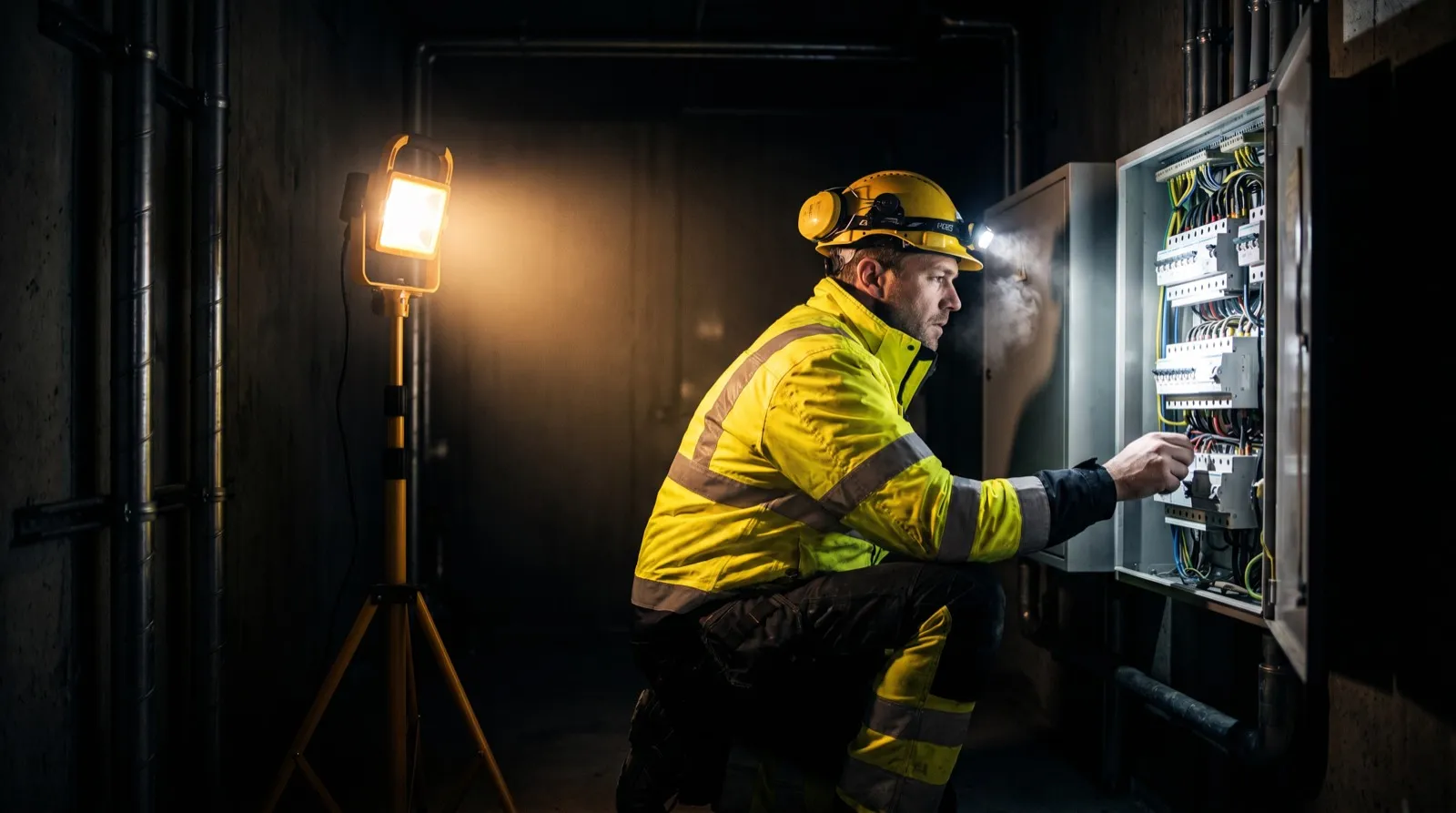
Industrial electrical failures do not keep business hours. A blown main fuse, a tripped RCD that will not reset, a switchboard fault throwing arc-flash risk, a motor control centre that has gone dark at 2 am on a Monday — these are the calls we are built for. Ironclad Electrical has run 24/7 emergency operations since 2004 and our response processes are engineered with the same rigour we apply to the infrastructure we repair.
What Counts as an Electrical Emergency?
Any unplanned outage that halts production or poses a safety risk to personnel qualifies for our emergency line. Common call types include total or partial power loss to a facility, persistent RCD or RCBO tripping under load, burnt or arcing switchboard equipment, motor starter and drive failures, underground or overhead cable faults, and loss of essential services such as emergency lighting or fire-system power supplies. We also attend situations where a fault has been isolated but cannot be made safe without licensed intervention — for example, live exposed conductors or damaged submain cabling.
- Fault isolation and safe make-off of damaged circuits to AS/NZS 3000 Wiring Rules
- Switchboard emergency repairs including fuse replacement and circuit-breaker swap-out
- Arc-flash risk assessment and controlled safe-approach procedures on all live-work callouts
- Temporary supply restoration to maintain critical production lines while permanent repairs are scheduled
- Thermal imaging to locate high-resistance connections and imminent failure points
- Written fault report and compliance certification issued before our truck leaves site
Our Emergency Dispatch Process
When you call 1300 476 625, you reach a qualified tradesperson, not a call centre. We ask four questions: what is the symptom, what is the last known safe state, is anyone in immediate danger, and where exactly are you. That information goes to our nearest available A-Grade licensed industrial electrician simultaneously with the call. Our metro response target is under 90 minutes from first call to boots on your floor. Regional sites are dispatched with realistic ETAs given immediately — we do not guess and we do not promise what we cannot deliver.
Why Industrial Faults Demand Industrial Electricians
Three-phase industrial installations carry risks that residential and light-commercial electricians are not routinely trained or equipped to manage. Arc-flash incident energy at a 415 V industrial switchboard can reach levels that cause fatal burns at distances beyond arm's length. Fault-loop impedance on long submain runs can be high enough that a standard MCB does not clear a fault within the required disconnection time under AS/NZS 3000. Ironclad electricians carry calibrated loop impedance testers, thermal cameras and arc-flash PPE on every emergency truck. We diagnose accurately, we work safely, and we do not bounce hard problems back to you as a quote for further investigation.
Documentation and Follow-Up
Every emergency callout produces a written fault report documenting the nature of the failure, the AS/NZS 3000 clause or relevant standard that was applied, the corrective action taken, and any outstanding risks identified that require scheduled rectification. Where a Certificate of Compliance for Electrical Work (CCEW) is required under Queensland or applicable state legislation, it is issued before commissioning. This paperwork is not bureaucracy — it is the evidence trail your insurer, your WHS team and your next scheduled audit will ask for.