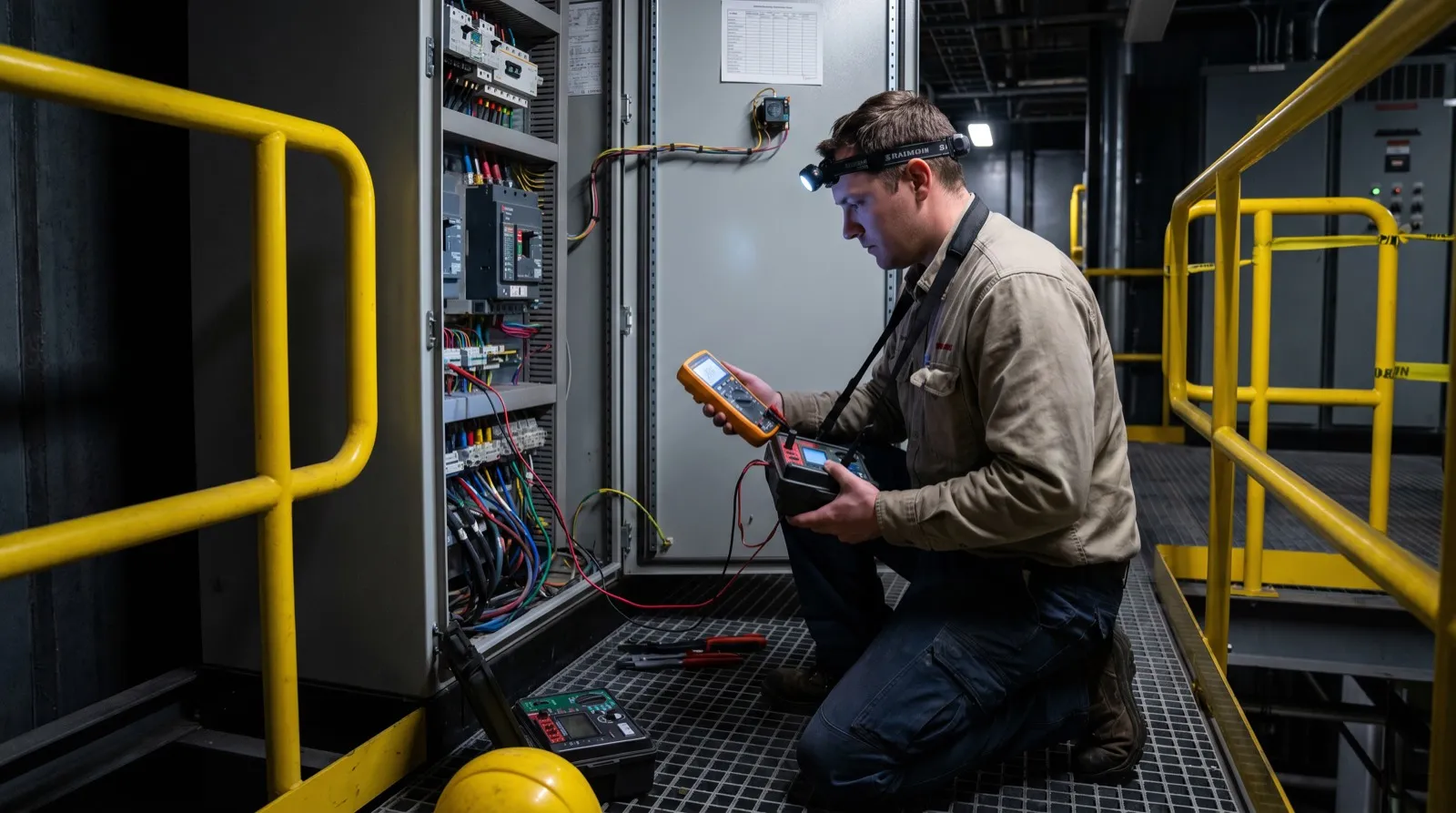
Electrical fault finding is a discipline, not a lucky guess. At Ironclad Electrical we approach every diagnostic job with a structured methodology: gather the fault history, review the as-installed documentation, isolate the affected circuit or system, apply the correct test instrument for the symptom type, and interpret the results against the relevant Australian standard. This approach is how we achieve a 98% first-visit fault resolution rate across our industrial client base.
Diagnostic Instruments We Deploy
The quality of a fault-finding outcome is directly proportional to the quality of the test equipment and the operator's ability to interpret it. Ironclad technicians carry calibrated multifunction installation testers capable of insulation resistance testing to 1000 V DC, fault-loop impedance measurement, RCD trip-time and ramp testing to AS/NZS 3760, earth continuity verification and prospective short-circuit current calculation. For buried cable and underground fault location we deploy time-domain reflectometry (TDR) equipment and a high-voltage cable fault locator. Thermal imaging cameras are standard issue on all fault-finding trucks — a FLIR camera finds a high-resistance connection in 30 seconds that a multimeter could take an hour to locate.
- Insulation resistance testing to AS/NZS 3000 and AS/NZS 3008 on submains and distribution cabling
- Fault-loop impedance and prospective fault current measurement to verify protection coordination
- RCD trip-time and ramp testing in accordance with AS/NZS 3760
- Thermal imaging surveys to detect high-resistance joints, overloaded conductors and failing terminations
- Time-domain reflectometry (TDR) for underground and buried cable fault location
- Power quality analysis including harmonic spectrum, voltage sags and power factor measurement
Common Industrial Fault Types We Resolve
The most time-consuming faults to diagnose are intermittent ones — circuits that trip under certain load conditions, RCDs that operate only during wet weather, motors that develop earth faults after a thermal cycle. These faults will not present themselves on a simple visual inspection and they will not show up on a resistance measurement taken at ambient temperature. Ironclad technicians are experienced in load-cycling circuits to replicate fault conditions, performing insulation resistance tests at elevated test voltages to stress-test cable insulation, and using power quality analysers to capture transient events that trigger nuisance protection operations. We also handle motor insulation degradation, variable speed drive earth-fault faults, transformer winding failures and lighting circuit ground faults in wet and chemical environments.
Documentation and Fault Reports
Following every diagnostic engagement, Ironclad issues a structured fault report that documents the symptom history, the test methodology applied, the test results with instrument readings, the fault root cause identified, the corrective action taken and any residual risks or recommended follow-up work. Results are cross-referenced against AS/NZS 3000 Wiring Rules acceptance criteria and relevant equipment manufacturer specifications. This report forms part of the maintenance register for your facility and provides the evidence base your compliance team needs for audit purposes.
When to Call Ironclad for Diagnostics
Call us when a circuit has tripped more than once without a clear cause. Call us when your in-house maintenance team has changed the MCB or RCD and the problem has returned. Call us when you are getting unexplained increases in energy consumption on a circuit or meter. Call us when switchboard temperatures are elevated on thermal inspection but the cause is not visible. And call us before you replace expensive equipment — a motor control centre, a variable speed drive, a transformer — based on a fault that has not been conclusively traced to that equipment. Misdiagnosis on industrial electrical plant is an expensive mistake that Ironclad diagnostics are designed to prevent.