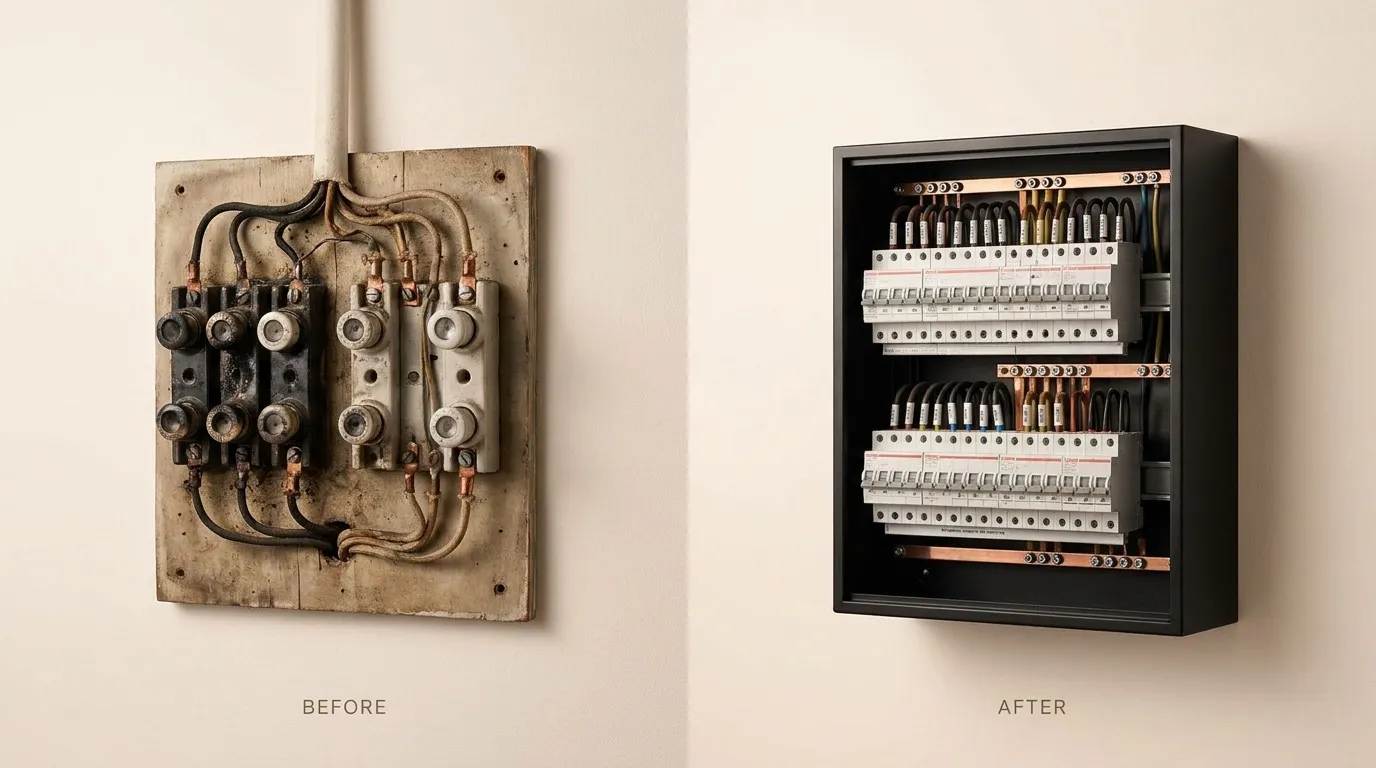
Energy efficiency investment in commercial and residential buildings in Australia has never been more compelling. With electricity retail tariffs in the range of 25 to 40 cents per kilowatt-hour across most Australian markets, the payback period for well-chosen electrical efficiency upgrades has shortened considerably. The question for most building owners and managers is not whether to invest, but where to invest first and in what sequence to maximise returns.
This article ranks the most impactful electrical upgrades by typical payback characteristics, explains the mechanisms by which each delivers savings, and describes what is involved in implementation. It is written for commercial building managers and owner-occupiers, but the principles apply equally to larger residential properties. We have deliberately avoided publishing specific prices because they vary significantly by location, system scale, and market conditions — your licensed electrical contractor should provide a detailed proposal and return-on-investment analysis for any specific project.
First Priority: LED Lighting Retrofits
If your building still has any fluorescent, metal halide, or halogen light sources in regular use, LED retrofitting is almost certainly your highest-return electrical investment. The energy consumption reduction from T8 fluorescent to equivalent-output LED is typically 50 to 60 percent. From metal halide high-bay fittings to LED high-bay, savings of 50 to 70 percent are common. From halogen downlights to LED, 75 to 85 percent energy reduction is achievable.
Beyond the direct energy saving, LED sources generate dramatically less heat, which reduces the cooling load in air-conditioned spaces — an often-overlooked secondary benefit. LED lamp life of 50,000 hours or more versus 8,000 to 15,000 hours for fluorescent substantially reduces maintenance and re-lamping costs, which in high-bay commercial environments can be material. A well-specified LED retrofit project should carry a payback period of two to five years in most commercial applications at current tariff levels.
Second Priority: Lighting Controls and Occupancy Sensing
Even LEDs waste energy lighting unoccupied spaces. Lighting controls — occupancy sensors, daylight harvesting sensors, and time-of-day scheduling — typically add 20 to 40 percent additional savings on top of the efficiency gains from LED sources alone. In commercial office environments where spaces are partially occupied for significant portions of the working day, occupancy sensing can be the single most impactful control measure.
DALI (Digital Addressable Lighting Interface) control systems allow individual or group dimming, occupancy response, and daylight compensation from a central platform. The investment in DALI infrastructure is higher than simple switching, but the granularity of control and the metering data it provides are substantial advantages. For new commercial fit-outs or major refurbishments, DALI specification is now effectively the industry standard in Australia for any project above a modest scale.
Third Priority: Sub-Metering and Power Factor Correction
Sub-metering — the installation of energy meters on individual circuits, tenancies, or pieces of equipment — does not itself save energy, but it is the prerequisite for informed energy management. You cannot manage what you cannot measure. A sub-metering system with real-time monitoring typically reveals consumption patterns and waste that were invisible before the system was installed, and the behavioural and operational changes that follow routinely deliver five to fifteen percent reductions in overall consumption without any capital investment in efficiency measures.
Power factor correction is directly relevant to commercial premises billed on demand tariffs that include a reactive component (kVAr). Inductive loads — motors, air conditioning compressors, fluorescent ballasts — draw reactive current that does not appear on a kilowatt-hour meter but does appear on a demand-based invoice as a power factor penalty. Automatic power factor correction capacitor banks bring power factor toward unity, eliminating or substantially reducing this penalty. The payback depends entirely on the tariff structure and the existing power factor: premises with a power factor below 0.85 and demand-based billing typically see paybacks of two to four years.
- LED retrofit of all non-LED sources: typically the fastest payback, two to five years in commercial
- Occupancy and daylight sensing: 20 to 40 percent additional saving on top of LED efficiency
- DALI controls for granular dimming, scheduling, and metering in commercial fit-outs
- Sub-metering to identify waste and enable informed energy management decisions
- Power factor correction where demand tariffs include a reactive power component
- HVAC controls and variable speed drives on pump and fan motors: significant savings in larger buildings
- Solar PV with or without battery storage: payback now well established for most commercial applications
Solar, Battery, and Voltage Optimisation
Solar photovoltaic systems have become a mainstream commercial investment in Australia, with payback periods of three to seven years common for commercial rooftop systems self-consuming a significant proportion of generation. The economics are site-specific: a building with high daytime consumption, a large available roof area, and a favourable network connection capacity will see better returns than one with low daytime load or constrained network capacity. Battery storage improves the economics for sites with time-of-use tariffs that have high peak rates, by enabling solar generation to be stored for use during evening peak periods or for demand charge management.
Voltage optimisation is a less widely understood efficiency measure that is relevant in areas where network voltage runs consistently above the nominal 230V. Many loads — particularly resistive loads and older motor loads — consume more power at higher voltage. A voltage optimisation unit installed at the main switchboard reduces voltage to the design level, reducing consumption on voltage-sensitive loads by a typical three to eight percent. It is not a universal solution and requires a proper voltage survey and load analysis before specification — a competent electrical contractor will assess whether your premises are a good candidate before recommending it. As with all efficiency measures, the investment decision should be grounded in measurement and analysis rather than generic claims about typical savings.