Most Australian homes are lit the same way: a single ceiling fitting in the centre of each room, possibly with a downlight grid added during a renovation. The result is flat, shadowless, slightly institutional light that does nothing to make a room feel welcoming, does not support the tasks people actually perform there, and often looks worse than the rooms it inhabits. Good lighting design is one of the highest-impact changes you can make to a residential interior, and — unlike structural work — much of it can be retrofitted with relatively modest electrical work.
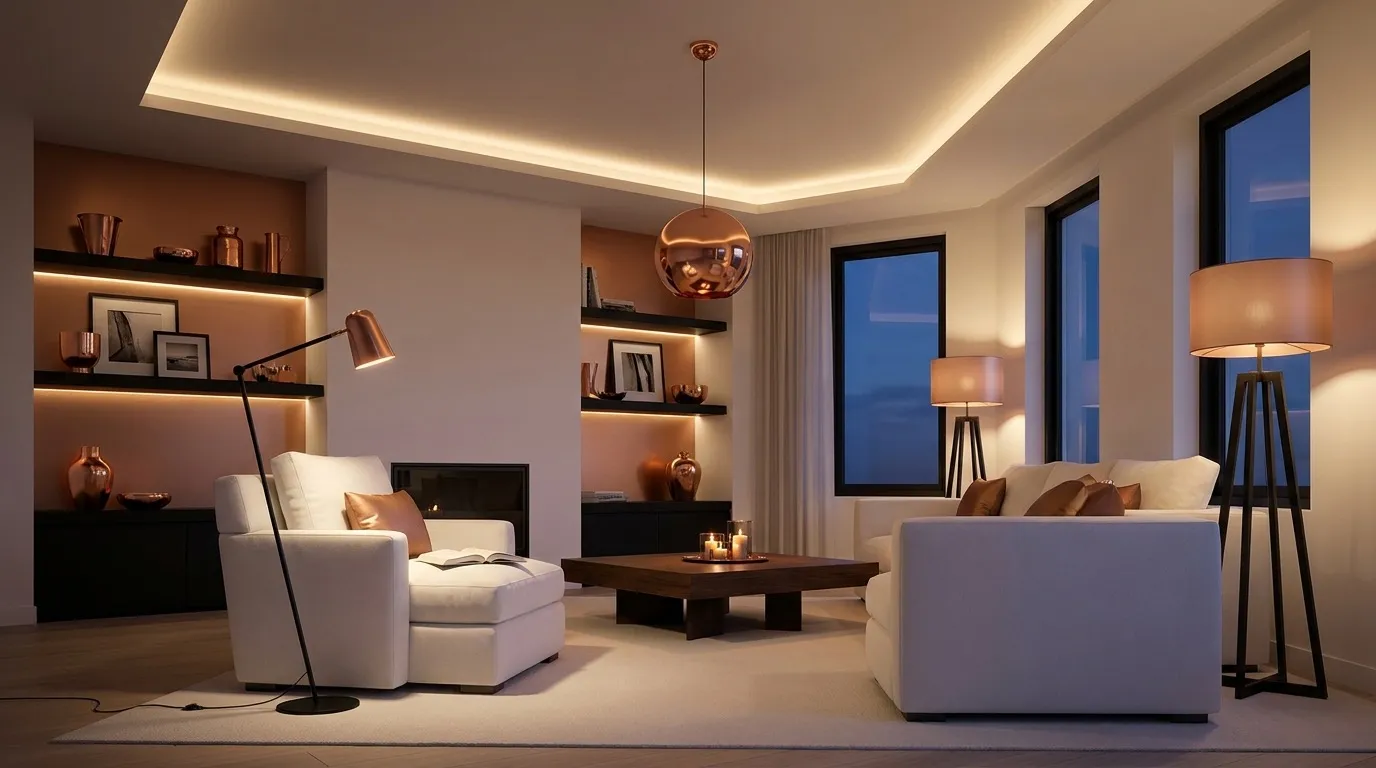
The foundation of professional lighting design is the concept of layers. Rather than one light source trying to do everything, effective residential lighting uses four distinct layers — each serving a specific function — that can be combined and dimmed to create different experiences in the same space. Understanding these layers is the starting point for every project we undertake.
The Four Layers and What They Actually Do
Ambient lighting is the base layer: general illumination that allows you to move safely through a space and perform low-intensity tasks. It does not need to be bright, and in most living spaces it should not be. Recessed downlights, cove lighting bounced off a ceiling, or a central pendant fitting on a dimmer can all serve this role.
Task lighting is targeted at specific activities. Under-cabinet lighting in a kitchen illuminates the bench where food preparation happens — the overhead ambient layer casts shadows when you stand at the bench, and under-cabinet lighting eliminates them. A reading lamp beside an armchair, a mirror light in a bathroom, a pendant over a kitchen island: these are all task lights. They should be independent of the ambient circuit so they can be used without flooding the room with light.
Accent lighting draws attention to specific elements — artwork, architectural features, a textured wall, a display shelf. It creates contrast and visual interest. Spotlights on adjustable track, directional recessed fixtures, and LED strip behind joinery or in reveals all serve this layer. Accent lighting requires a brightness ratio of roughly three to one above the ambient level to be effective.
Feature lighting is the decorative layer — a pendant, a chandelier, a wall sconce — whose primary purpose is to be seen rather than to illuminate. Feature lights contribute to the ambient layer, but their value is largely aesthetic. They anchor the visual hierarchy of a room and communicate the design intention of the space.
Colour Temperature, CRI, and Why They Matter
The colour of light is measured in Kelvin. Warm white at 2700–3000K has a golden quality suited to living spaces, bedrooms, and hospitality environments. Neutral white at 3500–4000K is appropriate for kitchens, bathrooms, and workspaces where you want clarity without harshness. Cool white at 5000K and above suits garages, workshops, and commercial environments but is genuinely uncomfortable in a domestic living setting. One of the most common renovation mistakes we see is warm-white ambient downlights combined with cool-white under-cabinet strips — the colour mismatch is jarring and difficult to live with.
CRI — the Colour Rendering Index — describes how accurately a light source renders the colours of objects compared to natural daylight. It runs from zero to 100. Anything below 80 CRI is unsuitable for residential use: colours appear muted and skin tones look grey. Specify a minimum of 80 CRI for ambient and task lighting, and 90 CRI or above in bathrooms, kitchens, and anywhere that accurate colour matters. Most quality LED fittings sold today meet 80 CRI; 90 CRI-plus fixtures cost a little more but make a visible difference.
- Never rely on a single central fitting to light a room — layer ambient, task, accent, and feature
- Keep colour temperature consistent within a space or zone; mixing warm and cool is jarring
- Specify 80 CRI minimum for all fittings; 90 CRI-plus for kitchens and bathrooms
- Design every circuit for dimming — even if you do not fit dimmers immediately
- Under-cabinet lighting is the single most impactful kitchen lighting upgrade
- Bathroom mirrors require diffuse, shadow-free light at face level, not overhead only
- Accent lighting needs its own circuit and must be significantly brighter than ambient to read as accent
Dimming, Scenes, and Getting the Electrical Right
Dimming transforms a room. The ability to shift from bright task light to a low ambient level for evening use is one of the things that makes a house feel genuinely comfortable. However, dimming LED lighting is not as simple as fitting a dimmer and assuming it will work. LED drivers must be compatible with the dimmer type — leading edge, trailing edge, or DALI — and the lamp must be confirmed compatible with the specific dimmer brand and model. Incompatible combinations result in flicker, hum, limited dimming range, or premature failure. This is an area where specifying fixtures and dimmers together, and confirming compatibility before installation, saves significant frustration.
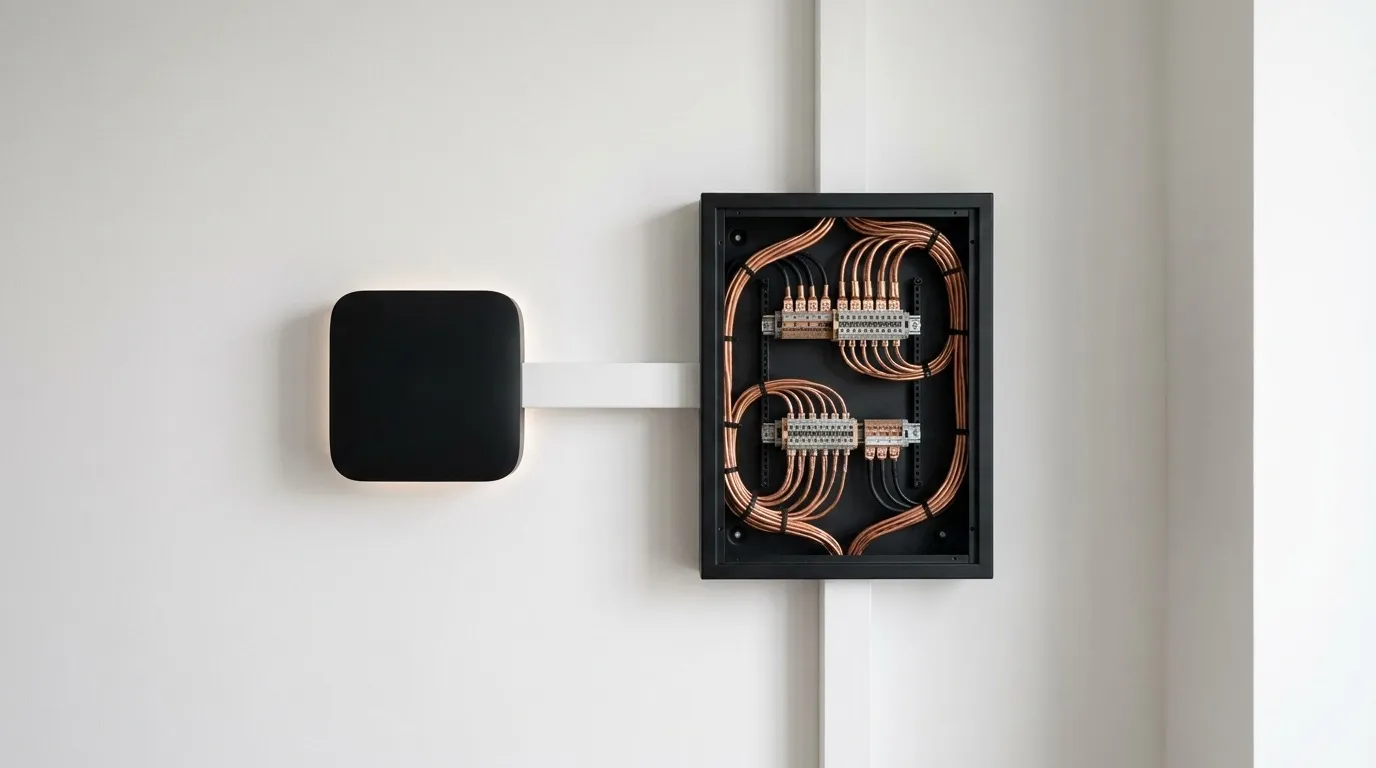
Lighting scenes — predetermined combinations of levels across multiple circuits — require either a dedicated lighting control system or a smart home platform. At their simplest, a scene might be 'dinner': dining pendant at 60 percent, kitchen ambient off, living ambient at 20 percent. At their most sophisticated, scenes can respond to time of day, natural light levels, and occupancy. Planning for scenes during the construction or renovation phase — running separate circuits and installing multi-gang dimmers or a control system — is far more cost-effective than retrofitting later. Conduit in walls during a renovation costs very little; cutting open finished walls to add circuits costs a great deal.