The conversation about smart home technology in Australia has shifted considerably over the past few years. The arrival of the Matter protocol in 2022 and its steady maturation through 2025 and 2026 has changed what is possible with wireless systems, while the case for structured wired infrastructure remains as strong as ever for serious installations. The choice between wired and wireless is not simply a question of budget — it is a question of what you are trying to achieve, how long you want it to last, and how much disruption you are prepared to accept during installation.
We work across both systems and are genuinely agnostic between them. The right answer depends on the specific project. What we try to provide here is an honest account of the trade-offs, without the evangelical enthusiasm for one camp or the other that characterises a lot of the coverage in this space.
Wired Systems: KNX and C-Bus
KNX and C-Bus (Clipsal's proprietary protocol, widely used in Australian commercial and high-end residential installations) represent the gold standard for wired building automation. Both systems run on dedicated low-voltage cable — KNX on a twisted pair, C-Bus on Cat 5 — that carries both power and data to every device on the network. Switches, dimmers, sensors, and actuators all communicate over this cable, and the intelligence of the system sits distributed across the devices rather than centralised in a single hub that can fail.
The practical consequence of this architecture is exceptional reliability. A KNX or C-Bus installation has no single point of failure, requires no internet connectivity to function, and operates identically whether your router is online or not. The local intelligence means that switching a light on takes approximately 100 milliseconds — fast enough to feel instantaneous to a human. By contrast, a wireless smart light that routes commands through a cloud server and back can take 500 milliseconds to two seconds, and fails entirely if the cloud service is disrupted or the product reaches end-of-life and the server is shut down.
The cost of a wired system is front-loaded and significant. Dedicated cable must be run to every device location — this is straightforward during construction and costly or impractical in a finished building. Programming KNX or C-Bus requires accredited practitioners. But the system will function correctly for 30 years or more without the underlying technology platform being superseded, because the protocol is owned by an industry consortium (KNX) or a major manufacturer (Schneider, for C-Bus) with long-term commitments to backward compatibility.
Wireless Systems: Zigbee, Z-Wave, and Matter in 2026
Zigbee and Z-Wave are mesh wireless protocols that have powered most of the serious smart home ecosystem for the past decade. They operate on sub-GHz and 2.4 GHz bands respectively, do not compete with Wi-Fi traffic, and form self-healing mesh networks where each mains-powered device acts as a repeater. They are genuinely reliable within their design parameters and have powered millions of installations worldwide.
Matter — ratified by the Connectivity Standards Alliance and now in its second major revision — represents the industry's attempt to solve the interoperability problem that has frustrated smart home adoption. Matter devices can be controlled by Apple HomeKit, Google Home, Amazon Alexa, and Samsung SmartThings simultaneously, with no cloud lock-in for local control. In 2026, the Matter device ecosystem is mature for lighting, switches, blinds, and climate control. Thread — the networking protocol that underpins most Matter devices — creates a mesh network similar in principle to Zigbee, with a border router (often built into a smart speaker or hub) connecting the Thread mesh to IP.
The honest assessment of wireless systems in 2026 is that they work well under favourable conditions and introduce complexity under unfavourable ones. RF interference, building materials that attenuate signals, mesh networks that need careful design, and the ongoing reality that some devices require cloud connectivity for full functionality are all real considerations. The risk of platform discontinuation — a manufacturer exiting the market or ending software support — is also genuine, even within the Matter ecosystem.
- Wired KNX or C-Bus offers maximum reliability and longevity for new construction and major renovations
- Matter in 2026 is the most interoperable wireless standard and is worth specifying for new wireless installations
- Thread mesh networks require at least one border router per zone to maintain low latency
- Wireless systems require ongoing router, hub, and firmware maintenance to remain functional
- No wireless system yet matches a wired system for response speed and independence from internet connectivity
- Structured cabling — even if wireless switches are used — provides a backbone for upgrades
- Platform discontinuation is a genuine risk; prefer devices with local control fallback
The Role of Structured Cabling
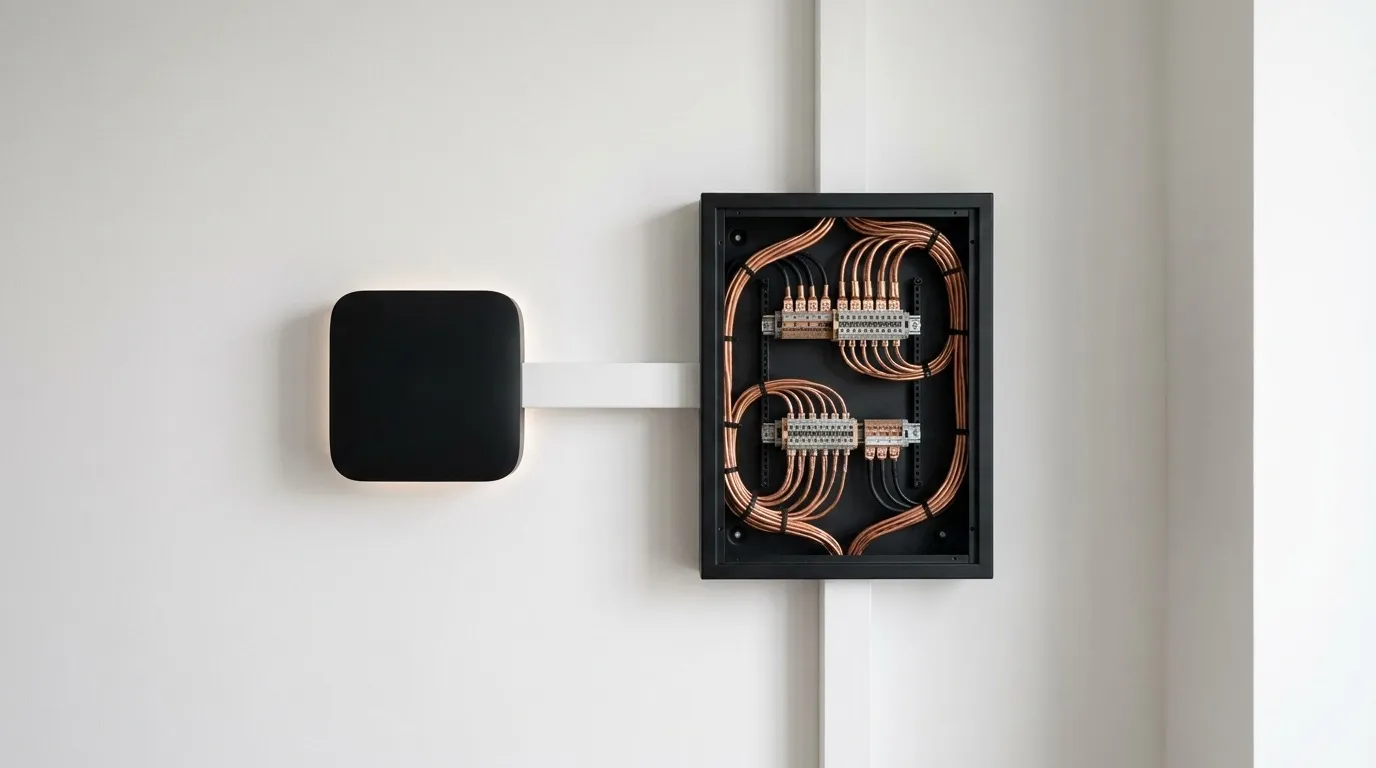
Even in a primarily wireless smart home, structured cabling provides critical backbone infrastructure. A central comms cabinet with a quality router, managed network switch, and patch panel supports the wireless devices in the home — every Zigbee hub, every Thread border router, every NAS, every IP camera — on a wired Ethernet backbone that does not compete with the wireless control mesh. Cat 6A cabling run to every room during construction costs relatively little in the context of a new build and eliminates the performance degradation of running everything over Wi-Fi.
For renovation projects where running new cable to every switch position is not practical, a hybrid approach is often the right answer: wireless switches and sensors at the device endpoints, with any central processing or hub equipment on wired Ethernet, and conduit left in key walls and cable paths to allow future upgrades. This is the pragmatic middle ground between the ideal of a full wired system and the convenience of going entirely wireless. As a master electrical contractor, planning that conduit and cabling infrastructure correctly from the start is part of what we bring to a project.