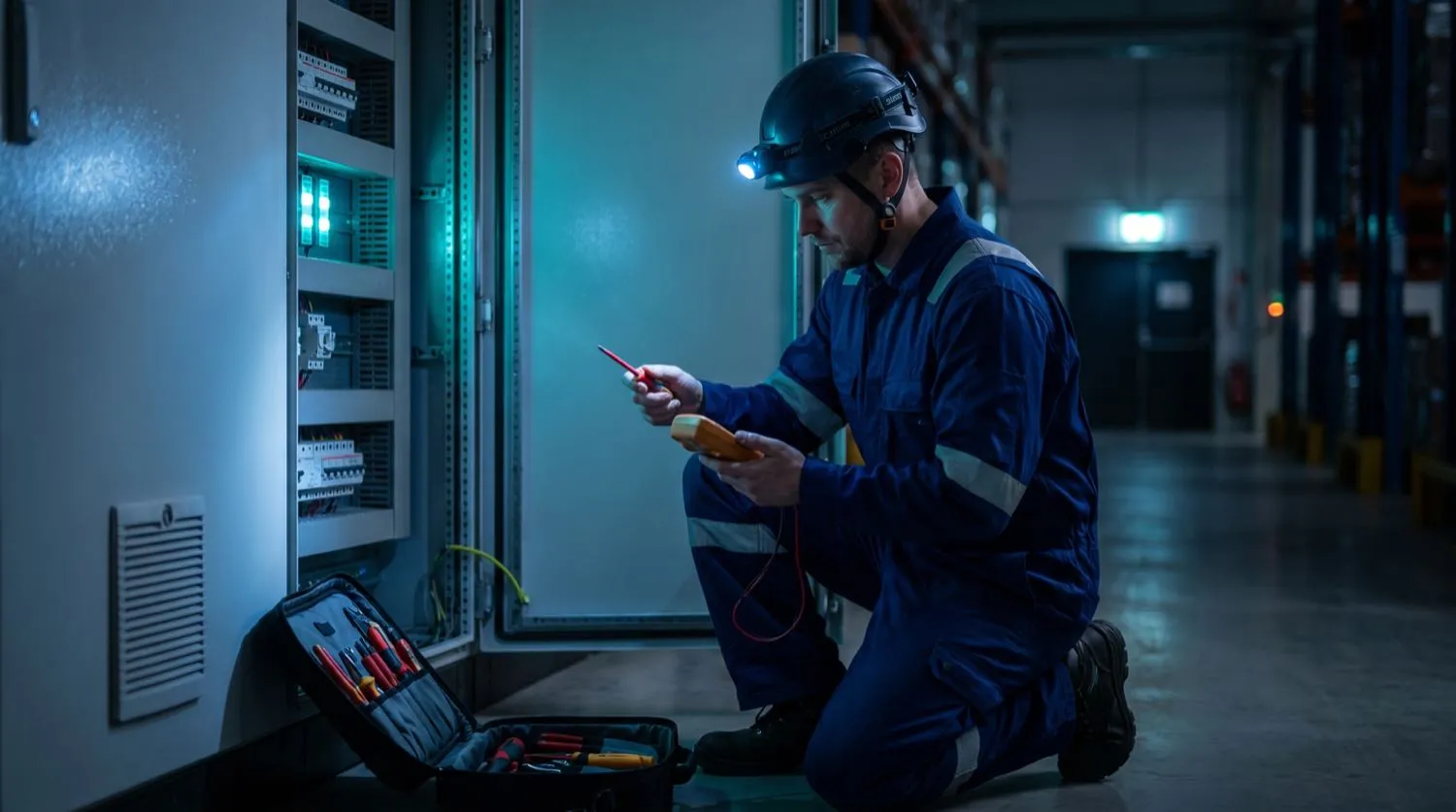
Electrical emergencies do not keep business hours. A sudden loss of power, the acrid smell of burning insulation, a tripped main switch that refuses to reset — each scenario carries real risk of injury, equipment damage, or fire. Nexus Grid Electrical maintains a 24-hour emergency dispatch network so that a licensed A-grade electrician can reach your site, assess the fault, and make the installation safe before the hazard escalates.
What Qualifies as an Electrical Emergency?
Under AS/NZS 3000:2018 (the Wiring Rules), any condition that creates an immediate risk of electric shock, fire, or explosion demands immediate intervention. Common emergency call-outs include complete loss of supply, partial outage affecting critical circuits, visible arcing or sparking at switchboards, burning odours from cabling or outlets, water ingress into electrical enclosures, and storm or vehicle damage to overhead or underground services. Our team carries the test equipment and spare materials to address most faults in a single visit.
Our Emergency Make-Safe Process
On arrival, the attending electrician conducts a rapid site safety assessment before touching any live equipment. The sequence follows a standardised isolation-and-test protocol: identify and isolate the affected circuit using a calibrated test instrument, verify dead using a voltage indicator compliant with AS/NZS 61243-3, apply lockout-tagout controls, then diagnose the root cause. Where a circuit cannot be safely restored during the emergency visit, a formal make-safe report is prepared and handed to the site owner, detailing the fault, the remediation undertaken, and any follow-up works required to reinstate the installation to AS/NZS 3000:2018 compliance.
- Complete power-loss diagnostics — mains fuse, service fuse, distribution board, and metering checked in sequence
- Switchboard make-safe: isolation of faulty breakers, replacement of failed components, torque-checking of bus-bar connections
- RCD (safety switch) testing: confirming 30 mA trip threshold and disconnection time within 300 ms per AS/NZS 3000:2018 clause 2.6
- Storm and flood damage assessment with written hazard report for insurers
- Temporary supply restoration using generator interconnection or temporary boards where permanent repair requires extended works
- Coordination with the local Distribution Network Service Provider (DNSP) for metering or service fuse issues that fall within network jurisdiction
Switchboard and Mains Failure
Switchboard failures are among the most hazardous emergency fault types. Overloaded main switches, failed neutral links, and loose busbar connections can generate sustained arcing that reaches temperatures exceeding 4000 °C — sufficient to ignite the switchboard enclosure and surrounding structure. Our technicians carry infra-red thermometers and clamp meters to identify hot-spots before opening any enclosure. Earth fault loop impedance is measured on restored circuits to confirm that protective devices will operate within required disconnection times: for final subcircuits up to 32 A, the loop impedance must be low enough to guarantee disconnection in ≤ 0.4 seconds per AS/NZS 3000:2018 Table 8.1.
Why Compliance Matters Even in an Emergency
Some operators believe that an emergency justifies shortcutting compliance. It does not. Every repair carried out by Nexus Grid Electrical — including emergency make-safe works — is inspected and tested before being re-energised. Insulation resistance is measured and must read ≥ 1 MΩ between active conductors and earth. Polarity is verified on each outlet restored to service. A compliant Certificate of Electrical Safety (COES) or equivalent state documentation is issued for all notifiable works. This protects the building owner from liability, satisfies insurer requirements, and ensures the installation meets the legal standard of care required under each state's electrical safety legislation.
- Certificate of Electrical Safety issued for all notifiable emergency repairs
- Insulation resistance testing: ≥ 1 MΩ threshold verified before re-energisation
- Earth continuity confirmed on all metallic enclosures and exposed conductive parts
- Polarity checks on every socket outlet reinstated during the emergency
- Written fault report provided to site owner and insurer on request