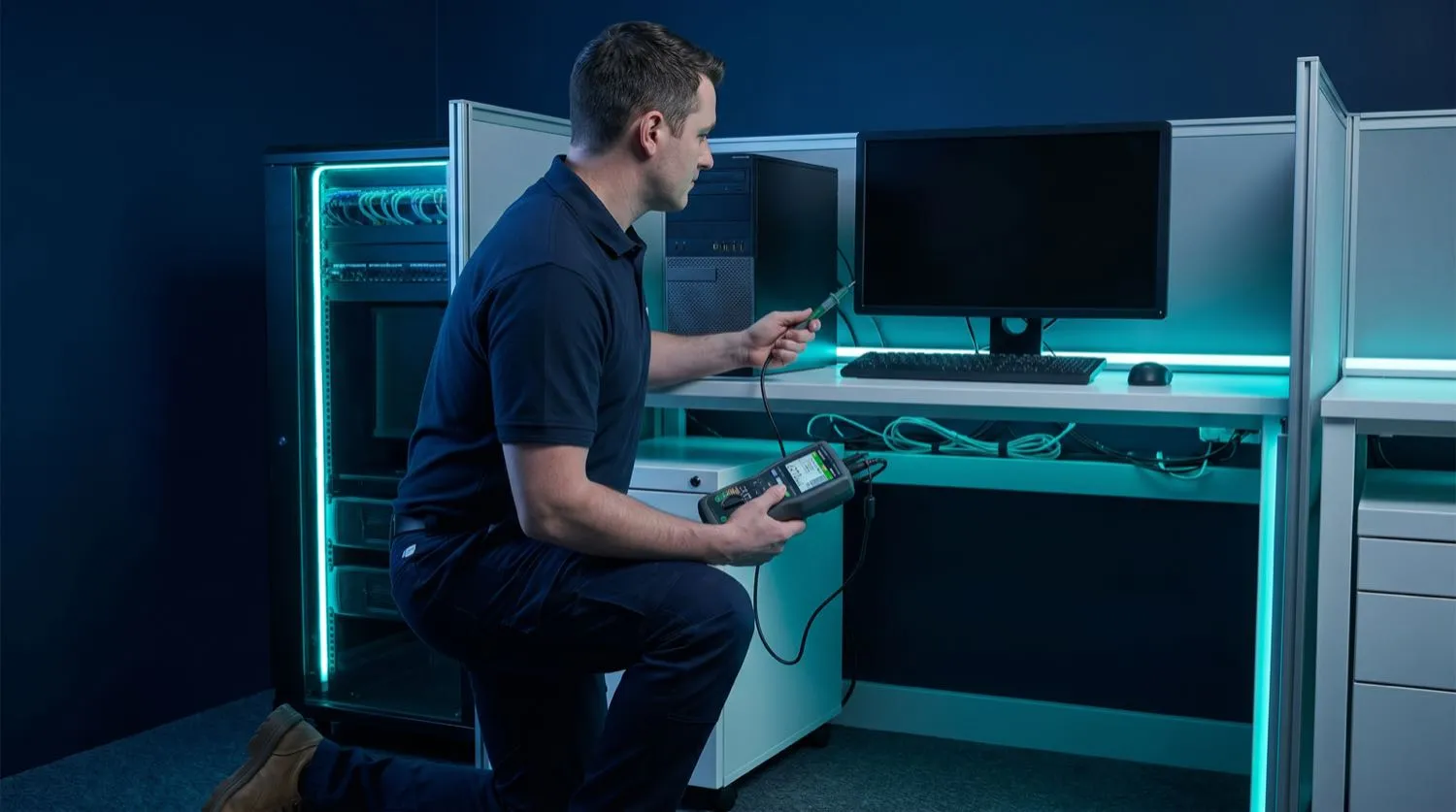
In-service inspection and testing of electrical equipment — universally referred to as test and tag — is governed in Australia by AS/NZS 3760:2022. The standard establishes the visual inspection criteria, electrical test parameters, pass/fail thresholds, retest intervals, and record-keeping requirements that must be met to demonstrate that portable and cord-connected equipment is safe for continued use. Nexus Grid Electrical operates a fully calibrated test and tag service across commercial, industrial, construction, and hospitality environments, providing the documentation trail that satisfies WorkSafe investigators, insurers, and due-diligence auditors alike.
What AS/NZS 3760 Actually Requires
AS/NZS 3760:2022 mandates a two-stage process for each item of equipment: a visual inspection followed by a series of electrical tests using a Portable Appliance Tester (PAT) — an instrument that must itself be calibrated to a known standard traceable to National Measurement Institute (NMI) references. The visual inspection checks cable condition, plug and socket integrity, enclosure damage, and correct strain relief. Electrical tests include earth continuity (pass threshold: ≤ 1 Ω for Class I equipment with protective earth conductor), insulation resistance (pass threshold: ≥ 1 MΩ at 500 V dc for equipment rated up to 230 V), and leakage current measurement where the appliance cannot withstand the standard IR test voltage.
- Earth continuity: ≤ 1 Ω measured at 200 mA test current between the plug earth pin and all accessible conductive parts
- Insulation resistance: ≥ 1 MΩ at 500 V dc between active/neutral conductors combined and the earth conductor
- Touch leakage current (alternative to IR test for sensitive electronics): ≤ 0.5 mA for Class I portable equipment
- Polarity confirmation on all three-pin plugs checked during visual inspection
- Cord and plug integrity: no cuts, abrasion damage, kinking, or insulation cracking
- Correct strain relief at both the appliance entry point and the plug
RCD Testing as Part of the Test and Tag Cycle
AS/NZS 3760:2022 includes specific requirements for in-service testing of residual current devices (RCDs) — both fixed RCDs built into switchboards and portable RCDs used on construction sites and in temporary supply situations. RCDs must be tested at their rated tripping current of 30 mA and must disconnect within the time limits specified in the relevant installation standard. For final subcircuits (those serving socket outlets up to 20 A), the disconnection time must be ≤ 0.4 seconds. Portable RCDs used on construction sites have the most demanding retest interval under AS/NZS 3760: every three months for construction environments, compared with 12 months for many office settings. Nexus Grid Electrical tests all RCDs using a dedicated RCD tester with a calibrated trip-time display, recording the measured disconnection time against the pass threshold in the compliance register.
Test Intervals by Environment
One of the most commonly misunderstood aspects of AS/NZS 3760 is that the retest interval is not fixed — it varies according to the environment in which the equipment is used and the class of equipment. The risk-based approach acknowledges that a power tool on a construction site experiences far greater mechanical abuse and environmental exposure than a desk lamp in a climate-controlled office. Nexus Grid Electrical assesses the correct interval for each item during the initial test and records it on the tag and in the register, ensuring your compliance program does not under-test high-risk equipment or over-test low-risk items unnecessarily.
- Construction and demolition sites: 3-month retest interval for all portable equipment and portable RCDs
- Industrial workshops and manufacturing (high abuse): 6-month interval for portable tools and extension leads
- Commercial offices, retail, and light commercial: 12-month interval for most cord-connected equipment
- Hire equipment: before each hire, per AS/NZS 3760 clause 5.5
- Equipment with visible damage or repaired items: immediately after repair, before return to service
- Colour-coded tag system: each calendar year assigned a distinct tag colour for rapid visual compliance verification
Compliance Registers and Record Management
A compliant test and tag program is not merely about attaching a label to a power cord. AS/NZS 3760:2022 requires that a register be maintained for every tested item, recording: the item description and asset number, the date of inspection and test, the name and qualification of the person who performed the test, the result (pass or fail), the measured test values (not just a pass/fail tick), the serial number of the test instrument used, and the due date for the next inspection. Nexus Grid Electrical produces digital registers in PDF and spreadsheet formats, linked to individual item photographs, and emails the complete register to the site manager within 24 hours of the testing visit. Failed items are quarantined on-site, tagged with a red danger tag, and listed with specific fault descriptions to guide repair or disposal decisions.