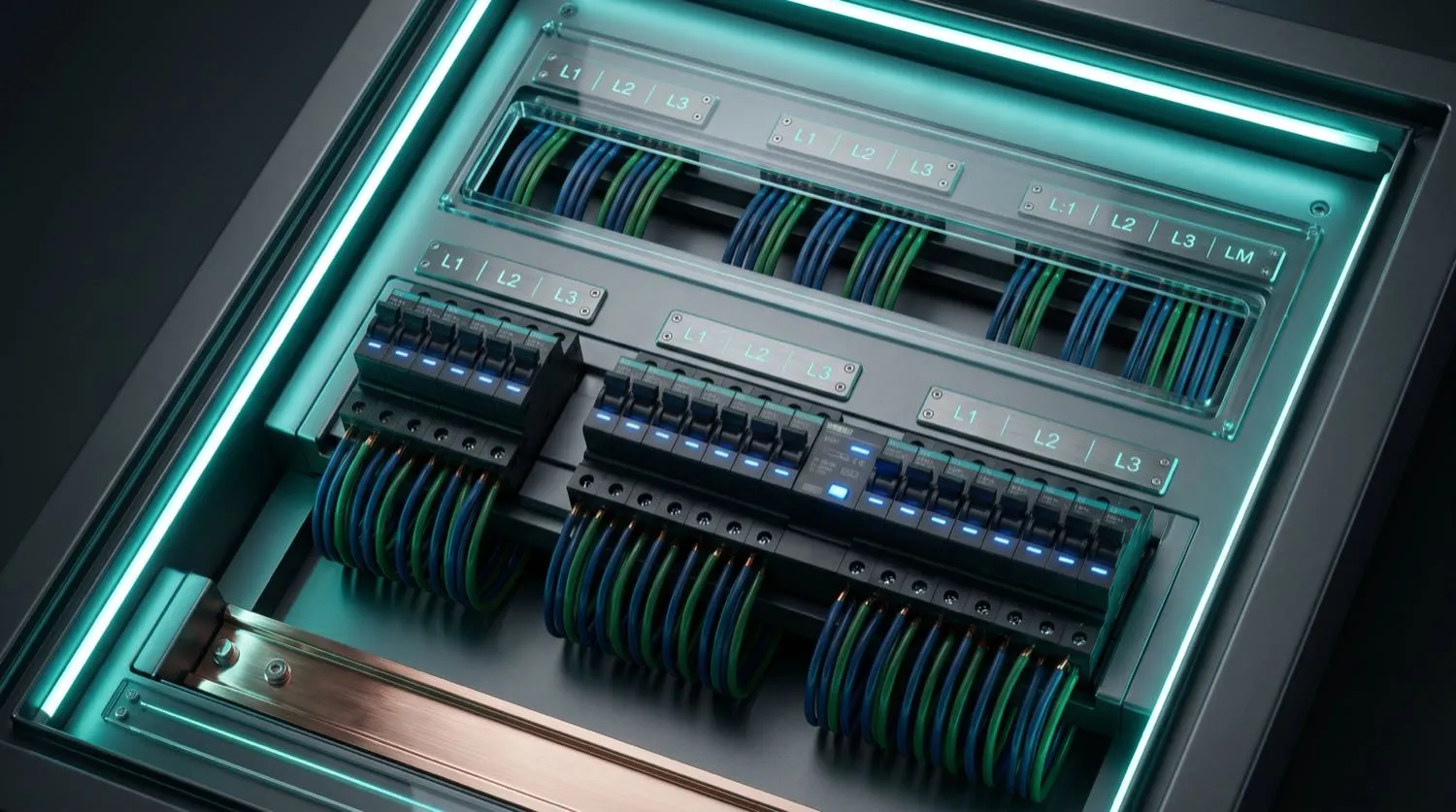
A switchboard is the nerve centre of any electrical installation. It protects conductors against overload and short circuit, provides residual current protection to guard against electrocution, and — when correctly specified — limits prospective fault current to levels that switchgear can safely interrupt. As household electrical loads have grown to encompass EV chargers, multi-head air conditioning, induction cooktops, and solar inverters, boards installed in the 1970s and 1980s are chronically undersized and dangerously outdated.
Fault Rating and Prospective Fault Current
Every miniature circuit breaker (MCB) and RCBO carries a rated short-circuit capacity — the maximum prospective fault current the device can safely interrupt without catastrophic failure. Residential Type B and Type C MCBs typically carry a 6kA or 10kA fault rating. Before specifying replacement devices, Nexus Grid engineers measure or calculate the prospective fault current (PFC) at the mains terminals using supply authority impedance data and measured loop impedance. Selecting devices with a fault rating below the PFC at their installation point is a critical non-compliance under AS/NZS 3000:2018 Clause 2.5.
Modern dual-function RCBOs eliminate the need for a separate RCD protecting groups of MCBs — each circuit receives independent overcurrent and residual current protection. This architecture means a single fault on a pool circuit does not trip the kitchen or bedroom circuits simultaneously, which is a common failure mode of older boards using a single 30mA RCD upstream of multiple MCBs.
MCB Trip Curve Selection
AS/NZS 60898.1 defines three principal trip curves for residential and light commercial MCBs. Type B devices (instantaneous trip at 3–5× rated current) suit purely resistive loads such as immersion heaters and lighting circuits. Type C devices (trip at 5–10× rated current) are specified for motor loads — compressors, pumps, and air conditioning units — where inrush current during start-up would nuisance-trip a Type B. Type D devices (10–20×) are reserved for high-inrush transformer and welding equipment. Incorrect trip curve selection results in either nuisance tripping or delayed fault clearance; Nexus Grid specifies trip curves for each circuit individually based on connected load type.
- Prospective fault current measurement and device fault-rating verification per AS/NZS 3000:2018 Clause 2.5
- Type B MCBs on lighting; Type C RCBOs on air conditioning, compressors, and motor circuits
- Main switch rated for full installation maximum demand including diversity
- Neutral bar insulation and MEN link configuration to AS/NZS 3000 Clause 5.4
- Spare ways provided for future circuits — minimum 20% spare capacity design standard
- All terminations torqued to manufacturer specifications and documented
Surge Protection Devices
Type 2 transient overvoltage surge protection devices (SPDs) installed at the main switchboard clamp switching transients generated by the distribution network and inductive load switching to levels within equipment immunity ratings. AS/NZS 1768:2007 provides the Australian standard for lightning and surge protection. The SPD is connected between active, neutral, and earth at the incomer, and must be rated for the prospective surge current of the installation — typically 20kA minimum impulse current (Iimp) for residential main boards. Nexus Grid coordinates SPD selection with the switchboard fault rating and earth electrode resistance to ensure effective clamping under both direct and indirect transient events.
Load Balancing and Maximum Demand
A well-engineered switchboard distributes circuits across phases (in three-phase installations) and applies AS/NZS 3000 maximum demand diversity factors to ensure the mains cable and main switch are rated appropriately. Nexus Grid performs a full load audit prior to replacement — logging existing circuit loads with a power analyser where required — to identify overloaded neutrals, unbalanced phases, and circuits carrying currents that exceed the fuse or MCB rating of the existing board. The replacement design documents each circuit, its calculated maximum demand, and the selected protective device rating.
On completion, the upgraded switchboard is tested to AS/NZS 3017, including insulation resistance (≥1 MΩ), RCD trip time (≤300ms at rated current, ≤40ms at 5× rated current), and earth loop impedance verification. A Certificate of Inspection is issued to the electrical safety regulator.