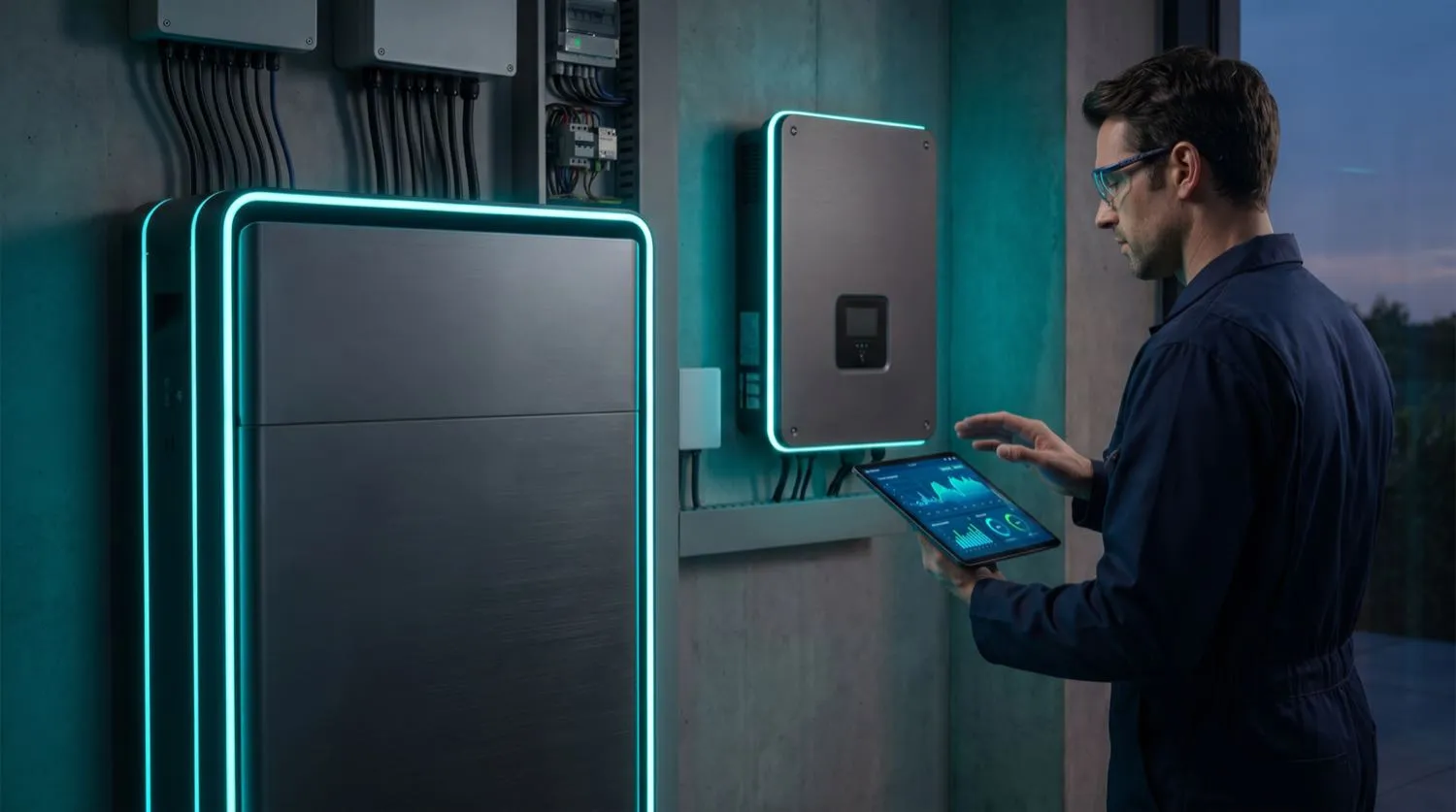
A solar PV and battery storage system is a long-lived capital asset — typical panel warranties run 25 years and battery warranties 10 years — but realising that service life depends entirely on structured maintenance and timely fault intervention. Without periodic servicing, inverter firmware falls behind mandatory grid protection updates, degraded cells in a battery module go undetected until a BMS fault takes the system offline, and soiling or partial shading on a string array quietly reduces annual generation by 10–15% without triggering any visible alarm. Nexus Grid Electrical structures maintenance programs around the specific requirements of AS/NZS 4777 (grid-connected inverters) and AS/NZS 5139 (battery installations), ensuring every protection function, connection integrity check and performance metric is documented against a traceable engineering baseline.
AS/NZS 4777 Inverter Compliance and Protection Testing
AS/NZS 4777.1 (Installation Requirements) and AS/NZS 4777.2 (Inverter Requirements) set the technical framework for grid-connected inverter installations in Australia. Part 2 specifies that inverters must hold Clean Energy Council (CEC) type-approval and must implement the volt-watt and volt-VAr response modes mandated by the relevant DNSP connection standard — in Queensland, ENERGEX and Ergon require compliance with the AS/NZS 4777.2:2020 and the DNSP's own connection and metering requirements documents. During a maintenance inspection, Nexus Grid engineers verify that inverter firmware is current, that the AC and DC isolation systems function correctly, and that the inverter's anti-islanding protection — mandatory under AS/NZS 4777 to prevent back-feed during a grid outage — trips within the standard's specified response time when the grid supply is interrupted.
String-level performance is verified by comparing measured open-circuit voltage and short-circuit current for each string against the expected values at the ambient irradiance measured on the day of inspection. Deviations exceeding 5% from expected values indicate cell degradation, bypass diode failure, or MC4 connector resistance issues. We use a clamp-based DC current logger and a reference cell pyranometer to normalise measured output to standard test conditions, generating a performance ratio (PR) figure that can be compared directly across inspection periods. A PR below 0.75 on a system less than five years old typically indicates a maintenance-addressable fault.
AS/NZS 5139 Battery System Safety Inspections
AS/NZS 5139:2019 (Electrical Installations — Safety of Battery Systems for Use with Power Conversion Equipment) governs the installation, protection and maintenance of battery energy storage systems (BESS) in Australia. The standard distinguishes between battery technologies by hazard class — lithium-ion systems with no thermal management issues are classified differently from systems that have experienced cell venting events — and requires that battery management system (BMS) faults, cell voltage deviations and temperature excursions are logged and acted upon within defined intervals.
During a BESS inspection, Nexus Grid engineers review the BMS fault log for any cell voltage imbalance events exceeding the manufacturer's tolerance, verify that the battery enclosure ventilation or thermal management system is unobstructed and functional, and confirm that the manual DC isolation switch and arc-flash protective equipment requirements specified in AS/NZS 5139 Section 7 are in place. State of health (SoH) — the ratio of available capacity to design capacity — is extracted from the BMS interface and documented. An SoH below 80% of nameplate capacity indicates the system has consumed a material portion of its warranty-covered cycle life and should trigger a warranty claim review.
Performance Monitoring, Firmware and Maintenance Scheduling
- Inverter firmware update verification and CEC-approved model status confirmation under AS/NZS 4777.2:2020
- Anti-islanding protection function test with calibrated trip-time measurement
- String open-circuit voltage and short-circuit current measurement vs expected values at measured irradiance
- Performance ratio calculation normalised to STC using reference cell pyranometer data
- AS/NZS 5139 BMS fault log review — cell voltage balance, temperature logs, venting event history
- Battery state of health (SoH) extraction and documentation against warranty capacity threshold
- AC and DC connection torque inspection and thermographic imaging of combiner boxes and DC isolators
- DNSP export limit and protection relay settings verification against current connection agreement
Nexus Grid recommends annual maintenance inspections for systems up to five years old and biannual inspections thereafter, with an additional out-of-cycle inspection following any cyclone, flood or significant hail event. All inspection results are documented in a system maintenance register maintained per AS/NZS 4777.1 recommendations, providing an auditable service history. Where systems are enrolled in DNSP virtual power plant (VPP) programs, our inspection reports confirm that the dispatch control interface and protection coordination remain within the VPP agreement parameters. Clients operating solar-plus-storage systems under a Power Purchase Agreement receive a copy of the performance verification report formatted to satisfy their PPA metering and compliance obligations.