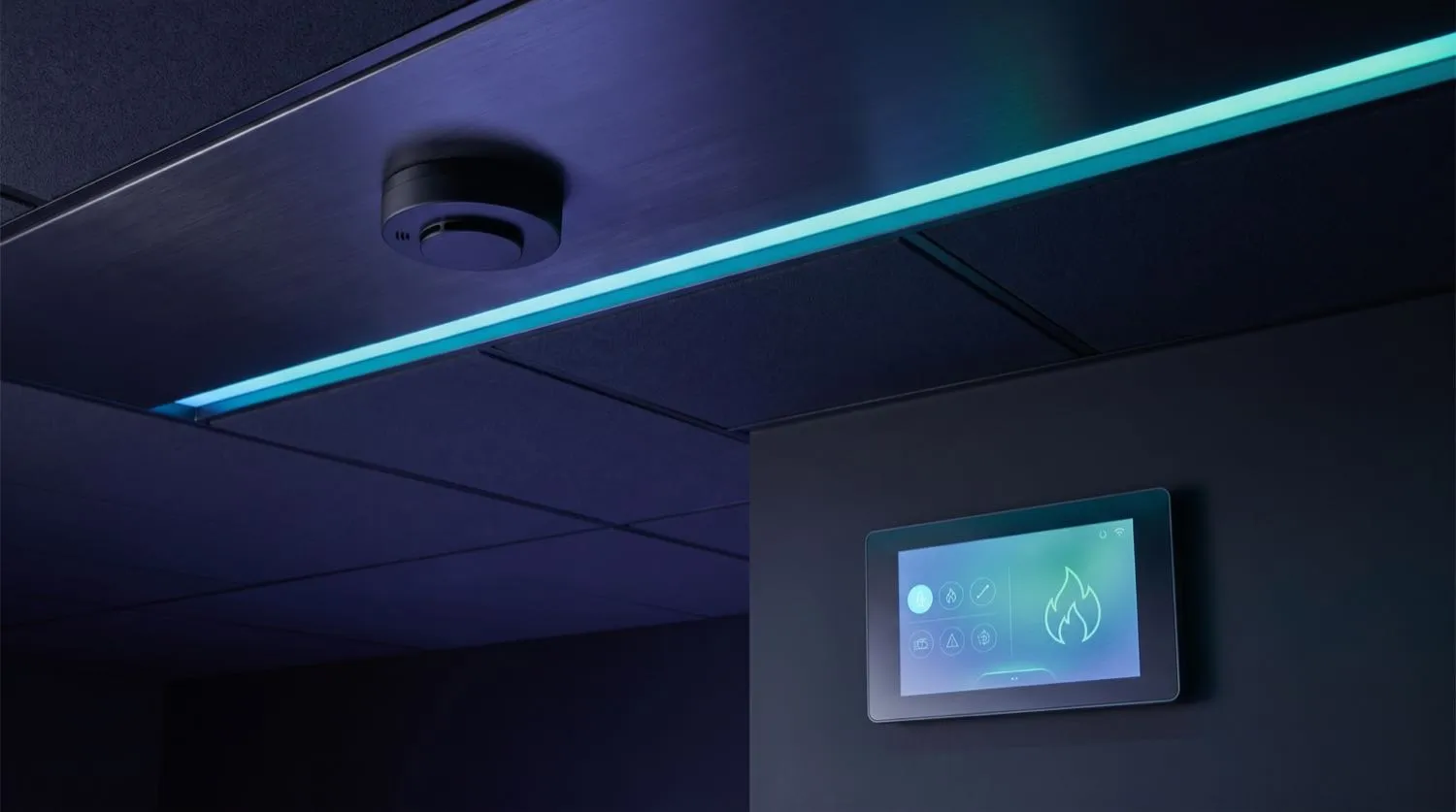
Fire detection and alarm systems are classified as life-safety infrastructure under the National Construction Code (NCC) and the Building Code of Australia (BCA). Their design, installation, commissioning, and maintenance are governed by a suite of Australian Standards that impose specific engineering requirements on every component — from detector spacing and placement geometry to cable segregation, monitoring panel configuration, and the frequency of routine service inspections. Nexus Grid Electrical holds the necessary licences and technical competencies to deliver compliant fire system works across all building classes, from single-tenancy retail to multi-storey commercial and critical-infrastructure facilities.
Design and Installation: AS 1670.1
AS 1670.1 (Fire Detection, Warning, Control and Interoperability Systems — System Design, Installation and Commissioning — Fire) is the primary engineering standard governing conventional and addressable fire alarm systems in Australian buildings. It prescribes the maximum floor area per detector based on ceiling height and detector type, the maximum spacing between detectors, the placement offsets from walls and beams, the requirements for zone configuration, the cable types and segregation rules, and the interfacing requirements with other building services (HVAC shutdown, door holders, emergency lighting, and lift recall). Nexus Grid Electrical prepares system design documentation in accordance with AS 1670.1 prior to installation, submitting drawings to the relevant fire authority for approval where required by the jurisdiction.
- Smoke detector placement: maximum 7.5 m spacing (reduced at ceiling heights above 6 m per AS 1670.1 Table 3.1)
- Heat detector coverage: maximum 30 m² per detector in Standard sensitivity class at 3.6 m ceiling height
- Zone configuration: maximum 2000 m² per zone for conventional systems, with zone boundaries aligned to building compartments
- Manual call points (MCPs): maximum 30 m travel distance to nearest MCP per AS 1670.1 clause 4.10
- Addressable systems: full point-identity mapping with panel cause-and-effect matrix programmed and documented
- Emergency wiring: fire-rated cable (AS/NZS 3013 circuit integrity classification) on all critical signal and power circuits
Smoke Alarms: AS 3786 and Residential Requirements
AS 3786:2014 (Smoke Alarms — Application, Installation, Testing and Maintenance) governs smoke alarms in residential buildings. In Queensland, new and substantially renovated dwellings must be fitted with photoelectric smoke alarms (not ionisation type) that are interconnected so that activation of one alarm triggers all alarms in the dwelling — a requirement that has progressively applied to all dwellings since 2022. Nexus Grid Electrical installs AS 3786-compliant photoelectric smoke alarms with hardwired 240 V supply and 10-year battery backup, in the locations mandated by the NCC: on each storey of the dwelling, in each bedroom, and in each hallway connected to a bedroom. Wireless interconnection using the same-brand RF protocol is available where retrofitting hardwired interconnection cables is impractical.
AS 1851 Routine Service and Maintenance
AS 1851 (Routine Service of Fire Protection Systems and Equipment) mandates the maintenance activities, inspection frequencies, and record-keeping requirements for all installed fire protection equipment in commercial buildings. For conventional and addressable fire alarm systems, AS 1851 prescribes quarterly, six-monthly, and annual inspection tasks. Quarterly inspections include functional testing of a representative sample of detectors on a rotation basis (typically 25% of devices per quarter, completing 100% annually), manual call point test, control panel function check, battery load test, and verification of monitoring centre connection. Annual inspections include full system walk-test, sensitivity testing of smoke detectors (addressing the common issue of contaminated detectors that respond too slowly or have drifted out of calibration), cable insulation check, and review of the cause-and-effect matrix. Nexus Grid Electrical provides a comprehensive AS 1851 service log for each system — a bound record that documents every inspection activity, test result, and corrective action, available to the building owner and fire authority on request.
- Quarterly service: sample detector functional test (25% rotation), MCP activation, panel self-test, battery voltage and capacity check
- Six-monthly: aspirating and beam detector sensitivity verification, sounder and strobe level measurement
- Annual service: full system walk-test, 100% detector test cycle complete, cable insulation resistance check, cause-and-effect matrix verification
- Monitoring: alarm signal transmission confirmed to Category 1 monitoring centre (Grade A1 response per AS 2201.1)
- Corrective maintenance: defective detectors replaced within timeframes mandated by AS 1851 Table 7.1 based on defect severity class
- Service certificate: issued after each inspection, retained in the fire system maintenance logbook held on-site
Monitoring and Panel Technology
Modern fire alarm panels support dual-path monitoring — typically over the public switched telephone network (PSTN) or broadband IP, with mobile network as a backup path — to ensure that an alarm signal reaches the monitoring centre even if one communication path fails. AS 2201.1 (The Monitoring of Alarm Systems) governs the performance requirements for monitoring centres and the communication protocols between panels and monitoring receivers. Nexus Grid Electrical programs and commissions panels from leading Australian-approved manufacturers, configures the dual-path communication modules, and witnesses the alarm transmission to the monitoring centre during commissioning. All new installations are registered with the relevant fire authority and the monitoring centre, ensuring the correct emergency response category is assigned to the premises.