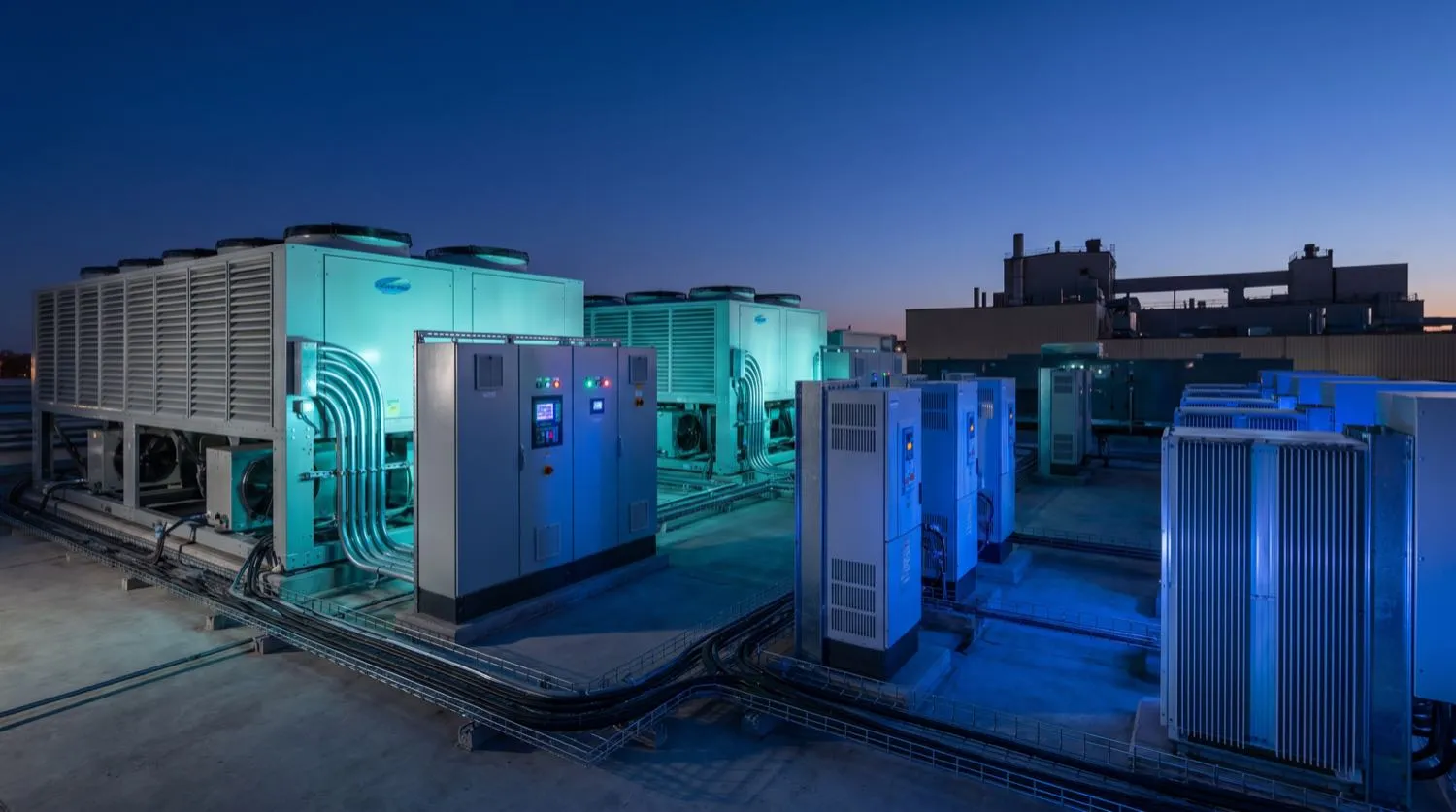
HVAC systems are among the largest electrical loads in any commercial or industrial building, and their electrical infrastructure is disproportionately complex relative to their apparent simplicity. A rooftop air handling unit (AHU) driving a 55kW supply fan and a 30kW return fan through variable speed drives, incorporating a chilled water valve actuator, a heating battery, damper actuators, and a BMS communication interface, represents a significant electrical engineering scope in its own right. Nexus Grid Electrical engineers HVAC electrical systems from motor circuit protection through to BMS termination, working to the mechanical services load schedule and the project electrical engineer's distribution design.
Motor Circuit Design and Protection
Every motor circuit must be individually designed against the motor's full-load current (FLC) as declared in the mechanical engineer's equipment schedule. AS/NZS 3000:2018 Clause 4.4 governs motor installations, specifying that the circuit protective device must be capable of carrying the starting current — typically 600–700% of FLC for direct-on-line (DOL) starting — without nuisance tripping, while protecting the conductors against overload and short-circuit. Motor circuit conductors are sized to carry at least 125% of FLC per AS/NZS 3000, with voltage drop verified at full load from the distribution board to the motor terminals.
Motor protection relays are calibrated to the motor nameplate FLC with a tripping characteristic that mirrors the motor's thermal withstand curve. Nexus Grid engineers specify electronic motor protection relays (rather than bimetallic overloads) on motors above 11kW, providing phase-loss detection, negative-sequence protection, ground-fault supervision, and current-imbalance monitoring — all critical in HVAC applications where single-phasing can destroy a compressor motor within minutes.
Variable Speed Drive Installation and EMC Management
Variable speed drives (VSDs) are standard equipment on modern HVAC fans, pumps, and compressors — offering energy savings of 30–50% compared with fixed-speed operation at partial load. The electrical installation of VSDs introduces several engineering considerations beyond basic motor wiring. VSDs are significant sources of conducted and radiated electromagnetic interference (EMI), and their output waveforms subject motor cable insulation to repetitive voltage pulses with fast rise times (high dV/dt) that stress cable insulation and generate bearing currents in the motor.
- VSD input supply with dedicated MCCB, not shared with other loads, to isolate harmonic injection
- Input line reactors (minimum 3% impedance) fitted to reduce supply-side harmonic current to acceptable levels
- Output cable — shielded, four-core (three phases plus dedicated PE) — routed in separate tray from BMS control cables
- Output cable length verified against VSD manufacturer maximum to prevent standing wave voltage overshoot
- EMC input filters installed where drives are within 10m of sensitive instrumentation or BMS controllers
- Drive enclosure earthed via 360° shield termination at both VSD end and motor terminal box
BMS Control Wiring and Interface Engineering
Building management systems (BMS) communicate with HVAC plant via a combination of digital inputs and outputs (DI/DO), analogue inputs and outputs (AI/AO), and data bus protocols — most commonly BACnet/IP over Ethernet, BACnet MS/TP over RS-485, or Modbus RTU. Nexus Grid engineers design and install the control wiring infrastructure that connects field devices — sensors, actuators, valve positioners, and VSD communication cards — to BMS outstations and the central supervisory controller.
RS-485 BACnet MS/TP bus wiring is a common source of commissioning problems on HVAC projects. The bus must be correctly terminated with 120Ω resistors at each physical end — not at each device — and shielded cable must be daisy-chained, not star-wired, to prevent signal reflections. Nexus Grid engineers document BMS wiring topology, specify shielded twisted-pair (STP) cable rated to RS-485 signalling requirements, and verify bus termination before BMS commissioning. This upstream discipline eliminates the most common cause of BMS communication faults at practical completion.
Mechanical Services Distribution Boards
Large commercial buildings typically have dedicated mechanical services distribution boards (MSSBs) located in plant rooms, feeding all HVAC equipment on a floor or zone. Nexus Grid designs MSSBs to AS/NZS 61439-2, with individually metered and protected circuits for every motor, VSD, control transformer, and ancillary load. Energy sub-metering on mechanical services — isolated from the building's general power sub-meters — enables facility managers to track HVAC energy consumption independently, validate mechanical system performance against design intent, and identify degrading plant performance before it becomes a failure.