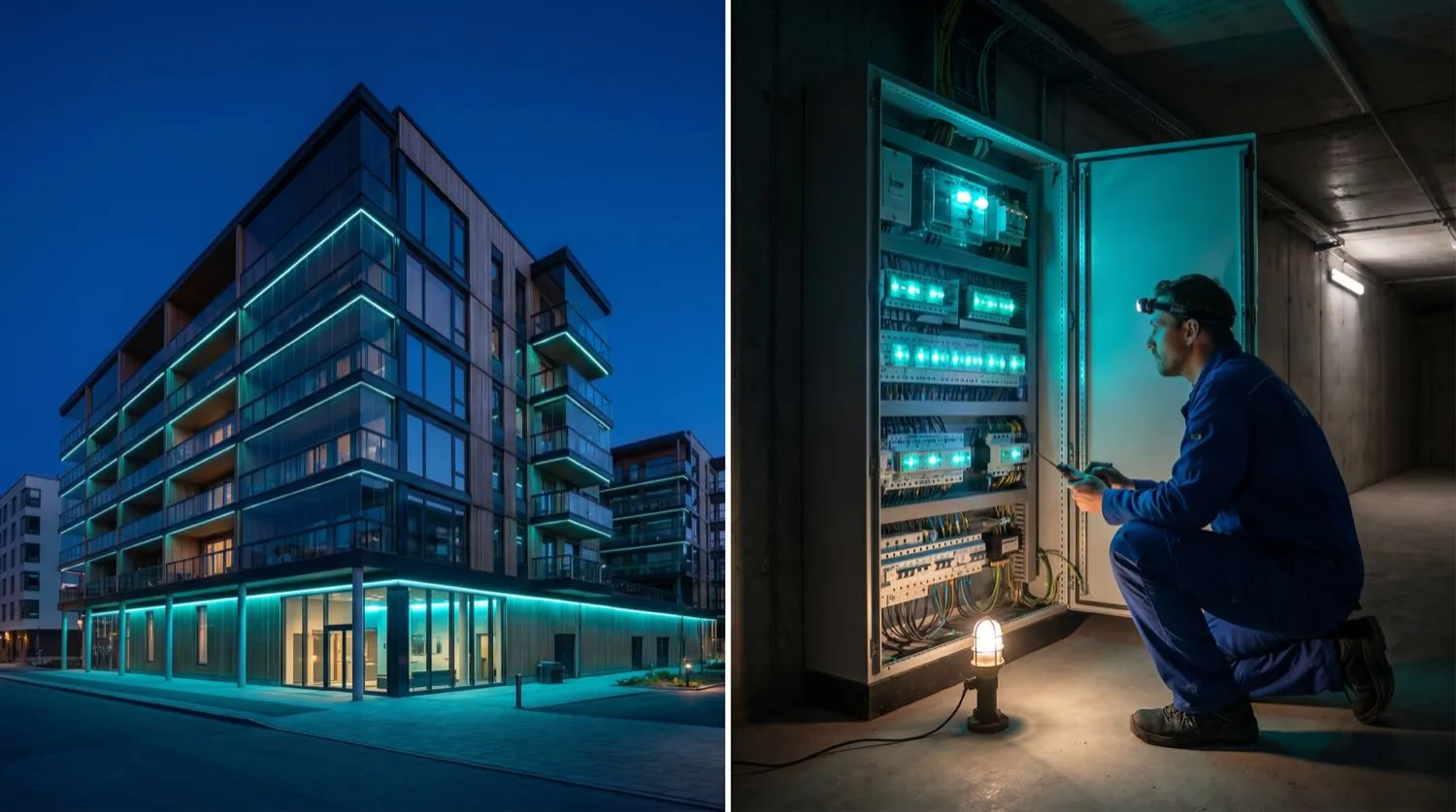
Electrical infrastructure in strata schemes and commercial properties is subject to ongoing degradation from thermal cycling, mechanical vibration, moisture ingress, vermin activity, and the accumulated effects of load growth that was not anticipated in the original design. Without systematic maintenance and periodic inspection, these degradation pathways progress silently until they produce a fault — at which point the consequences range from a nuisance outage to a fatal electric shock or building fire. Nexus Grid Electrical designs and delivers structured maintenance programmes that interrupt degradation before it reaches failure threshold, and provides the documentation trail that satisfies Australian Standard requirements, insurer obligations, and body corporate duties of care.
AS 1851 Preventive Maintenance Framework
AS 1851:2012 (Routine service of fire protection systems and equipment) is the primary Australian Standard governing scheduled maintenance of life safety electrical systems including emergency lighting, exit signs, fire detection and alarm systems, and emergency power supply systems within strata and commercial buildings. The standard defines service frequencies, test procedures, acceptance criteria, and the records that must be retained. Non-compliance with AS 1851 is among the most commonly identified deficiencies in strata building audits, and it is a standard exclusion trigger in building insurance policies where a fire or evacuation incident occurs.
Nexus Grid's AS 1851 maintenance programme covers the full scope of life safety electrical systems — monthly functional tests of emergency lighting and exit signs, six-monthly and annual discharge tests of emergency luminaire batteries to the 90-minute endurance requirement, annual inspection of fire detection and alarm panel event logs and detector sensitivity, and annual test of generator automatic transfer switching where an emergency generator is installed. All test results are logged electronically and provided to the body corporate or building manager in a format suitable for insurer submission.
Periodic Inspection and Test to AS/NZS 3017
AS/NZS 3017:2022 (Electrical installations — Verification guidelines) defines the inspection and testing programme that should be applied to electrical installations at defined intervals. For commercial and common-area electrical installations in strata schemes, Nexus Grid recommends a full periodic inspection and test every five years for premises with significant public access, and every ten years for low-risk common-area installations — consistent with the guidance in AS/NZS 3000:2018 Clause 8.3.
- Insulation resistance test — minimum 1 MΩ phase-to-earth and phase-to-phase per AS/NZS 3017
- Earth fault loop impedance measurement at representative final sub-circuit outlets
- RCD operation test at 50% and 100% rated tripping current, verifying ≤300ms trip time at 1× I∆n
- Switchboard thermographic survey — identifying hot connections indicative of resistance joints or loose terminals
- Visual inspection of all accessible wiring, cable supports, conduit, and trunking condition
- Maximum demand comparison against metered site peak load data to identify overloaded circuits
RCD Testing and Verification
Residual current devices (RCDs) are the primary protection against electrocution in Australian electrical installations, and their function degrades over time. Mechanical components wear, the toroidal core can develop residual magnetism from repeated nuisance tripping, and moisture ingress can alter trip current characteristics. AS/NZS 3000:2018 requires that RCDs protecting socket outlets in commercial and strata common areas be tested by a licensed electrician using a calibrated RCD tester — not merely by pressing the TEST button, which only exercises the electronic test circuit, not the full trip mechanism.
Nexus Grid schedules six-monthly RCD testing for all common-area socket outlets in strata schemes, verifying that each RCD trips within the required time at both 50% and 100% of its rated residual operating current (I∆n). Type A RCDs are confirmed to respond to pulsating DC residual current — the form produced by single-phase rectifier loads common in modern electrical equipment. Any RCD that fails to trip within 300ms at I∆n is immediately replaced. Test records are issued in a format compatible with body corporate maintenance registers and insurer reporting requirements.
Common-Area Switchboard Upgrades and Compliance
Legacy strata switchboards — particularly in buildings constructed before 2000 — frequently contain aged moulded-case circuit breakers (MCCBs) with unverified fault ratings, absent or inadequate RCD protection, deteriorated busbars with resistance joints visible on thermographic scan, and no provision for sub-metering common-area energy. Nexus Grid engineers assess existing switchboards against the current AS/NZS 61439-1 requirements, identify compliance gaps, and present a staged upgrade programme prioritised by safety risk — replacing life-expired protective devices and introducing RCD protection first, then upgrading to metered distribution as budgets allow.
Energy sub-metering of common-area electrical loads — lifts, carpark ventilation, pool and gym equipment, corridor lighting — enables bodies corporate to accurately attribute energy costs, identify plant operating outside design hours, and demonstrate measurable energy reduction to lot owners. Nexus Grid installs Modbus-capable energy meters behind existing main switches, connects them to a building-level data concentrator, and provides dashboard access to the building manager without requiring a full switchboard replacement.