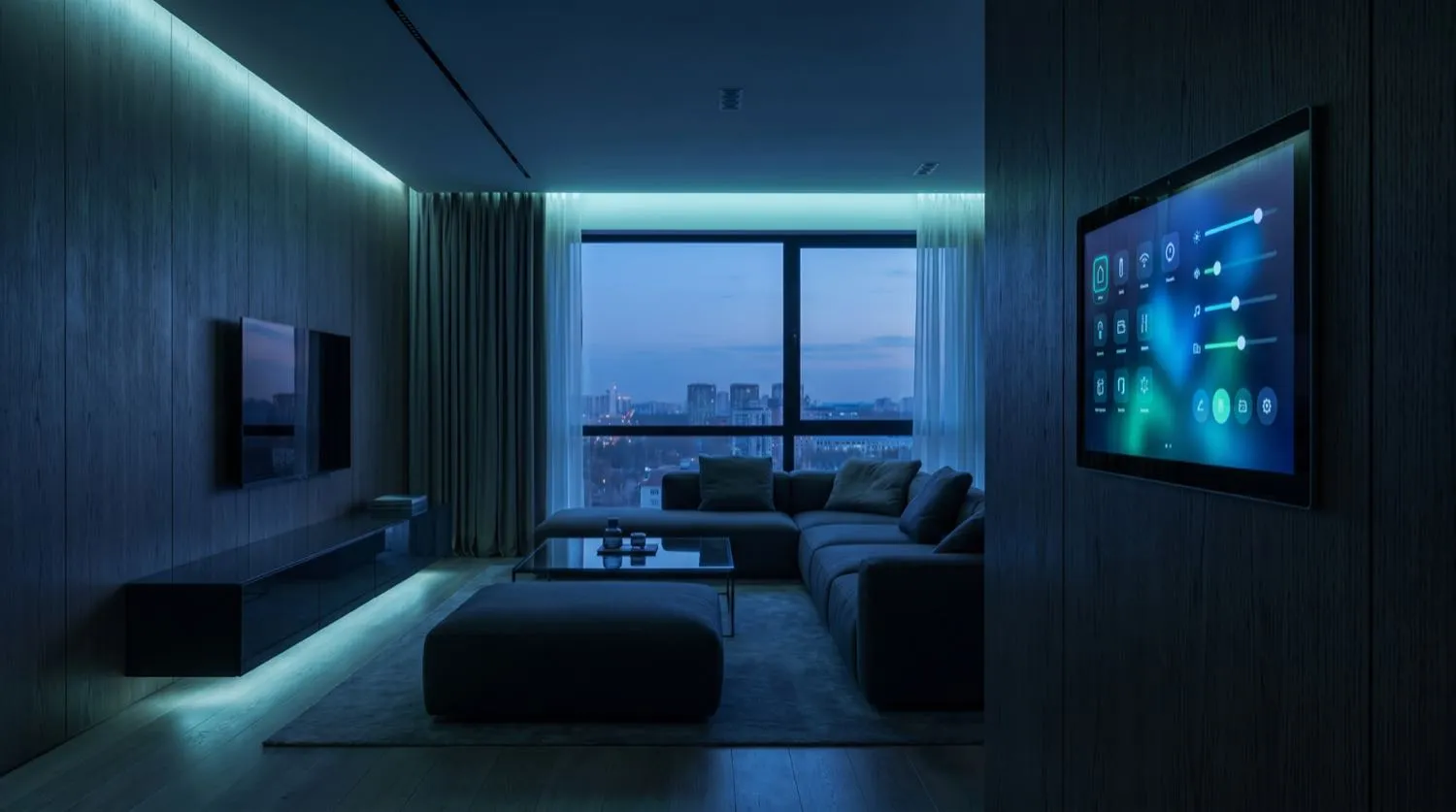
Smart home automation is not simply a matter of installing wireless switches and configuring a smartphone app. A professionally engineered system integrates structured control cabling, correctly specified DIN-rail power supplies, properly coordinated circuit protection, and load-type matched dimming technology. Nexus Grid approaches smart home projects as electrical engineering exercises first — the software integration follows a verified electrical infrastructure.
Control System Architecture: KNX and C-Bus
KNX is an internationally standardised (ISO/IEC 14543-3) building automation protocol widely adopted in commercial and premium residential applications. C-Bus, developed by Clipsal (Schneider Electric), is the dominant residential automation platform in the Australian market. Both systems operate on a distributed bus architecture where each device — switch, dimmer, sensor, or actuator — contains its own intelligence, eliminating single-point failure through central controllers. The bus cable (TP1 twisted pair for KNX; Category 5 for C-Bus) is supplied at ELV (extra low voltage) — 24V DC for KNX, 36V DC for C-Bus — meaning the control network is separated from mains voltage and does not require a licensed electrician for programming adjustments once installed.
Nexus Grid engineers specify KNX or C-Bus based on project scale and client requirements. KNX offers greater flexibility for mixed-vendor integration and is the preferred platform where HVAC, shading, energy metering, and third-party integration are required. C-Bus is well-supported locally, with a mature installer base and strong residential dimming ecosystem. Both support integration with Crestron, Control4, and Savant higher-layer control systems.
Power Supply and Circuit Design
DIN-rail mounted KNX power supplies (typically 640mA or 1280mA) and C-Bus power supply units must be correctly sized against the total bus current draw of all connected devices, with a 20–30% headroom margin for reliable operation. Each power supply requires a dedicated fused circuit, clearly identified at the switchboard. Nexus Grid uses separate circuit protection for each automation panel — a fault on the automation supply does not affect safety-critical circuits such as emergency lighting or smoke alarm systems.
- Dedicated SELV (safety extra low voltage) control cable separated from mains wiring throughout
- KNX TP1 or C-Bus Cat5 cabling run in conduit or cable tray per AS/NZS 3000:2018 installation requirements
- Power supply sizing calculated at 80% bus loading to ensure stable bus voltage
- Actuator modules located in DIN-rail panels with full circuit directory and group address documentation
- Separate circuit protection for each panel; fault on automation system cannot affect safety services
- All mains-voltage wiring to actuators and dimmers inspected and tested to AS/NZS 3017
Lighting Loads and Dimmer Compatibility
LED luminaires introduce power quality challenges absent from incandescent dimming. LED drivers present non-linear load characteristics that generate harmonic currents; a poorly selected trailing-edge dimmer driving an incompatible LED driver can produce total harmonic distortion (THD) exceeding 20% on the circuit, degrading dimmer longevity and creating conducted emissions that interfere with control buses. Nexus Grid engineers specify leading-edge and trailing-edge dimmers after confirming load compatibility with luminaire manufacturers' technical data. Target THD is maintained below 2% at the dimmer output under rated load.
Minimum-load requirements are another common failure point. Most DALI and phase-cut dimmers specify a minimum connected load — often 5–15W — below which the dimmer circuit is unstable. When replacing high-wattage incandescent lamps with equivalent LED fittings, the connected load may fall below this threshold. Nexus Grid specifies dummy load resistors or selects dimmers with zero-minimum-load ratings where total circuit wattage is low.
Energy Monitoring and Scene Control
Integrated energy monitoring via modbus or KNX energy meters provides per-circuit consumption data accessible through the home automation interface. This data supports load-shifting against time-of-use tariffs — automatically deferring pool pumps, dishwashers, and EV charging to off-peak periods. Scene control groups and time schedules are programmed and documented in a system configuration file provided to the client, enabling future adjustments without requiring an on-site engineering call.