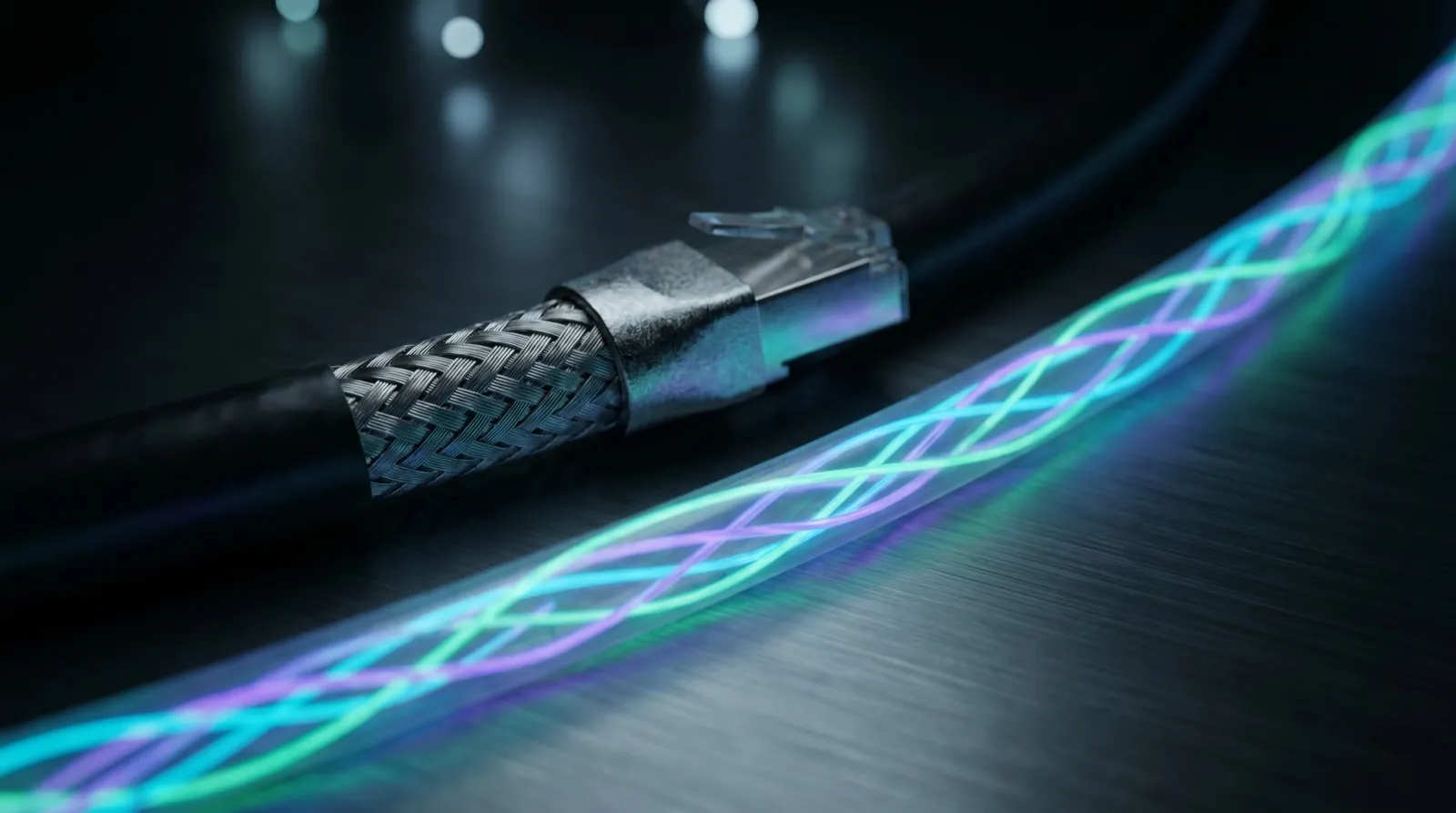
Cat6A and single-mode fibre both promise future-proof connectivity, but the right choice depends on your building footprint, budget, and where you expect bandwidth demands to go over the next decade.
When a business or developer is designing a structured cabling installation, the choice between augmented Category 6 copper (Cat6A) and fibre optic cable is rarely as binary as vendors suggest. Both technologies are mature, standards-compliant, and capable of supporting 10 Gigabit Ethernet. The real decision involves transmission distances, power over Ethernet (PoE) requirements, bend radius constraints, installation environment, and a realistic 10-year forecast of bandwidth demand. Getting this decision right at the design stage costs nothing extra. Getting it wrong means ripping out cable three years into a fit-out.
What Cat6A Actually Delivers
Cat6A (Augmented Category 6) is standardised under ANSI/TIA-568-2.D and ISO/IEC 11801-1 and is designed to support 10GBASE-T Ethernet at distances up to 100 metres. This covers the vast majority of horizontal cabling runs in commercial buildings — from the comms room to the furthest desk or access point. Cat6A is an unshielded twisted pair (UTP) or shielded (STP/F/UTP) copper cable and operates up to 500 MHz, which gives it the headroom needed for 10G without the alien crosstalk problems that plagued Cat6 at those speeds.
The practical advantage of Cat6A for most commercial fit-outs is that it supports IEEE 802.3bt PoE++ at up to 90 watts per port. This means a single Cat6A run can simultaneously carry 10G data and power a ceiling-mounted Wi-Fi 7 access point, a PTZ security camera, a VoIP handset, or a smart building sensor — without a separate power circuit. For large open-plan offices with dozens of ceiling-mounted devices, this significantly reduces electrical installation cost and complexity.
What Fibre Optic Delivers
Optical fibre transmits data as pulses of light through a glass or plastic core, which means it is entirely immune to electromagnetic interference (EMI), cannot carry ground loops, and imposes no practical bandwidth ceiling at the distances used in commercial buildings. The two main types relevant to structured cabling are multimode fibre (OM3/OM4/OM5) and single-mode fibre (OS2). OM4 supports 100G at 150 metres and 10G beyond 400 metres. OS2 single-mode has effectively unlimited distance for campus and inter-building applications and is the correct choice for backbone runs between buildings or between floors in high-rise structures.
Fibre is also the preferred choice in electrically noisy environments — manufacturing facilities, hospitals with MRI equipment, data centres, mining operations, and any site with large variable-speed drives or heavy electrical plant nearby. Copper cabling in these environments picks up interference that degrades link quality even when the physical layer reports a connected state. Fibre does not have this problem.
- OM3 multimode: 10G to 300 m, 40G to 100 m — adequate for most in-building backbones
- OM4 multimode: 10G to 400 m, 100G to 150 m — suited to campus-scale horizontal runs
- OM5 multimode: designed for SWDM4, supports 400G over short distances with the right transceivers
- OS2 single-mode: 10G and beyond at distances of kilometres — inter-building and campus backbones
- All fibre types: zero susceptibility to EMI, no PoE capability, requires optical transceivers at each end
The PoE Trade-off
The single biggest functional gap between Cat6A and fibre is power delivery. Fibre optic cable cannot carry electrical power — it is purely a data medium. In a building where every access point, camera, and IoT sensor requires a PoE feed, a fibre-only horizontal cabling strategy means you still need copper to every powered endpoint, or you need PoE switches co-located with each cluster of devices (a legitimate design choice in large buildings, but it adds cost and introduces additional switching hardware to maintain).
For modern offices and hospitality venues deploying Wi-Fi 7 infrastructure, a hybrid design is often optimal: fibre OS2 backbone between floors and comms rooms, Cat6A horizontal to every active endpoint. This provides the bandwidth head-room and EMI immunity on the long, high-density backbone runs while retaining PoE capability at the point of use. The fibre-to-copper conversion happens at a distribution switch on each floor or zone.
Installation Considerations for Australian Commercial Projects
Cat6A UTP in large commercial buildings requires careful attention to alien crosstalk (AXT) during installation. Bundling cables tightly in high-fill conduit degrades AXT performance. Shielded Cat6A (F/UTP or S/FTP) eliminates AXT risk but requires continuity of the shielding braid and correct grounding at patch panels — an incorrect shield termination can actually worsen noise performance by creating a ground loop antenna. PrismTech's installation standard calls for Cat6A shielded cable on all runs over 50 metres or in any environment adjacent to electrical conduit.
Fibre installation requires trained cable jointers for fusion splicing (where runs exceed factory-terminated pigtail lengths) and careful management of bend radius — single-mode fibre's minimum bend radius is typically 10 times the cable diameter for long-term installations, and violations cause microbend losses that are invisible on a visual inspection but show up as elevated insertion loss on an OTDR trace. All PrismTech fibre installations are tested end-to-end with a calibrated OTDR and results recorded per TIA-526-7 (multimode) or TIA-526-14 (single-mode) before handover.
Making the Decision: A Practical Framework
For most Australian commercial fit-outs under 10,000 square metres, Cat6A horizontal cabling with fibre backbone is the correct answer in 2026. The economics of 10G copper switches have improved substantially — a managed 48-port 10G PoE++ switch now costs a fraction of what an equivalent fibre-fed chassis switch did five years ago. If your runs are all under 100 metres, you are not gaining meaningful performance from fibre at the horizontal level, and you are sacrificing PoE.
Choose fibre as your primary horizontal medium when: your floor plates exceed 100 metres in effective cable run length; you are in a heavy EMI environment; you are connecting buildings on a campus; your bandwidth requirements genuinely exceed what 10G copper can deliver; or your organisation's security policy prohibits copper in certain zones due to emanations concerns. In every other scenario, Cat6A to ISO/IEC 11801-1 standards, properly installed and tested, will serve the next decade of network infrastructure evolution without limitation.