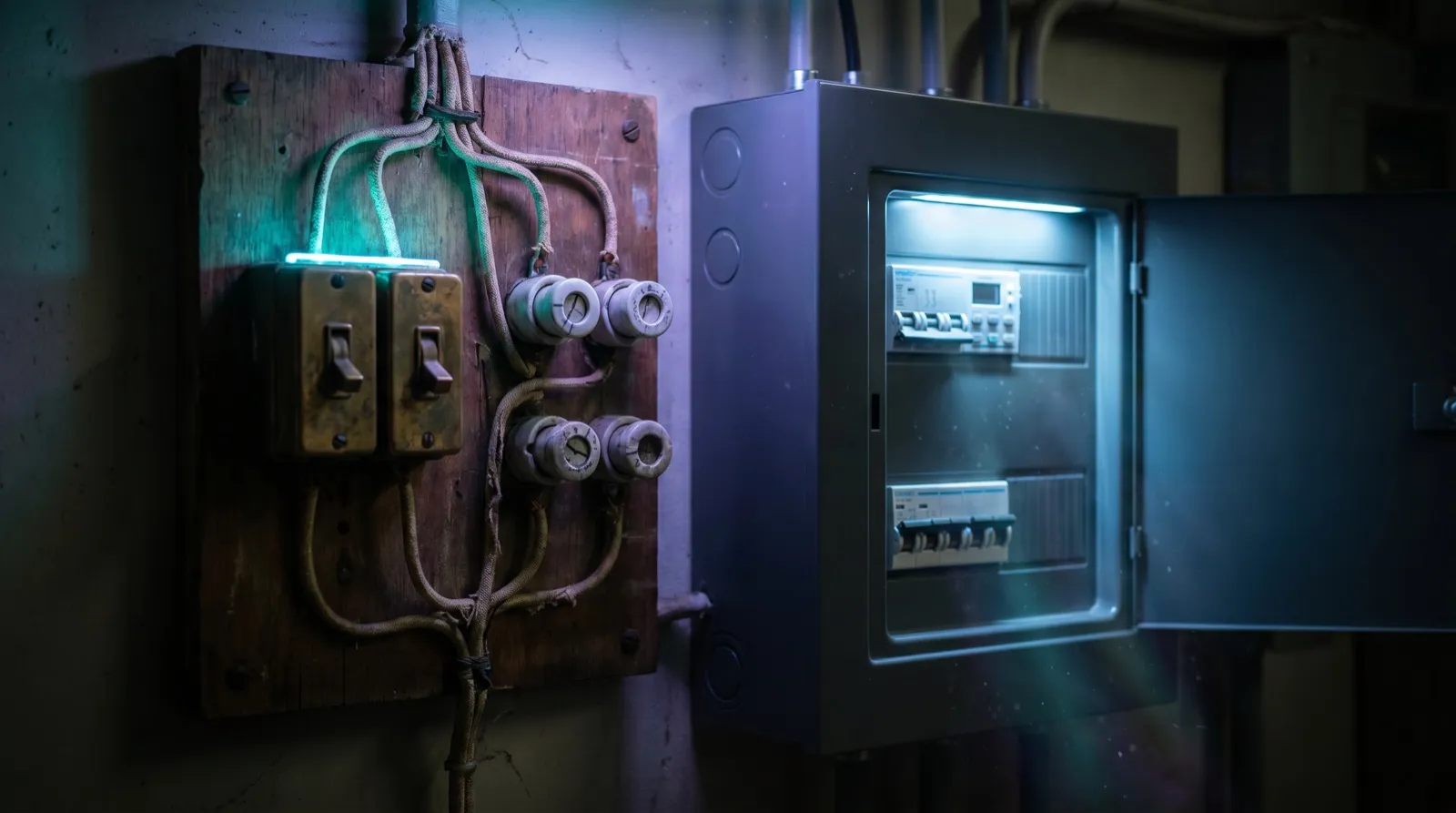
An ageing switchboard is the single most overlooked fire and shock risk in Australian homes and commercial premises — here are seven signs yours needs replacing before it becomes a liability.
Australia's residential and commercial building stock carries a significant legacy problem: switchboards installed under pre-2000 wiring rules that were never designed to handle today's electrical loads. Air-conditioners, EV chargers, induction cooktops, server racks, and banks of USB charging points push older panels well past their design capacity. The result is not just nuisance tripping — it is elevated fire risk, accelerated insulation breakdown, and potential non-compliance with AS/NZS 3000:2018 (the Wiring Rules). Knowing the warning signs means you can act before an insurance assessor — or worse, a fire investigator — does it for you.
1. Ceramic Fuse Holders or Rewireable Fuses
If you open the switchboard door and see porcelain fuse carriers holding lengths of fuse wire, you are looking at technology that predates the moon landing. Rewireable fuses offer no overload discrimination, can be incorrectly rewired with wire of the wrong gauge, and provide zero earth leakage protection. Under AS/NZS 3000 Clause 2.6, every final subcircuit protecting socket outlets in a new installation must have RCD (residual current device) protection. Older fuse-based boards simply cannot accommodate RCDs without a full replacement.
Beyond the standards compliance issue, insurance underwriters are increasingly flagging fuse-wire boards as a material risk. Some policies contain exclusion clauses that apply where a claim arises from a panel that does not meet current Wiring Rules. Have a licensed electrician assess yours — the replacement cost is far lower than an uninsured structural loss.
2. Tripping Circuit Breakers That Cannot Be Reset
A breaker that trips, is reset, and holds is doing exactly what it should. A breaker that trips repeatedly or refuses to reset is telling you one of two things: either the circuit is genuinely overloaded for its installed cable rating, or the breaker itself has failed mechanically. Older moulded-case breakers lose their calibration over time as the bimetal thermal element fatigues. The danger is a breaker that no longer trips at the correct threshold — it may allow sustained overcurrent to flow through undersized conductors, heating insulation toward ignition temperature.
Modern switchboards use Type B or Type C miniature circuit breakers (MCBs) to AS/NZS 60898.1 with defined tripping curves. If your board is using generic or unbranded breakers without visible standard markings, they should be treated as suspect and tested or replaced.
3. Visible Scorching, Burn Marks, or a Persistent Electrical Smell
Discolouration around breakers, melted insulation on incoming cables, or a persistent smell of hot plastic or burnt rubber is a Category 1 fault — stop using the affected circuits and call a licensed electrician the same day. Thermal damage inside a switchboard typically indicates a sustained loose connection or an overloaded neutral. A loose neutral under load creates a voltage imbalance that can damage sensitive electronics and generate arcing at the termination point.
- Scorching or heat staining on the switchboard enclosure itself
- Discoloured or brittle cable sheathing at the termination block
- Any evidence of arc flash — pitting or metal splatter on bus bars
- A switchboard door that is warm or hot to the touch under normal load
- Smell of ozone or burning plastic when no appliances have overheated
4. No RCD or RCBO Protection
Residual current devices (RCDs) and residual current breaker with overload (RCBOs) are mandatory under AS/NZS 3000:2018 for all socket outlet circuits and all lighting circuits in new residential work. An RCBO combines overcurrent protection (breaker function) and earth leakage protection (RCD function) in a single device, providing discrimination per circuit — meaning a fault on one circuit does not knock out an entire bank of circuits sharing a common RCD.
If your switchboard has a single RCD protecting multiple circuits, a fault anywhere on that group trips protection for the whole group. That is both an inconvenience and a safety gap: the kitchen refrigerator, the hallway lighting, and the bedroom power points should not be sharing a single protection device. A modern board with individual RCBOs per circuit is the current best practice, and in Queensland and Western Australia, mandatory RCD rules for existing residential properties have already expanded significantly. Other states are following.
5. Insufficient Circuits for Modern Loads
A switchboard with 6 or 8 circuit positions was appropriate for a home with a stove, a hot water system, and a handful of power points. That calculation changes dramatically when you add a 7.2 kW wall-mounted EV charger, a 6.6 kW reverse-cycle air-conditioner, a 3-phase induction cooktop, and a 5 kW battery inverter. Each of these requires a dedicated circuit, correct cable sizing, and — for EV chargers — compliance with the AS/NZS 3000 Appendix C load calculations.
Running high-draw appliances from shared circuits causes sustained overcurrent that ages conductors faster than rated. The heat generated accelerates oxidation at termination points, which increases resistance, which generates more heat — a progressive cycle that ends in insulation failure. If your switchboard is full or has circuits doubled up with piggyback connectors, it needs to be replaced with a larger enclosure before the next major appliance goes in.
6. A Switchboard That Has Never Been Tested or Inspected
AS/NZS 3760 — the standard for in-service safety inspection and testing of electrical equipment — applies to portable appliances, but the broader obligation for switchboard safety falls under the Wiring Rules and state electrical safety legislation. Thermal imaging (thermography) of a switchboard under load is the most effective way to identify hot spots at connections before they become faults. A loose 63-amp termination running 15 degrees above ambient is invisible to the naked eye but immediately obvious on an infrared camera.
Commercial and industrial properties should be having their main switchboards thermally imaged on a scheduled basis — annually for high-load facilities, biannually as a minimum for lower-load tenancies. If you cannot produce an inspection record for your switchboard, that alone is a risk management gap worth closing.
7. The Board Is Located in a Hazardous Area
Switchboards installed in roof spaces, under staircases, inside bathroom wall cavities, or adjacent to water services represent both a compliance issue and a practical maintenance problem. AS/NZS 3000 specifies clearance requirements from water pipes and wet areas, and a switchboard that cannot be safely accessed for testing and maintenance will inevitably go unserviced. If your main board is in a location that makes regular inspection impractical, relocation to a compliant position as part of an upgrade is well worth building into the project scope.
Upgrading a switchboard is not merely a compliance exercise — it is the single most high-leverage electrical investment you can make in a property. A modern enclosure with appropriately rated MCBs or RCBOs per circuit, a whole-of-board surge protection device (SPD) to AS/NZS 61643.11, and clearly labelled circuit identification transforms your electrical infrastructure from a latent liability into a properly managed asset. PrismTech Electrical carries out full switchboard replacements to AS/NZS 3000:2018 with same-day turnaround on most residential jobs and documented handover inspections as standard.