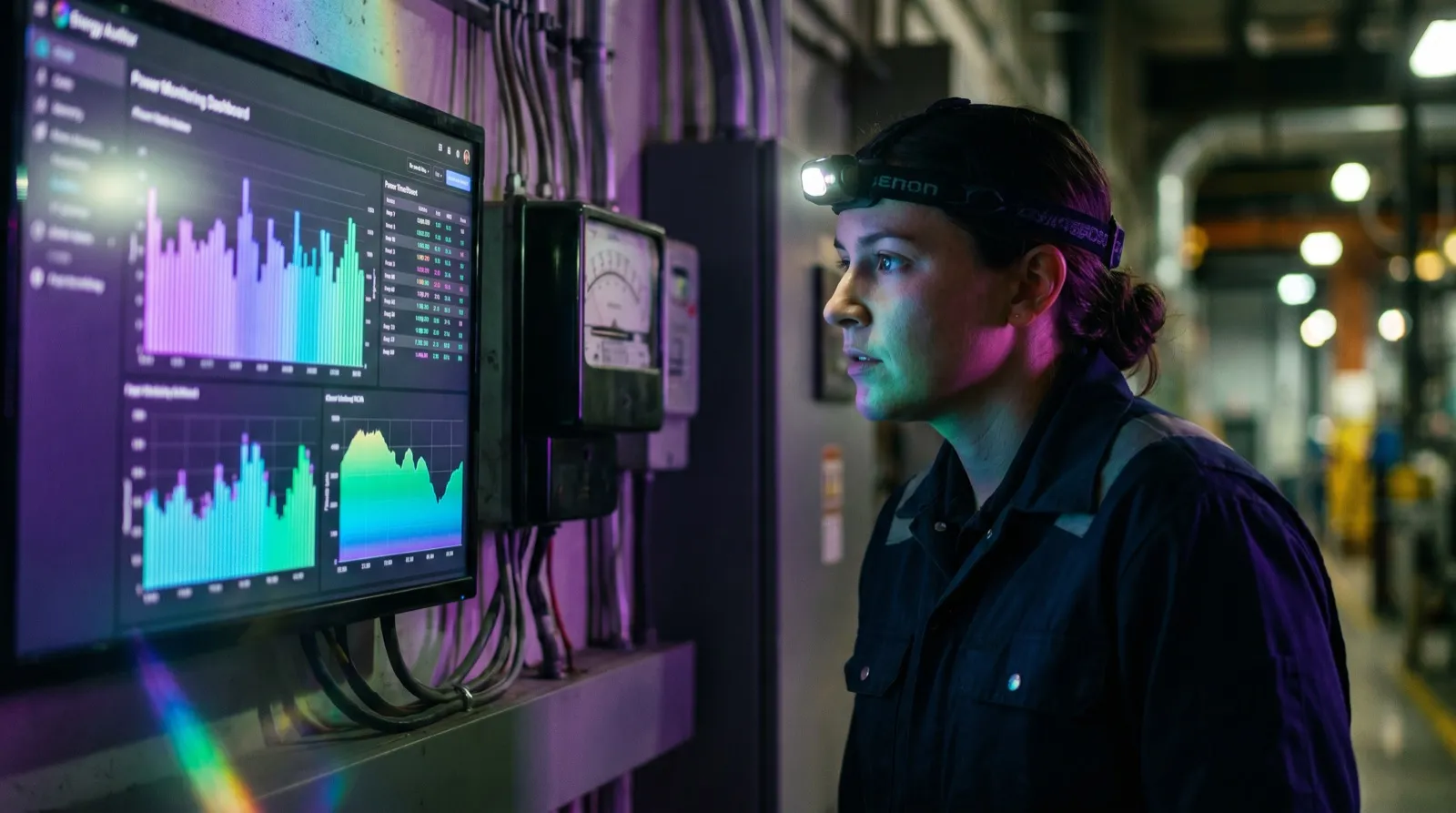
Energy efficiency in commercial and industrial premises is not a sustainability aspiration — it is a financial discipline. For a mid-size commercial building, the gap between a well-optimised electrical installation and an unmanaged one can represent tens of thousands of dollars per year in unnecessary energy spend. The challenge is that energy waste rarely annunciates itself: there is no alarm when a bank of aging fluorescent luminaires is drawing twice the watts of its LED equivalent, no warning light when power factor has drifted to 0.78 and the network operator is quietly adding a demand surcharge to every quarterly bill, and no notification when HVAC auxiliary loads are running outside occupied hours because a timer has drifted. PrismTech Electrical's energy efficiency audit service makes the invisible visible — with calibrated measurement, not estimates.
Power Monitoring and Load Profiling
The foundation of any meaningful energy audit is measured data. We deploy calibrated power quality analysers and sub-metering equipment at the main distribution board and at key sub-circuit level to capture a complete load profile of your premises across a full operating cycle — typically five to seven days minimum to capture weekday, weekend, and overnight consumption patterns. The data captured includes active power (kW), reactive power (kVAR), power factor, harmonic distortion, voltage and current waveforms, and peak demand events. This dataset allows us to identify which loads are driving your peak demand — which often determines a significant component of your network tariff — and which circuits are consuming energy during unoccupied periods, indicating control or scheduling failures.
The load profile is benchmarked against Energy Use Intensity (EUI) figures for your building type and climate zone, drawn from the National Australian Built Environment Rating System (NABERS) and AIRAH technical guides. Where your EUI significantly exceeds the benchmark for comparable facilities, the audit identifies the likely contributing factors and quantifies the saving available from addressing each one. Every recommendation in our audit report is accompanied by an estimated implementation cost and a modelled simple payback period, allowing you to prioritise investments by financial return rather than energy-saving intent alone.
Lighting Audits and LED Upgrade Assessments
Lighting typically accounts for between 20 and 40 percent of electricity consumption in commercial office, retail, and warehouse environments. The gap between a maintained T8 fluorescent fitting and a modern LED equivalent with an integrated occupancy sensor can be as large as 60 percent in watt-for-watt consumption, with additional savings from the sensor eliminating consumption during unoccupied periods entirely. Our lighting audit documents every luminaire type, wattage, operating hours, control strategy, and maintained illuminance level in your premises. We model the energy saving, light quality improvement, and maintenance cost reduction available from an LED upgrade and provide a specification for replacement product that meets or exceeds the illuminance and colour rendering requirements of AS/NZS 1680 for your activity areas.
- Power quality analysis — active power, reactive power, harmonics, and power factor
- Peak demand profiling and network tariff optimisation assessment
- Lighting audit to AS/NZS 1680 with LED upgrade specification and ROI modelling
- Power factor correction (PFC) design to bring power factor above 0.95
- HVAC auxiliary load monitoring — fans, pumps, and compressors
- Sub-metering strategy and ongoing energy dashboard recommendations
Power Factor Correction
Power factor is the ratio of active power (the real work performed by electrical loads) to apparent power (the total current drawn from the network). Inductive loads — electric motors, transformers, and magnetic ballasts — draw reactive current that does not perform useful work but does increase the apparent power demand and, under most commercial network tariffs, triggers a reactive energy or low-power-factor surcharge. A facility operating at a power factor of 0.75 is effectively paying the network operator to supply 25 percent more current than it actually uses. Power factor correction (PFC) involves installing capacitor banks at the main switchboard or at large individual loads to supply reactive current locally, reducing apparent power demand and eliminating the network surcharge.
From Audit to Implementation
An energy audit that sits in a drawer saves nothing. PrismTech Electrical's audit reports are structured as actionable project specifications — every recommendation is accompanied by a scope of works that our electrical team can implement directly. For lighting upgrades, we supply and install; for power factor correction, we design, supply, and commission the capacitor bank; for sub-metering and energy dashboards, we install the metering hardware, integrate it with your building management system or a cloud-based energy monitoring platform, and train your facilities team to read and respond to the data. We also provide a post-implementation measurement and verification report — taken at the same measurement points and over the same duration as the baseline audit — so you can see the actual saving achieved, not just the modelled one.
Frequently asked questions
How long does an energy efficiency audit take and what does it involve?
The on-site measurement phase typically runs for five to seven business days, during which our power monitoring equipment is installed at your switchboard with minimal disruption — the analyser clips onto existing conductors without interrupting supply. The audit report, with findings and recommendations, is typically delivered within five business days of the monitoring period concluding. The site walkthrough to inventory lighting and HVAC loads takes two to four hours depending on premises size.
What is power factor correction and does our business need it?
Power factor correction uses capacitor banks installed at your switchboard to offset reactive current drawn by inductive loads — motors, compressors, and transformers. If your business operates motor-driven equipment (HVAC, refrigeration, lifts, compressors, or process machinery), your power factor is almost certainly below 1.0, and your network tariff may include a reactive energy or low-power-factor penalty. We calculate your current power factor from the monitoring data and model the cost of the penalty against the installed cost of a correction system, so you have a clear financial case before committing to the upgrade.
Will an LED lighting upgrade affect the quality of light in our workspace?
Modern LED products, specified correctly, deliver equivalent or superior light quality to the T8 and metal halide sources they replace. Our lighting specifications reference AS/NZS 1680 maintained illuminance requirements for each activity area, ensuring the replacement product meets the lux levels appropriate for your workspace type. We specify LED products with colour rendering indexes (CRI) of 80 or above and colour temperatures appropriate to your environment — typically 4000K for office and retail, 5000K for warehouse and workshop — so the quality of light is maintained or improved alongside the energy saving.
Can you install sub-metering so we can track consumption ongoing after the audit?
Yes. Sub-metering is one of the most effective tools for sustaining energy savings after an initial audit. We install current transformers at key circuit groups — HVAC, lighting, process equipment, and common area loads — connected to a pulse-output or Modbus energy meter, which feeds data to a cloud-based energy monitoring dashboard. You receive real-time and historical consumption data by circuit, alerts when consumption exceeds normal patterns, and a continuous record of your EUI for NABERS and sustainability reporting purposes.