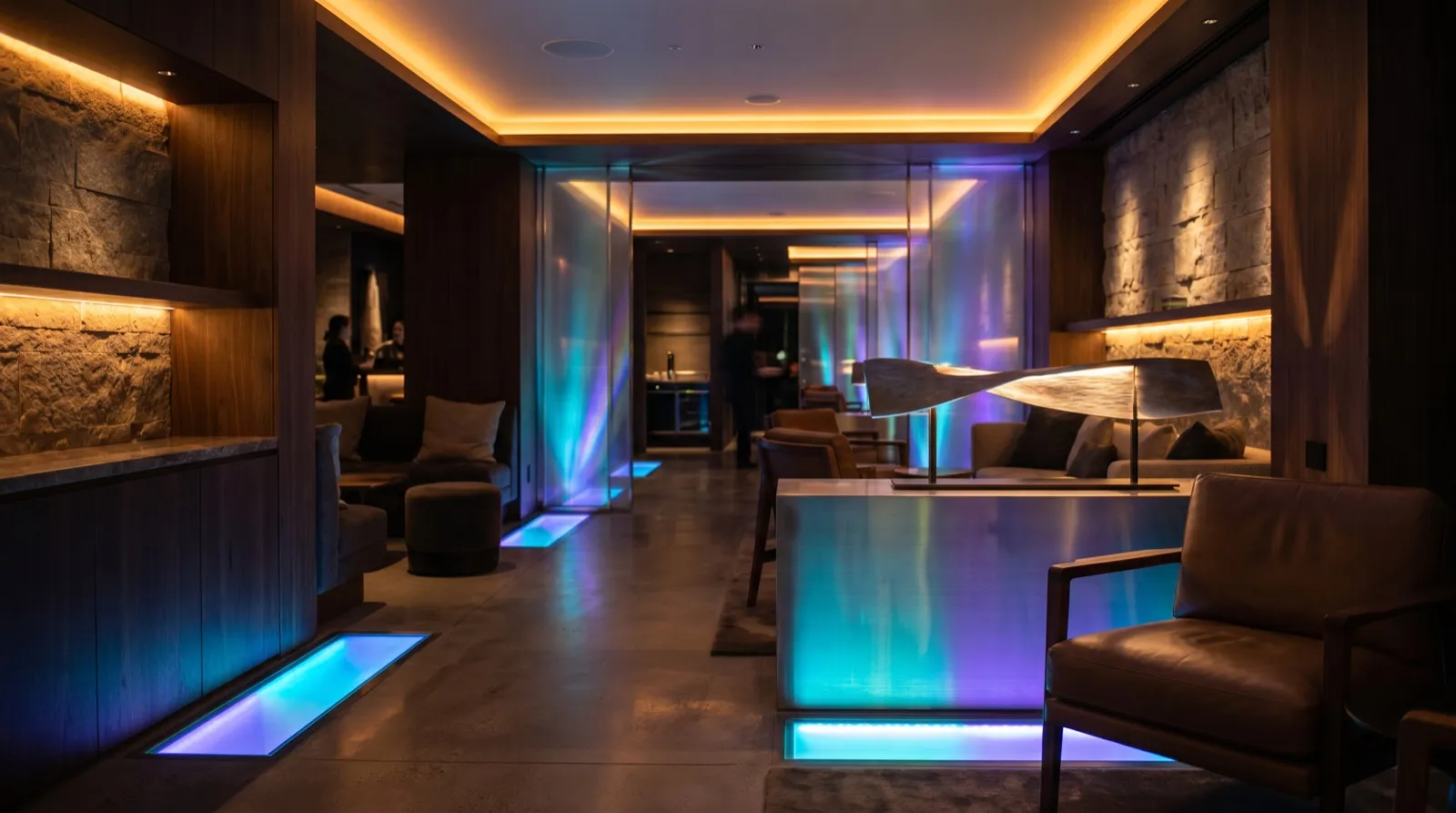
Light is the single most influential finish in any building. It affects how materials read, how large a room feels, how alert staff are at their desks, and how safe a car park appears at midnight. Yet lighting is still one of the most frequently under-engineered elements of a commercial or residential project — specified too late, purchased on price, and installed without photometric validation. PrismTech Electrical embeds into your project team early, working alongside architects and interior designers to ensure the lighting concept survives contact with structural reality, budget review, and the Australian energy compliance framework.
Photometric Design and Lux Compliance
Every commercial lighting project we undertake begins with a photometric model. Using DIALux evo, we simulate the exact luminaire positions, aiming angles, beam distributions, and surface reflectances of your space to produce maintained illuminance values in lux across every task plane. Australian Standards AS/NZS 1680.1 and its series define minimum maintained illuminance levels for each occupancy type — 400 lux at the working plane for general office, 500 lux for detailed drafting, 160 lux for corridors and circulation. We model to these targets, produce a false-colour illuminance map that identifies hotspots and underlit zones, and iterate the layout until the simulation is compliant before ordering any product.
National Construction Code Section J6 governs maximum lighting power density for commercial buildings, expressed in watts per square metre. LED technology has made compliance far easier than the fluorescent era, but poorly chosen LED luminaires with high wattage and mediocre efficacy still fail J6 checks. We specify luminaires with a minimum efficacy of 100 lumens per watt, and our designs routinely achieve lighting power densities well below the maximum allowable, which benefits your NCC certificate of compliance and reduces your long-term energy costs.
DALI-2 Intelligent Lighting Control
Digital Addressable Lighting Interface (DALI-2) is the industry standard for intelligent commercial lighting control. Unlike older 0-10V dimming wiring, DALI-2 is a two-wire digital bus where each luminaire, each driver, and each sensor occupies its own unique address. This means individual luminaire commissioning, real-time fault reporting, group reconfigurations without rewiring, and sensor-linked automatic dimming — all from a software interface rather than a screwdriver on a DIN rail.
- Individual luminaire addressing and group configuration via DALI-2 bus
- Daylight-linked dimming with ceiling-mounted photocell sensors
- Occupancy detection via DALI-2 push-button sensors and PIR motion detectors
- Scene pre-sets for presentation, meeting, cleaning, and after-hours modes
- Integration with BMS (Building Management Systems) via DALI gateway
- Real-time driver fault alerts with luminaire-level identification
Architectural LED Specification and Installation
We specify LED luminaires with consistent colour rendering across the installation — a minimum CRI of 90 for retail and hospitality environments where product and food presentation matter, and a tightly matched correlated colour temperature (CCT) tolerance of ±100K across a batch to avoid perceptible colour inconsistency between fittings. For architectural accent lighting — coves, valances, feature walls — we use high-density LED strip rated at a minimum 120 LEDs per metre with binned chips to eliminate colour banding. Recessed downlights in wet areas carry a minimum IP44 rating; shower zone fittings carry IP65 or better.
Emergency Lighting and Exit Signage
Emergency lighting is a life safety system, not an afterthought. We design and install self-contained maintained and non-maintained emergency luminaires and exit signs in accordance with AS/NZS 2293.1, ensuring minimum 10 lux on exit paths and 0.5 lux across open areas. All emergency luminaires are fitted with self-test modules that perform and log weekly function tests and six-monthly discharge tests automatically, producing a compliance record without requiring manual testing by your facilities team. We commission the system against the emergency lighting layout drawing and issue a handover certificate on completion.
Frequently asked questions
What is DALI and why is it better than a standard dimmer?
DALI (Digital Addressable Lighting Interface) is a two-wire digital control bus where each luminaire has its own address. Unlike traditional 0-10V or trailing-edge dimmers, DALI allows individual luminaire control, automatic fault reporting, sensor integration, and scene re-programming in software without rewiring. It's the standard for any commercial lighting installation where flexibility and energy optimisation are required.
Do you produce photometric compliance documentation for development applications?
Yes. Our DIALux evo models produce lux plot reports and false-colour illuminance maps that can be included in development application submissions, NCC Section J compliance reports, and building certifier documentation. We also issue a signed lighting design certificate on project completion.
What CRI rating do you recommend for retail or hospitality lighting?
We specify a minimum CRI of 90 for retail, hospitality, and healthcare environments. A higher CRI means colours render more accurately under the light source, which directly affects how products, food, and skin tones appear to customers. For specialist applications like jewellery display, we can specify luminaires at CRI 95 or above.
Can existing fluorescent fixtures be retrofitted to LED and DALI control?
In many cases, yes. T8 fluorescent battens can be retrofitted with LED tube replacements or replaced outright with LED panels connected to DALI-2 drivers. The viability depends on the existing wiring topology — if it's a loop-in-loop configuration, some additional wiring may be needed to create a proper DALI bus. We assess the existing installation before recommending a retrofit or replacement pathway.