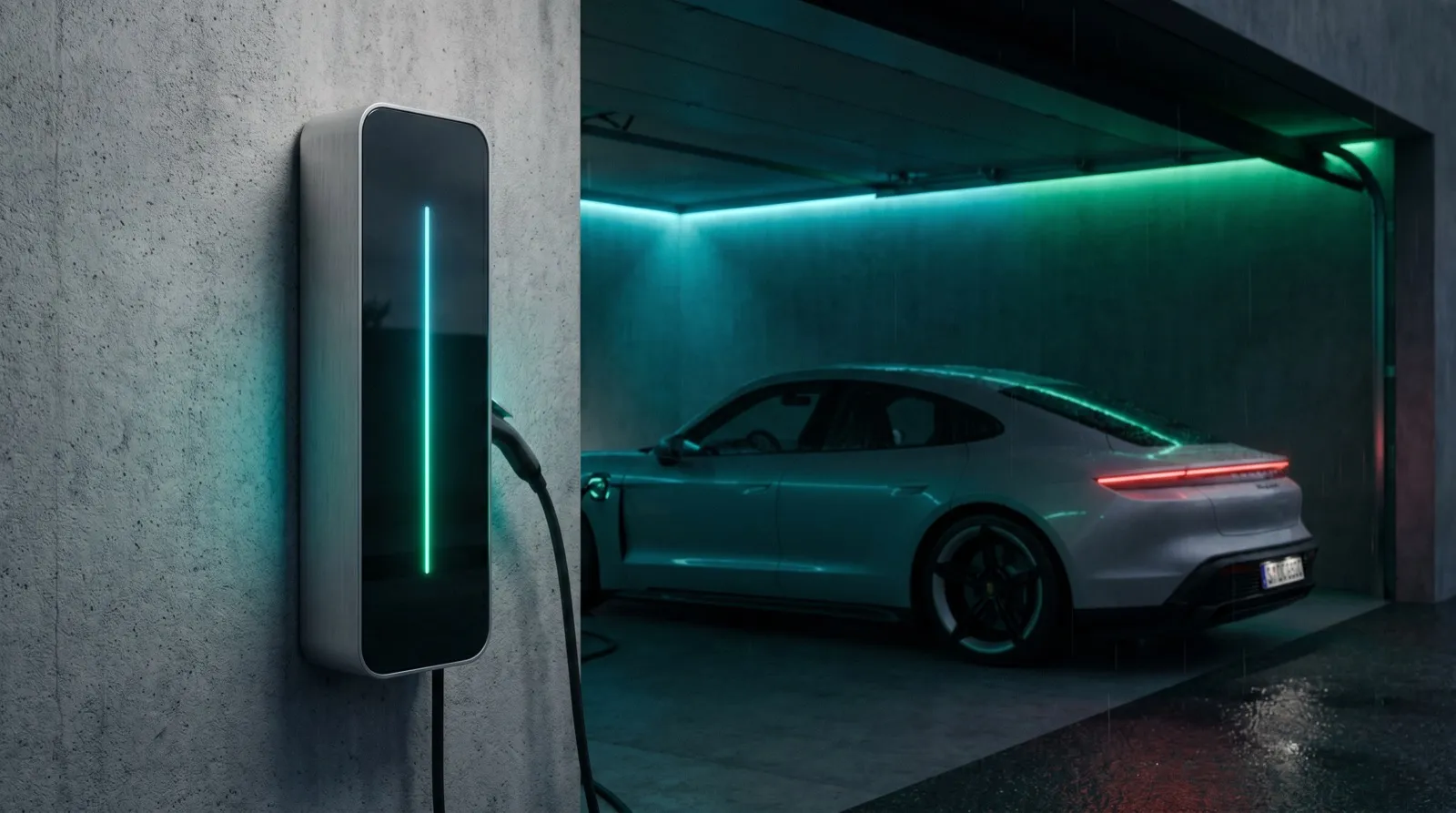
Electric vehicle adoption is accelerating across Australia, and the charging infrastructure supporting it must be engineered as carefully as the vehicles themselves. Relying on a standard 10A GPO to charge overnight is slow, inefficient, and in many cases beyond the rating of the outlet's dedicated circuit. A properly installed Type 2 AC wall charger reduces charge times from 12 or more hours to three or four, integrates with off-peak tariffs, and communicates with your home energy management system so charging never pushes your mains supply beyond its safe capacity.
Home EV Charger Installation: 7 kW Single-Phase
The most common residential installation is a 7 kW single-phase charger wired to a dedicated 32A circuit from the main switchboard. A 7 kW charger adds approximately 40 km of range per hour of charging, which satisfies the daily driving needs of the vast majority of Australian households with an overnight charge window of four to six hours. PrismTech installs EVSE hardware from brands including Wallbox, Fronius Wattpilot, and Tesla Wall Connector, selected to match your vehicle's on-board charger specification and your preference for smart features.
The installation process begins with a switchboard assessment to confirm spare circuit capacity, main switch rating, and earthing system compliance. Where the switchboard requires an upgrade — common in older homes with 60A or 80A mains and full panel boards — we present upgrade options and costs before proceeding. The charger cable is run via the most appropriate route — through the roof cavity, inside conduit on the garage wall, or in underground conduit for detached garages — and terminated in a weatherproof enclosure rated for the outdoor environment.
Commercial EV Charging: 22 kW Three-Phase and Multi-Bay Arrays
Commercial sites — including shopping centres, office car parks, hospitality venues, and fleet depots — have different requirements. Three-phase 22 kW chargers deliver up to 120 km of range per hour for vehicles with compatible on-board chargers, making them appropriate for locations where vehicles park for two to four hours rather than overnight. Multi-bay installations require a dedicated sub-distribution board, appropriately rated cable from the main switchboard, and a load management controller that prevents simultaneous full-power charging from exceeding the site's mains supply allocation.
Open Charge Point Protocol (OCPP 1.6 or 2.0) compatible chargers allow commercial operators to manage billing, access control, and energy reporting through a cloud-based charge point management system (CPMS). Drivers can initiate sessions via RFID card or a QR code app, and the operator receives per-session energy data and invoicing records. PrismTech commissions the OCPP back-end connection and tests the full charging session workflow before handing over to the site operator.
Load Balancing, Solar Integration, and Smart Charging
Dynamic load balancing is essential in any property where total connected load approaches the main switch rating. A load management controller — either built into the charger hardware or installed as a standalone CT clamp monitor — measures real-time demand across the property and throttles charger output dynamically so the mains supply is never overloaded. For homes with rooftop solar systems, solar-integrated smart chargers such as the Fronius Wattpilot or Wallbox Quasar maximise the proportion of charging delivered from solar generation, reducing the grid energy cost of each charge cycle.
- Single-phase 7 kW residential EV charger installation with dedicated 32A circuit
- Three-phase 22 kW commercial charger installation with sub-distribution board
- Switchboard assessment, upgrade, and mains capacity verification
- Dynamic load balancing controller installation and commissioning
- OCPP 1.6 / 2.0 smart charging back-end configuration for commercial operators
- Solar self-consumption charging integration with compatible inverter and EVSE hardware
Compliance, Metering, and Warranty Protection
All PrismTech EV charger installations are performed under a licensed electrical contractor's licence and completed to AS/NZS 3000 Wiring Rules. A Certificate of Compliance for Electrical Work (CCEW) is issued on completion — the document your insurer and vehicle manufacturer require as evidence of a compliant installation. Using an unlicensed installer or a general GPO rather than a dedicated circuit can void your vehicle's battery warranty and invalidate any insurance claim arising from a charging-related incident.
For sites requiring sub-metering of charging energy for tenant billing, PrismTech installs dedicated energy meters on each charger circuit. Data from these meters can be exported to your property management system via Modbus or pulse output, or read directly from the OCPP CPMS if the charger hardware supports it. We document the metering configuration in the as-built drawings provided at project handover.
Frequently asked questions
What is the difference between a 7 kW and a 22 kW EV charger?
A 7 kW charger operates on single-phase 32A supply and is the standard for residential installation. A 22 kW charger operates on three-phase 32A supply and delivers up to three times the charging speed, but only if your property has three-phase mains supply and the vehicle's on-board charger supports three-phase AC input — many current models cap at 11 kW AC. For most homes, 7 kW is the practical and cost-effective choice. Three-phase 22 kW units are most appropriate for commercial sites or properties that already have three-phase supply for other loads.
Does my switchboard need to be upgraded before an EV charger can be installed?
Not always, but it depends on your switchboard's age, available spare circuit positions, and total connected load. Older ceramic fuse boards must be upgraded to circuit breaker panels before a dedicated EV charger circuit can be installed safely. Switchboards where all positions are occupied require a new circuit breaker or a sub-board addition. We assess this during the pre-installation site visit, which is included in the quotation process, so you have a clear picture of the total project cost before any work commences.
Can I use my EV charger to charge from solar panels?
Yes, with a compatible smart charger. Solar-integrated EVSE units such as the Fronius Wattpilot or Wallbox Quasar use a CT clamp on your mains cable to measure excess solar generation in real time and modulate charging speed to match. This means the charger draws additional grid power only when solar production is insufficient to meet the requested charge rate, maximising self-consumption without manual intervention. We configure this integration during commissioning and verify its operation before handover.
What documentation do I receive after installation?
You receive a Certificate of Compliance for Electrical Work (CCEW) issued to the relevant state electrical safety regulator, the charger manufacturer's installation record, an as-built wiring diagram showing the circuit route and switchboard connection, and the charger's app pairing and configuration guide. For commercial OCPP installations, we also provide the CPMS network configuration record and RFID card registration log. This documentation package protects your warranty, satisfies your insurer, and makes future service calls efficient.