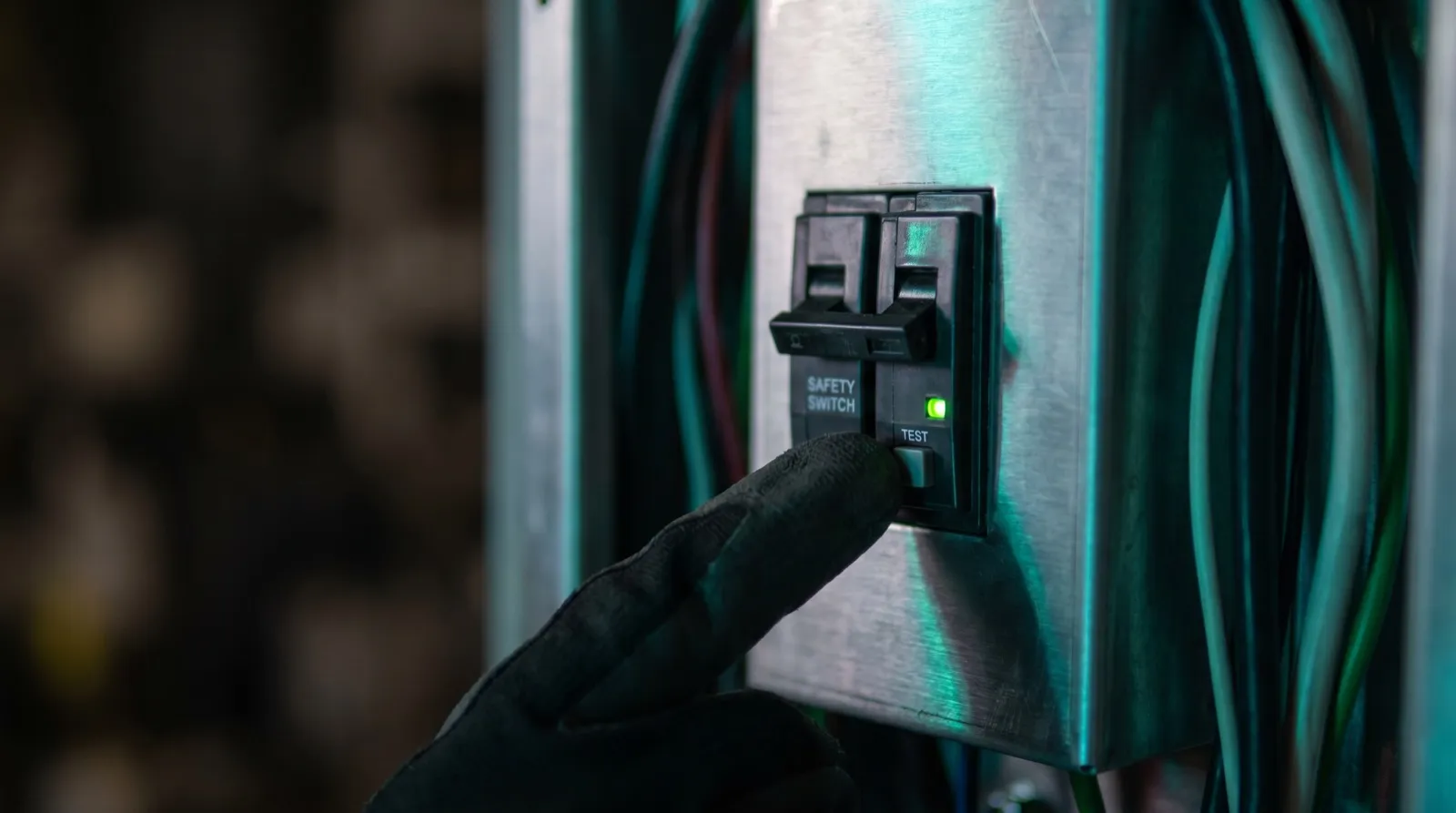
Residual current devices prevent electrocution by detecting earth leakage in milliseconds — but only if they are correctly installed, regularly tested, and matched to the circuits they protect.
Each year in Australia, around 15 to 20 people die from electrical accidents and several thousand are hospitalised with shock injuries. A significant proportion of those deaths and injuries involve circuits that lacked residual current device (RCD) protection. An RCD — also called a safety switch — monitors the difference between the current flowing out on the active conductor and the current returning on the neutral. When that difference exceeds 30 milliamps (the threshold at which cardiac fibrillation becomes a real risk), the RCD opens the circuit within 300 milliseconds. At that speed, a person in contact with a live fault will feel a significant shock but is extremely unlikely to suffer cardiac arrest or fatal burns.
How an RCD Works
Inside an RCD is a toroidal transformer through which both the active and neutral conductors pass. Under normal conditions, the magnetic fields generated by current flowing out on the active and back on the neutral cancel each other, and the resultant flux in the toroid is zero. When earth leakage occurs — current finding a path to earth through a person, a faulty appliance, or degraded insulation — the current balance is disturbed. The toroid detects the residual flux, trips the solenoid, and opens the circuit.
The 30 mA trip threshold specified in AS/NZS 3000 for general-purpose socket outlet protection is not arbitrary. It is derived from IEC 60479 (effects of current on human beings), which establishes that currents below 30 mA through the chest are unlikely to cause ventricular fibrillation in a healthy adult. Some specialist applications — operating theatres, for instance — use 10 mA RCDs for additional protection. Standard residential and commercial installations use 30 mA.
Types of RCDs and RCBOs
There are several RCD form factors used in Australian switchboards. The most common are:
- Type 2 (double-pole) RCD: a dedicated device that provides earth leakage protection for a group of circuits — common in older switchboard retrofits
- RCBO (Residual Current Breaker with Overload): combines a Type 2 RCD and MCB function in a single device — provides both overcurrent and earth leakage protection per individual circuit
- Type A RCD: detects both sinusoidal AC and pulsating DC residual current — required for circuits feeding switched-mode power supplies, variable-speed drives, and EV chargers
- Type F RCD: detects multi-frequency residual current including composite waveforms — specified for some EV charging equipment
- S-type (selective/time-delayed) RCD: used at the main switchboard to allow downstream RCDs to trip first, maintaining supply to unaffected circuits
The distinction between Type AC and Type A RCDs matters significantly in 2026. Type AC RCDs — which only detect sinusoidal residual current — are no longer adequate for circuits powering inverter-driven appliances. Modern heat pumps, variable-speed pool pumps, induction cooktops, and EV chargers generate DC components in their leakage current that a Type AC RCD may not detect. AS/NZS 3000:2018 already references IEC 62423 for Type F and Type B RCDs in specific applications. Installations with EV charging should be using Type A or Type F RCDs as a minimum.
Testing Your RCDs: The 6-Month Requirement
AS/NZS 3000 and most state electrical safety regulations require that RCDs be tested periodically using the test button on the device. The recommended interval is every 6 months for residential installations. The test button simulates a small earth leakage current through an internal resistor — if the device trips, it is operating. If it does not trip, the device may have failed mechanically or electronically and must be replaced immediately.
A functional test button press is not the same as a full calibration test. Calibration testing verifies that the device trips within the required 300 ms at 30 mA (or at I∆n for other rated devices) and requires a calibrated RCD tester. Licensed electricians carry these instruments as standard equipment. Commercial properties and rental premises should have full RCD calibration tests carried out during each periodic inspection, with results documented. An RCD that trips reliably on the test button but takes 450 ms to trip at rated current is compliant enough to pass a casual check but non-compliant with AS/NZS 61008 performance requirements.
Mandatory RCD Requirements in Australia
The mandatory RCD installation requirements vary by state and territory but have converged significantly since 2010. In all Australian jurisdictions, new residential construction requires RCD protection on all socket outlet circuits and all lighting circuits. Queensland, Western Australia, and the ACT have extended mandatory requirements to existing residential properties — requiring RCDs on socket outlet circuits before a property can be sold or tenanted. Other states have mandatory requirements on rental properties for socket outlet circuits as a condition of tenancy compliance.
For commercial and industrial properties, the requirements are tied to the scope of electrical work: any new circuit installed must be RCD-protected, and a complete switchboard replacement triggers full compliance with current AS/NZS 3000 requirements. If you are a commercial property owner and your main switchboard still has circuits without any RCD protection, you are operating outside the current electrical safety standards — and potentially outside your insurance coverage. A licensed electrician can carry out an RCD audit of your switchboard in under an hour and provide a written report on what is required to reach full compliance.
What to Do If Your RCD Trips
A tripping RCD is doing its job — there is genuine earth leakage on the circuit. The correct response is not to simply reset the device and move on. Identify which circuit has tripped by checking the label, unplug all appliances on that circuit, reset the RCD, and then reconnect appliances one at a time. If the RCD trips when a specific appliance is reconnected, that appliance has a leakage fault and must be repaired or discarded — do not continue using it. If the RCD trips with no appliances connected, the fault is in the fixed wiring or the device itself, and a licensed electrician should be called before the circuit is used again.
Nuisance tripping — where an RCD trips without an obvious fault — can result from cumulative leakage across a large number of appliances on a shared circuit, degraded cable insulation in older wiring, or moisture ingress in outdoor or bathroom circuits. A clamp-meter Earth Leakage Test will identify which circuit is responsible. PrismTech Electrical carries out RCD installation, testing, and fault-finding across residential, commercial, and industrial sites, and every service call includes a written test result record.