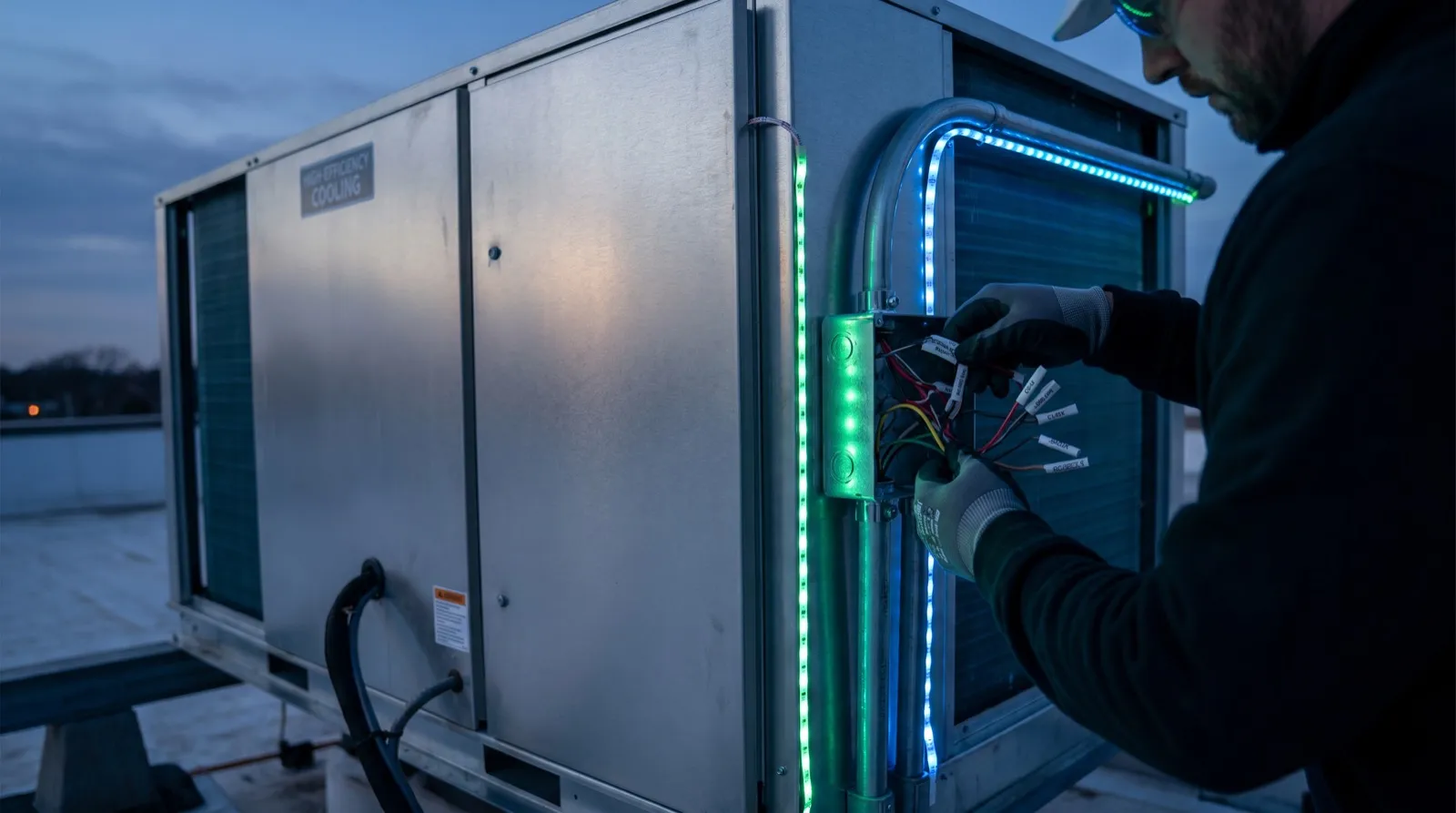
The refrigeration and mechanical side of an air conditioning installation gets most of the attention, but the electrical supply is the system's foundation — and it's where corners are most commonly cut. An undersized supply cable creates resistive heating in the conductor, accelerating insulation breakdown and increasing the risk of a wiring fault. An incorrect circuit breaker — one that trips too readily under start-up inrush current — causes nuisance tripping that stresses the compressor and shortens the unit's life. PrismTech Electrical understands the electrical demands of heating and cooling systems across the full range of residential and commercial applications, and we deliver installations that are sized right the first time.
Dedicated HVAC Circuits and Switchboard Work
Australian Standard AS/NZS 3000 (the Wiring Rules) requires that air conditioning units above a certain load be supplied by a dedicated circuit — a circuit that serves no other load. This is not simply a regulatory formality: a dedicated circuit means the unit has its own circuit breaker sized to its running current with an appropriate allowance for compressor start-up inrush, its own RCD for personal protection, and an independent path back to the switchboard that isn't shared with other loads that might cause nuisance tripping. For split systems up to 7kW, a dedicated 20A single-phase circuit from a 2.5mm² cable is generally sufficient. Systems above 7kW and ducted units of most sizes require 32A or 40A circuits with appropriately sized conductors to keep voltage drop within the 5% maximum allowed by the Wiring Rules.
Large commercial ducted systems — particularly those with scroll or inverter-driven centrifugal compressors above 15kW — operate on three-phase 400V supply and draw starting currents that can cause significant voltage disturbances on the distribution network. We coordinate with the supply authority where a new three-phase service is required and specify the correct upstream protection, cable sizing, and connection arrangements for your particular installation.
Switchboard Capacity Assessment and Upgrades
The most common issue we encounter when new HVAC systems are being commissioned into existing buildings is insufficient switchboard capacity. A domestic switchboard rated at 63A main switch with fourteen existing circuits and an already-loaded 40A hot water element has very little headroom to accept a new 32A air conditioning circuit without overloading the main switch and the incoming service fuse. We assess your switchboard capacity — the main switch rating, the incoming service fuse size, the existing connected load, and any diversity factors applicable to your occupancy — before any HVAC work begins.
- Dedicated single-phase and three-phase HVAC circuits to AS/NZS 3000
- Switchboard capacity assessment and upgrades including main switch replacements
- Inverter-compatible RCD and MCB selection to prevent nuisance tripping
- Controls and signal wiring for BMS, DDC, and zone controller integration
- Heat pump and reverse-cycle system supply including SL (signal line) wiring
- Load management and demand limiting controls for tariff optimisation
Controls Wiring and BMS Integration
Modern HVAC systems are controlled by Direct Digital Control (DDC) panels, Building Management Systems (BMS), or dedicated zone controllers, all of which require signal cabling between the controller, the indoor unit, the outdoor unit, and any remote zone sensors or thermostats. This signal wiring is distinct from the power supply wiring and requires a different skillset — correct cable type selection (shielded twisted pair for noise immunity in commercial installations), correct grounding and shielding practice to prevent interference from variable-speed drive (VSD) switching noise, and correct integration with the BMS protocol, whether that's BACnet, Modbus, or a proprietary manufacturer protocol such as Daikin D-BACS or Mitsubishi's MA Remote Controller bus.
Heat Pump and Hot Water System Electrical Supply
Heat pump hot water systems are increasingly common as a high-efficiency alternative to electric resistance storage systems, and their electrical requirements are notably different from a conventional element-heated unit. A heat pump hot water system typically draws between 10A and 18A at 240V single phase during the compressor cycle, and must be supplied by a dedicated circuit with an appropriate time-delay circuit breaker to ride through compressor start-up inrush. Many units include a demand-response controller input that allows the unit to be controlled by an energy retailer's smart grid signal or a home energy management system. We wire these control inputs as part of the installation and can integrate them with solar PV diverter controllers so the heat pump preferentially operates when excess solar generation is available, maximising self-consumption and reducing operating costs.
Frequently asked questions
Does my air conditioner need a dedicated electrical circuit?
Under AS/NZS 3000, any air conditioning unit with a total power input above approximately 1.8kW must be supplied by a dedicated circuit — one that serves only the air conditioner. Most modern split systems and all ducted systems exceed this threshold. A dedicated circuit ensures the unit has appropriate overcurrent protection sized to its starting characteristics and cannot be tripped by other loads on a shared circuit.
My new air conditioner is tripping the circuit breaker — why?
Nuisance tripping is usually caused by one of three things: an undersized circuit breaker that doesn't accommodate compressor start-up inrush current, an incompatible RCD (some older electromechanical RCDs are sensitive to the DC components in the leakage current of variable-speed inverter drives), or an overloaded shared circuit. We diagnose the specific cause and fit an inverter-compatible Type A RCD and an MCB with an appropriate breaking characteristic — typically Type D for motor loads — to resolve the issue permanently.
Can you connect my HVAC system to a Building Management System?
Yes. We install and commission controls wiring for all major BMS protocols including BACnet MS/TP, BACnet IP, Modbus RTU, and Modbus TCP. We also wire manufacturer-native controller buses for Daikin, Mitsubishi, Fujitsu, Daikin Applied, and Trane equipment. Where a BMS gateway is required to translate a proprietary protocol, we specify and commission the appropriate device and verify two-way communication with the BMS head-end before handover.
How do I know if my switchboard can handle a new air conditioning unit?
The only reliable way to determine switchboard capacity is to assess it properly — check the main switch rating, measure the actual incoming service fuse, calculate the connected load of existing circuits, and compare that to the demand of the proposed new HVAC circuit. We provide this assessment as part of our pre-installation service. If an upgrade is needed, we specify the minimum scope of work required to safely accommodate the new load rather than upselling a full switchboard replacement when it isn't necessary.