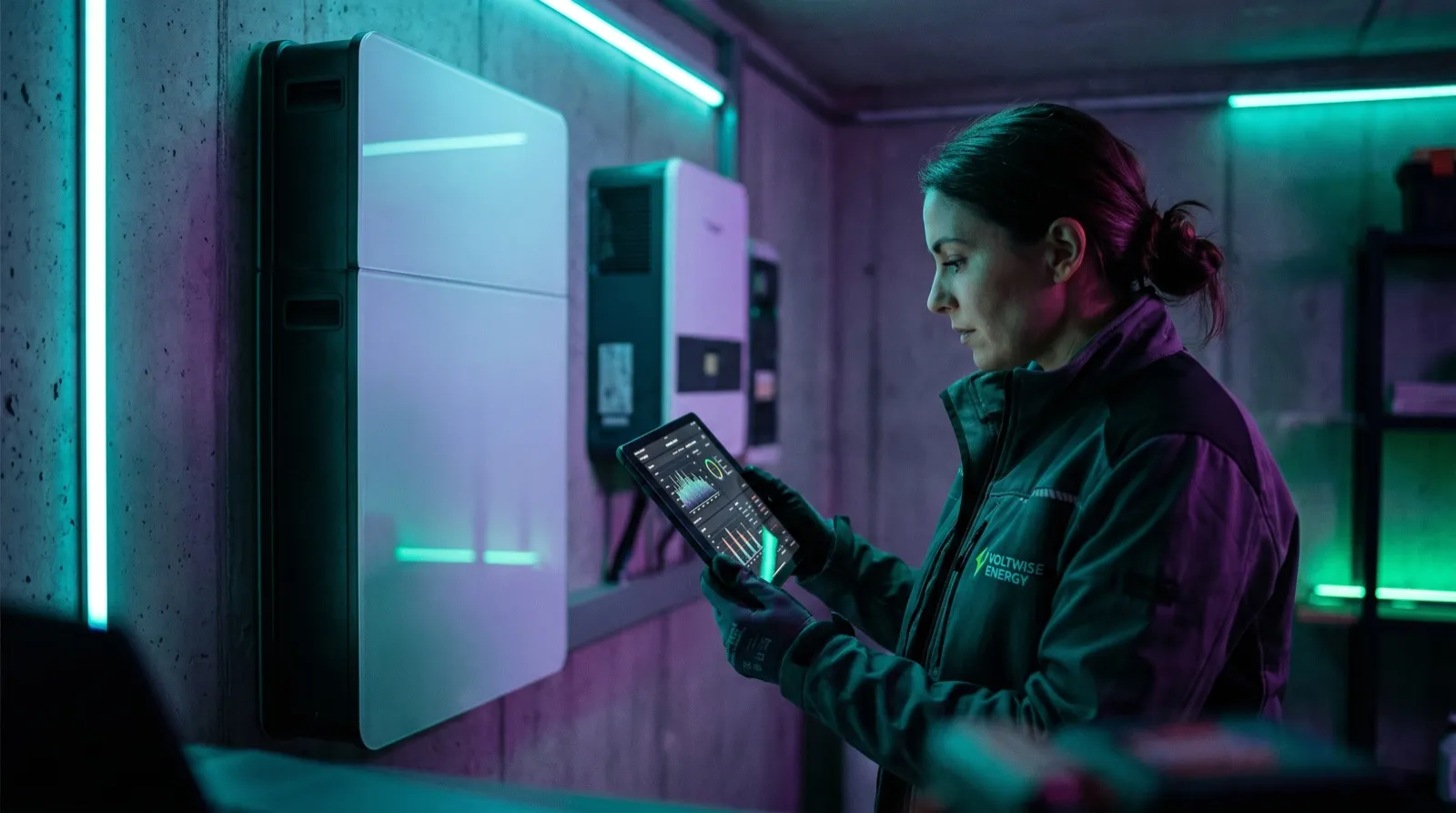
A solar and battery system is a significant electrical asset, and like all electrical infrastructure it degrades without proper maintenance. Inverter electrolytic capacitors age, DC isolators corrode under UV and moisture exposure, battery cells drift out of balance, and combiner box connections loosen under thermal cycling. The result is a system that generates less electricity than its rated capacity — sometimes significantly less — while the owner assumes it is performing normally because no fault light has illuminated. PrismTech Electrical's solar and battery maintenance service is designed to find and correct these silent losses.
Inverter Inspection and Performance Testing
The inverter is the most complex and failure-prone component in any solar system. PrismTech technicians connect to the inverter's data logging portal and compare historical generation curves against the expected output for your system size, orientation, and local irradiance data. Unexplained drops in daily generation — even those that appear as natural variation — often indicate a specific fault: a failed MPPT tracker, a degraded DC capacitor bank, an earth leakage fault, or a grid protection relay that is tripping prematurely under normal voltage conditions.
We service inverters from all major manufacturers including Fronius, SMA, Sungrow, Goodwe, Enphase, and Solar Edge. Where firmware updates are available that address known issues or improve anti-islanding performance, we apply them during the service visit. Fronius inverters with expired fan modules receive replacement fans during the service — a ten-minute procedure that extends inverter life by five or more years. All inverter work is performed under the electrician's licence required by AS 4777 grid connection standards.
Battery Storage System Maintenance: State of Health and Cell Balancing
Home battery systems — including Tesla Powerwall, Sonnen, Alpha ESS, and BYD Battery Box — contain lithium-ion cell stacks managed by a Battery Management System (BMS). The BMS monitors individual cell voltages and temperatures and balances charge distribution across the pack, but it cannot correct physical degradation caused by repeated deep cycling, high-temperature storage, or grid charge events that exceed the battery's specification. Over time, usable capacity falls below the rated figure and charge/discharge efficiency declines.
PrismTech technicians access the battery's service portal to extract State of Health (SoH) data, cycle count, and fault history. We compare actual usable capacity against the manufacturer's warranty threshold and advise on whether the system is within its warranted performance band or approaching the point where a warranty claim or capacity replacement is warranted. We also inspect the physical installation — cable connections at the battery terminals, isolator condition, ventilation clearances, and any signs of thermal stress on the enclosure — and verify that the system's grid protection settings comply with current AS 4777.2 requirements for your state.
DC Isolator Inspection, Cabling, and Array Checks
DC isolators on rooftop solar arrays are one of the most common causes of electrical fires in Australian residential buildings. Installed in outdoor environments and subjected to sustained UV radiation, heat cycling, and moisture ingress, isolators with inadequate IP ratings or substandard connector quality develop arc faults that can ignite roof materials. PrismTech inspects all rooftop DC isolators for housing integrity, contact condition, and correct labelling, and replaces non-compliant units with IP65-rated isolators that meet current AS 5033 requirements.
- Inverter data analysis, firmware update, and performance benchmarking against irradiance data
- Battery State of Health (SoH) assessment and BMS fault history review
- DC isolator inspection and replacement with AS 5033 compliant IP65 units
- Solar panel string current testing with a DC clamp meter for shading and soiling analysis
- Thermal imaging of combiner boxes, string combiners, and AC distribution boards
- AS 4777.2 grid protection relay verification and trip-point compliance check
When to Book a Solar and Battery Maintenance Inspection
Annual inspections are the industry best practice for systems more than three years old. Beyond the annual cycle, specific events should trigger an unscheduled inspection: a significant unexplained drop in monthly generation reported by your monitoring app, an inverter fault code that clears itself and recurs, a battery that is no longer reaching its full usable capacity overnight, or any physical damage to the roof or array following a storm event. Early intervention consistently costs less than emergency fault response, and catching a failing DC isolator before it arcs is categorically different to attending an electrical fire aftermath.
PrismTech issues a written inspection report after every service visit, covering the condition of each system component, any faults identified and corrected, any items requiring follow-up within the next 12 months, and the system's measured output relative to its theoretical capacity. This report is the evidence your system insurer may request following a generation shortfall claim, and the reference point for your next annual inspection comparison.
Frequently asked questions
How do I know if my solar system is underperforming?
The most reliable method is to compare your inverter's logged daily generation against the expected output for your system size and orientation using a solar irradiance tool such as the Clean Energy Council's PVWatts calculator or your inverter manufacturer's monitoring portal. A system that consistently produces 15% or more below expected output — accounting for seasonal variation — is likely experiencing a fault. Common causes include one or more failed panels, a shading obstruction that has grown since installation, a failing MPPT tracker in the inverter, or a DC isolator with increased contact resistance. PrismTech's maintenance inspection identifies the specific cause rather than speculating.
Can PrismTech service any brand of inverter or battery?
We service all major inverter brands sold in the Australian market, including Fronius, SMA, Sungrow, Goodwe, Enphase, SolarEdge, ABB, and Delta. For battery systems, we work with Tesla Powerwall, Sonnen, Alpha ESS, BYD Battery Box, Sungrow SBR, and Enphase IQ Battery, among others. Where a fault requires manufacturer-specific replacement parts or a warranty return, we manage the process with the manufacturer on your behalf. Our technicians carry common inverter consumables — fans, DC fuses, and terminal blocks — in their vehicles for same-day resolution of minor faults.
Is it safe to have rooftop DC isolators on my solar system?
Rooftop DC isolators installed under earlier versions of Australian standards used connector designs and enclosure ratings that have since been identified as inadequate for sustained outdoor exposure. Standards changes following a series of rooftop electrical fires have resulted in stricter IP rating and connector quality requirements under AS 5033. If your system was installed before 2012, or if you have not had the isolators inspected in the past three years, we strongly recommend an inspection. We assess the isolators' current condition and replace non-compliant units with IP65-rated alternatives where required.
Does my battery warranty cover capacity degradation?
Most residential battery warranties include a capacity retention guarantee — typically 70% of original nameplate capacity at the end of the warranty period, which ranges from 10 to 15 years depending on the manufacturer. If your battery falls below the warranted retention threshold before the warranty expiry, the manufacturer is obligated to repair or replace it. However, claiming under a capacity warranty requires documented State of Health data extracted from the BMS at the time of the fault, not an estimate. PrismTech's maintenance inspection provides this documentation, and we assist with the warranty lodgement process where a claim is warranted.