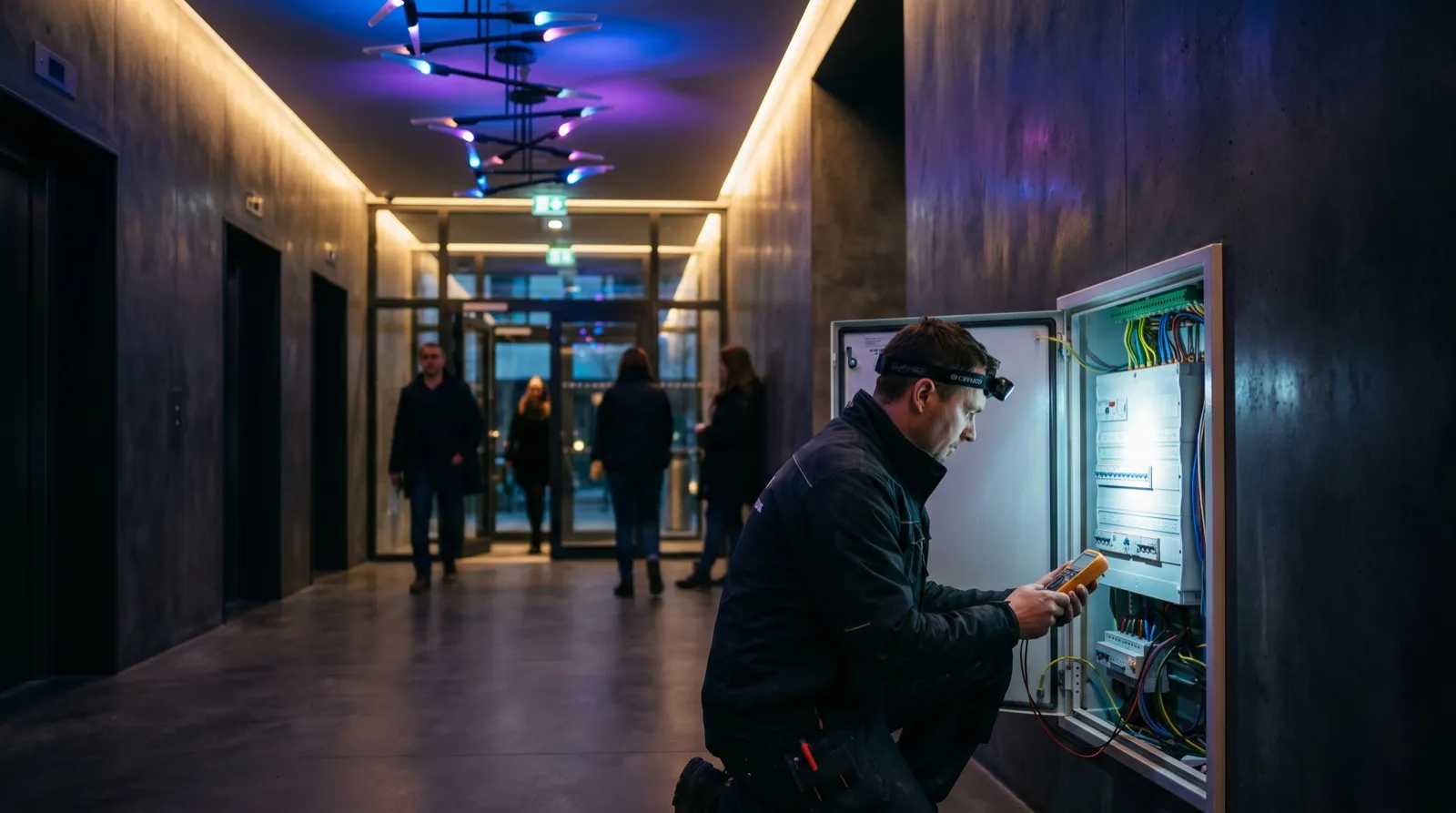
The electrical infrastructure of a strata scheme is among the most complex ongoing maintenance obligations a body corporate faces. Common-area lighting in car parks, corridors, lobbies, and stairwells must remain operational and safe at all hours. RCDs protecting common-area circuits must be tested regularly to verify they will operate within the trip parameters required by AS/NZS 3000. Emergency and exit lighting must be tested in accordance with AS/NZS 2293.2 to satisfy the requirements of the National Construction Code and the relevant state fire safety legislation. Switchboards serving common areas must be maintained in a condition that would satisfy an electrical inspector, with all circuits labelled, all covers in place, and no evidence of thermal damage or overloaded connections. The body corporate cannot outsource its legal duty of care in relation to these obligations — but it can engage a qualified electrical contractor to fulfil them on its behalf, systematically and with full documentation.
Common-Area Lighting Maintenance
Common-area lighting failures are among the most frequent maintenance calls in any strata scheme and, if left unaddressed, represent a genuine safety and liability risk. A failed luminaire in a stairwell or basement car park creates a foreseeable hazard that a body corporate has a duty to address promptly. PrismTech Electrical's strata maintenance agreements include scheduled lamp replacement and luminaire inspection visits that address relamping proactively — before failures occur — reducing reactive call-out costs and ensuring consistent illuminance levels are maintained throughout. Where the existing luminaire stock is aging fluorescent or HID technology, we will assess the financial case for a conversion to LED, which typically delivers a material reduction in both energy costs and ongoing maintenance frequency given LED's extended service life.
For outdoor and car park lighting, we maintain photocell and timer switching controls, inspect and clean luminaire housings for moisture ingress, and verify that illuminance levels in car parks and pedestrian areas meet the requirements of AS/NZS 1158 for the applicable road and pedestrian area classification. In properties with automatic car parking systems, access gates, and EV charging infrastructure, we extend maintenance coverage to the electrical components of those systems as part of an integrated property electrical agreement.
Switchboard Maintenance and RCD Testing
Common-area switchboards in strata schemes accumulate decades of incremental additions — individual lot submains, common facility circuits, communications cables, and emergency system wiring — that can leave the board in a condition that is difficult to maintain and impossible to fault-find efficiently. Our switchboard maintenance service includes a visual inspection under safe working conditions, thermal imaging to identify hot connections before they fail, verification that all circuits are correctly labelled and that labelling matches the as-built drawings on file, and testing of all RCDs on common-area circuits to verify trip times comply with AS/NZS 3000 requirements. Where a switchboard presents safety concerns — exposed live conductors, absent circuit breaker blanks, deteriorated busbars, or evidence of water ingress — we document the non-conformances and provide a remediation scope with compliant timeline recommendations for the body corporate's records.
- Common-area luminaire inspection, relamping, and LED conversion assessments
- AS/NZS 2293.2 emergency and exit lighting six-monthly and annual testing
- RCD trip-time testing on all common-area safety switches to AS/NZS 3000
- Switchboard thermal imaging and visual compliance inspections
- Car park and outdoor lighting maintenance to AS/NZS 1158
- Priority emergency response for contract strata clients, with 90-minute metro target
Emergency and Exit Lighting Compliance
Emergency and exit lighting is a life-safety system governed by AS/NZS 2293.2, which mandates a 90-minute duration test annually and a functional test every six months. The consequence of a failed emergency lighting system during an actual evacuation is potentially catastrophic, and the consequence for a building owner or strata committee of a non-compliant system identified during a fire audit can include prohibition notices and significant remediation costs. PrismTech Electrical conducts six-monthly functional tests and annual duration tests, documents results against each luminaire's unique identifier, replaces batteries and globes as required, and issues a compliance report that satisfies the requirements of fire safety statements and building certification records. We maintain a test schedule for each property and send reminders when tests are due, removing the obligation to track compliance calendars from the strata manager's workload.
Maintenance Agreements and Portfolio Management
For strata managers and real estate agencies managing portfolios of multiple properties, PrismTech Electrical offers consolidated maintenance agreements that cover all properties under a single commercial arrangement. Fixed monthly pricing for scheduled maintenance visits eliminates budget variability; included priority emergency response with defined SLA response times ensures reactive calls are handled without delay; and a single consolidated compliance register for all properties in the portfolio provides the documentation needed for annual general meetings, building certifier audits, and insurance reviews. Our account managers work directly with your strata management software where integration is available, raising and closing work orders within your existing workflow rather than creating a parallel administrative process. We issue Certificates of Electrical Safety for all notifiable electrical work performed under the agreement, maintaining the complete compliance record the body corporate requires.
Frequently asked questions
What electrical obligations does a body corporate have under strata legislation?
The body corporate is responsible for maintaining common property — including all electrical infrastructure serving common areas — in a state of good repair and safe condition. This includes common-area wiring, switchboards, lighting, RCDs, emergency and exit lighting, and any electrical components of common-area equipment such as lifts, car park systems, and pool plant. Failure to maintain these systems creates liability exposure and can result in WorkSafe or electrical safety regulator intervention. Our maintenance agreement is specifically structured to satisfy these obligations with documented compliance records.
How often should common-area RCDs be tested in a strata property?
AS/NZS 3000 recommends that RCDs be tested at regular intervals, with three-monthly push-button functional testing by the owner or occupier and annual or biannual trip-time testing by a licensed electrician using calibrated test equipment. For strata properties, we recommend biannual RCD trip-time testing as part of a scheduled maintenance visit, combined with a switchboard inspection. This frequency satisfies most insurance policy requirements and provides a documented record of due diligence for the body corporate's compliance file.
Can you handle emergency call-outs for common areas as well as scheduled maintenance?
Yes. All of our strata maintenance agreements include priority emergency response for common-area electrical faults — a failed car park lighting circuit, a common-area RCD that will not reset, or a switchboard fault affecting multiple lots. Contract clients are dispatched ahead of general call-out queue, with a 90-minute metropolitan response target after-hours. Emergency work is invoiced at agreed contract rates, not standard after-hours call-out pricing, providing budget certainty for the body corporate.
Do we need a Certificate of Electrical Safety for maintenance work on common areas?
A Certificate of Electrical Safety (CES) is required for all notifiable electrical work in New South Wales and most other Australian states — which includes any new wiring, switchboard work, installation of new fittings, or replacement of electrical equipment in the fixed installation. Routine relamping and non-electrical maintenance does not require a CES, but any work involving the switchboard, new circuits, or the addition or replacement of permanently wired fittings does. PrismTech Electrical issues a CES for all applicable work performed under our maintenance agreements, and we retain copies in your property compliance file for audit purposes.