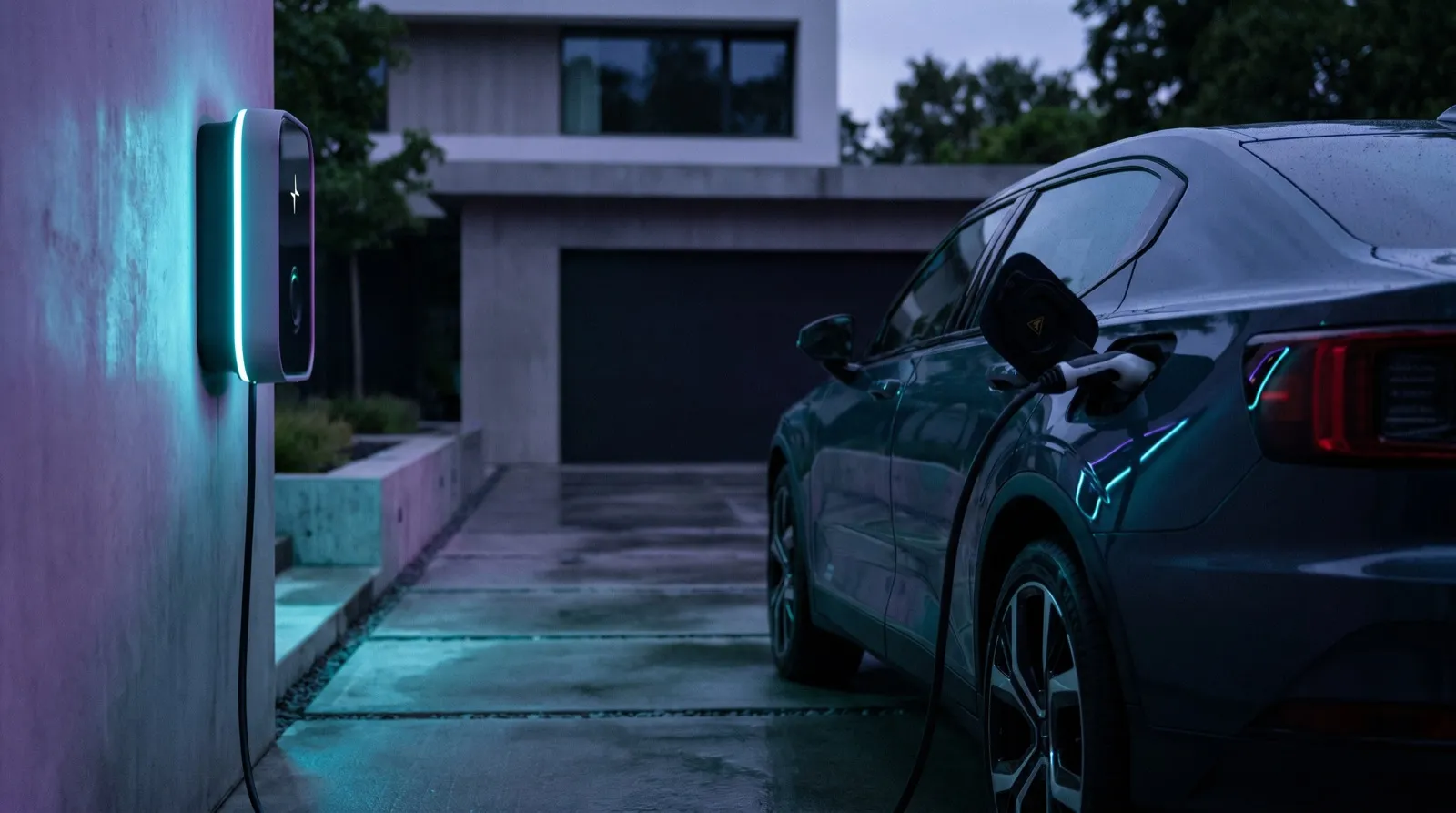
A properly installed home EV charger does far more than top up a battery overnight — it protects your vehicle warranty, controls energy costs, and future-proofs your home for the decade ahead.
Australia now has more than 250,000 fully electric vehicles on the road, with registrations growing faster than any other vehicle category. The overwhelming majority of EV charging — industry data consistently puts it at 80% or higher — happens at home, overnight, using the vehicle's AC on-board charger. That makes the home charging installation one of the most consequential electrical decisions an EV owner makes. A substandard installation does not just slow your charging speed: it can void vehicle warranties, create persistent earth leakage, and produce nuisance RCD trips that are frustratingly difficult to diagnose without the right test equipment.
Understanding Charging Levels
EV charging is divided into three levels. Level 1 is a standard 10-amp GPO — it delivers approximately 2.4 kW and charges most vehicles at around 15 km of range per hour. This is adequate for plug-in hybrids and light daily drivers but impractical for a pure BEV with a 70 kWh+ battery pack. Level 2 is AC charging through a dedicated EVSE (Electric Vehicle Supply Equipment) — also called a wall box — operating on a 32-amp single-phase or three-phase circuit, delivering 7.2 kW (single-phase) to 22 kW (three-phase 32A). Level 3 is DC fast charging, which bypasses the vehicle's on-board charger entirely — this is the province of commercial charging stations and is rarely installed residentially due to cost and network connection requirements.
For most Australian homes, a 7.2 kW single-phase Level 2 wall box on a dedicated 32-amp circuit is the correct starting point. At 7.2 kW, a 70 kWh battery charges from 20% to 80% in approximately 6 hours — overnight on a time-of-use tariff. If your property already has three-phase supply, a 22 kW wall box adds marginal installation cost and dramatically reduces charge time for large-battery vehicles, while also enabling future load balancing across three phases.
What the Electrical Installation Actually Involves
Installing a home EV charger is notifiable electrical work in every Australian state and territory — it must be carried out by a licensed electrician and, in most jurisdictions, a certificate of compliance issued. The work involves more than running a cable from the switchboard to the garage. A proper installation under AS/NZS 3000 includes a load assessment of the existing service, switchboard capacity review, correct cable sizing for the continuous duty cycle (EV chargers run at sustained current for hours), a dedicated Type A or Type F RCBO, and an earthing assessment.
Cable sizing for EV chargers requires particular attention because the continuous current rating — not the short-term rating — applies. A 32-amp circuit powering a 7.2 kW charger must use cable with a continuous current rating of at least 32A, derated for conduit grouping, installation method, and ambient temperature. The AS/NZS 3000 Appendix C load calculation must demonstrate that the switchboard's main fuse or circuit breaker can carry the existing connected load plus the EV charger load without sustained overcurrent.
- Switchboard capacity assessment — confirm the main fuse/breaker can carry the additional continuous load
- Dedicated circuit — the EV charger must never share a circuit with other loads
- Cable sizing — minimum 6mm² copper for 32A single-phase runs, derated for installation conditions
- Type A or Type F RCBO — standard Type AC RCDs are inadequate for EV charger circuits
- Earthing — bonding of the EVSE enclosure and, where applicable, the vehicle earth stake
- Cable protection — conduit or armoured cable for any exposed outdoor runs
- Smart charger configuration — load balancing, scheduled charging, solar self-consumption settings
Choosing the Right Wall Box
The Australian market now carries dozens of EVSE brands, ranging from $400 no-name imports to $2,500 smart units from established manufacturers. The critical minimum requirement is that the unit carries an RCM (Regulatory Compliance Mark) — this indicates conformance testing to the relevant Australian standards. Beyond compliance, the features worth paying for in 2026 are: smart scheduling (charge during off-peak tariff windows), solar self-consumption mode (ramp up charging when excess solar is available), load management (cap total draw to prevent tripping the main fuse), and Wi-Fi or cellular monitoring.
Brands with strong Australian service networks include Wallbox, Zappi (myenergi), EVNEX, and JET Charge's branded units. If you have solar panels, the Zappi and Wallbox Quasar series both have sophisticated solar-boosting modes that can significantly reduce the cost of charging a 70 kWh battery. PrismTech Electrical is charger-brand agnostic and configures smart units during installation to suit your tariff structure and solar setup.
Load Management and Grid Tariffs
The biggest misconception about home EV charging is that it necessarily adds a large amount to the electricity bill. Properly managed, it adds very little. An EV travelling 15,000 km per year consumes approximately 3,000 kWh. At a time-of-use off-peak rate of $0.12/kWh (available on most major Australian network tariffs between 10 pm and 7 am), that is $360 per year — roughly the cost of 600 litres of petrol at $1.20 per litre. A smart charger that is programmed to only charge during off-peak windows pays for its premium cost over a base timer-only unit within the first year for most drivers.
For properties with rooftop solar, the calculus is even more favourable. Charging during the middle of the day when solar export would otherwise be curtailed or earn minimal feed-in tariff can effectively reduce the cost of EV charging to near zero. Solar self-consumption modes in smart chargers work by monitoring the CT clamp on the solar inverter's export circuit and ramping the EV charger up or down in 1-amp increments to absorb available generation without drawing from the grid.
Future-Proofing Your Installation
If you are installing a single EV charger today, spend a little extra to install the infrastructure for a second. Running a second conduit to the garage or carport while the walls are open costs almost nothing compared to a future re-run. The number of multi-vehicle households with two EVs is growing rapidly, and the cost of a second installation done from scratch is typically $800 to $1,500 for labour alone — avoidable with a single run of spare conduit now.
Also consider bidirectional charging (V2H — vehicle to home, or V2G — vehicle to grid). A small number of vehicles available in Australia in 2026 support bidirectional AC charging — the Nissan Leaf with CHAdeMO and the newly launched Mitsubishi Outlander PHEV Gen 3. The infrastructure requirements for bidirectional include a grid-forming capable EVSE and, for V2G, a network service provider agreement. This technology will be mainstream within 3 to 5 years. Installing a 63-amp-capable circuit and conduit now means you will not need a complete re-run when V2H-capable hardware becomes the standard.