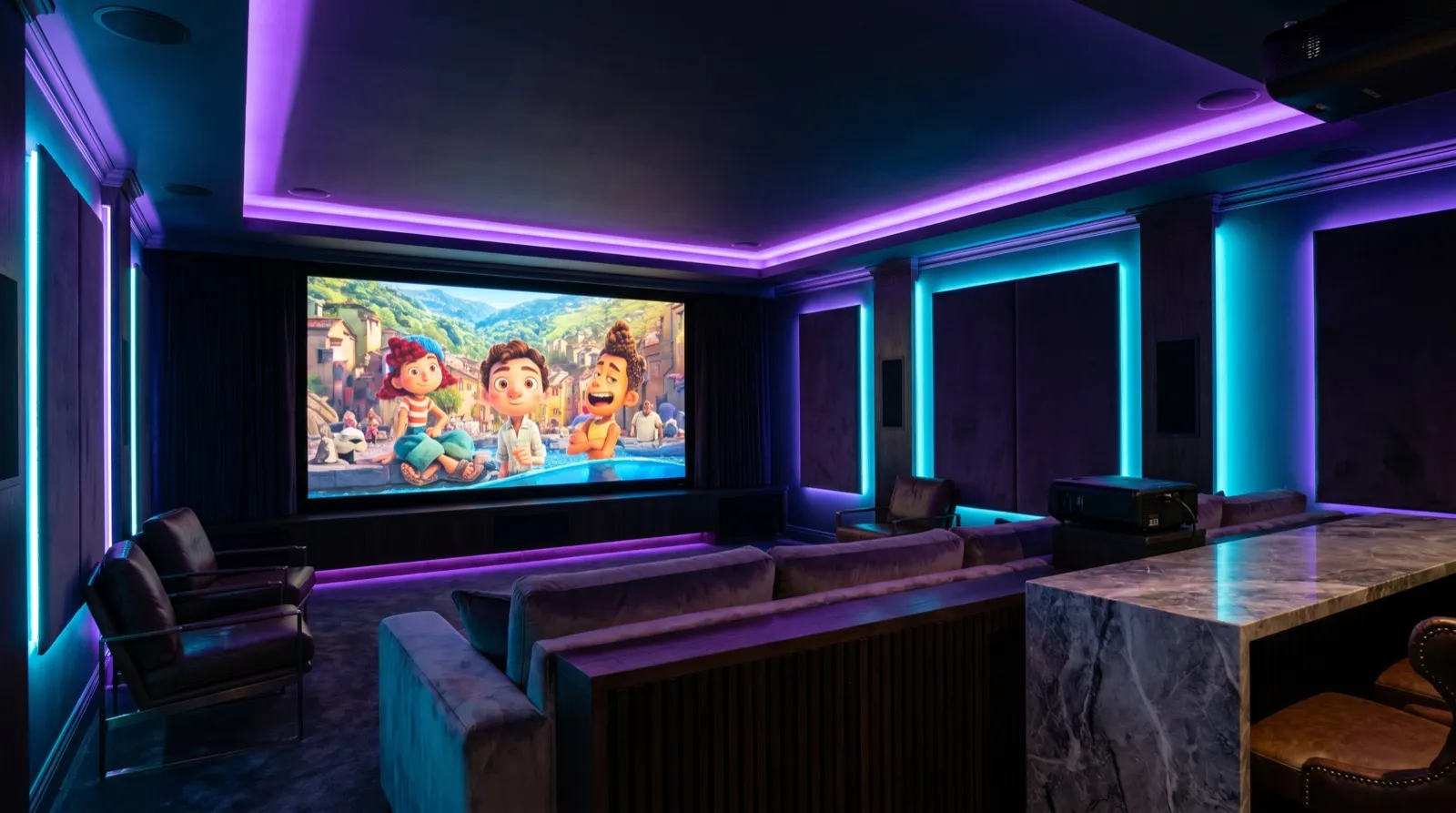
The gap between a home theatre that impresses and one that frustrates is almost entirely a planning problem. Screen gain versus ambient light, projector throw ratio versus room depth, subwoofer placement and room modal response, in-wall speaker position versus listening axis — every one of these variables interacts with the others, and getting them right requires a systems-level approach before a single hole is cut in the wall. PrismTech Electrical takes that systems-level approach as the foundation of every AV installation we design and build.
Dedicated Home Cinema Room Design
A dedicated cinema room starts with the room itself. We assess the dimensions, the construction type (stud frame, masonry, concrete slab), the existing HVAC arrangement, and the natural light sources before recommending any product. Room modes — the frequencies at which a rectangular room resonates — can create severe bass peaks and nulls that no amount of subwoofer adjustment can fully correct, so where a room choice is still available we advise on the dimensions that will produce the most acoustically neutral starting point.
For projection, we calculate the throw ratio required to achieve your target screen width from the available projector position, and then specify a projector with a lens zoom range that covers that throw with headroom for adjustment. Current 4K laser projectors from JVC, Sony, and Epson offer 10-bit HDR processing, lens memory for multiple aspect ratios, and native contrast ratios that make an enormous perceptible difference compared to DLP lamp-based projectors at similar price points. For rooms where a screen isn't feasible, we specify large-format direct-view OLED or MiniLED panels from 77 to 110 inches with native HDMI 2.1 inputs supporting 4K 120Hz and 8K 60Hz source material.
Dolby Atmos and Surround Sound Installation
Dolby Atmos moves beyond the channel-based surround formats of the previous generation by placing audio objects in three-dimensional space, including overhead. A 7.1.4 layout — seven surround channels, one subwoofer, four overhead Atmos channels — is the reference configuration for a dedicated cinema room and delivers a fully enveloping object-based audio field. We specify and install in-wall LCR (left, centre, right) speakers from manufacturers including Klipsch, KEF, Sonance, and Monitor Audio, with flush-mounted grilles that disappear into the wall finish. Overhead Atmos channels are installed as in-ceiling speakers angled toward the primary listening position, never as upward-firing add-on modules that compromise the overhead imaging.
- 4K and 8K projection with anamorphic lens and motorised screen options
- 7.1.4 Dolby Atmos and DTS:X in-wall and in-ceiling speaker layouts
- HDMI 2.1 48Gbps backbone cabling for 4K 120Hz and 8K source routing
- Acoustic treatment panels, bass traps, and diffusers integrated into room design
- Dedicated 20A mains circuits for projector, AV processor, and amplification
- Control4, Crestron, or Lutron integration for single-touch scene activation
In-Wall AV Cabling and Infrastructure
The cabling infrastructure of a home theatre needs to be planned before any wall or ceiling linings are installed — retrofitting AV cabling into a finished room is expensive, disruptive, and compromising. We install HDMI 2.1 cables rated for 48Gbps bandwidth — capable of carrying 4K at 120Hz, 8K at 60Hz, and variable refresh rate signals from the latest gaming consoles and PC sources. Cat6A is used for IP-based matrix switchers and AV-over-IP distribution. Speaker cables are run in-wall in conduit so they can be replaced without opening walls if technology changes. A dedicated four-GPO 20-amp mains circuit supplies the projector and AV processor, isolated from lighting circuits to eliminate potential dimmer interference.
Multi-Room Audio Systems
Beyond the dedicated cinema room, whole-home audio gives you control of music, podcasts, and streaming content in every room from a single app. We install distributed audio systems based on Sonos, Denon HEOS, or Russound platforms, with in-ceiling speakers in kitchens, bathrooms, alfresco areas, and bedrooms individually configured to the acoustic characteristics of each space. Volume controls are either app-based or physical keypads at each zone. Where a new build or major renovation is underway, we install Cat6A and speaker cable to every zone simultaneously during the rough-in phase, even if speakers aren't fitted immediately — the cost of running cable through open walls is a fraction of what it costs to retrofit later.
Frequently asked questions
What is the minimum room size suitable for a dedicated home theatre projector setup?
A comfortable dedicated cinema room for a 2.35:1 scope screen requires a minimum room depth of around 5.5 metres from screen to the rear wall, with a screen width of 2.4 to 3.0 metres being typical in that depth. Rooms shallower than 4 metres generally suit a large-format direct-view TV rather than a projector. We calculate throw ratio requirements for your specific room dimensions and recommend accordingly.
What is Dolby Atmos and do I need a dedicated room to enjoy it?
Dolby Atmos is an object-based audio format where sounds are placed as three-dimensional objects in a hemisphere around the listener, including overhead. A dedicated room with in-ceiling speakers delivers the reference Atmos experience. However, Atmos can also be enjoyed in a living room using an AV receiver with Atmos-enabled upward-firing speaker modules or a premium soundbar with overhead driver arrays — the experience is less precise spatially but still significantly better than standard 5.1 surround.
Do you integrate home theatre systems with smart home platforms like Control4 or Crestron?
Yes. We program Control4, Crestron, and Lutron-based control systems to deliver single-button scene activation for your home theatre — press "Movie Night" and the screen drops, the lights dim to a pre-set level, the projector warms up, and the AV processor switches to your preferred source. We also configure Sonos and Apple HomeKit integrations for clients who prefer an app-based approach without dedicated control processors.
Can AV cabling be retrofitted into a finished home?
Yes, though it requires more planning and labour than a new-build install. We use flexible fish rods and borescope cameras to navigate wall cavities, and identify optimal routing paths through ceiling space, wardrobes, and built-in joinery to minimise visible surface conduit. HDMI cables can be run through existing 25mm conduit where it's already in place, and HDMI-over-Cat6A extenders allow longer runs via existing data cabling infrastructure. The scope and cost depend heavily on wall construction type and the presence of fire-stopping elements.