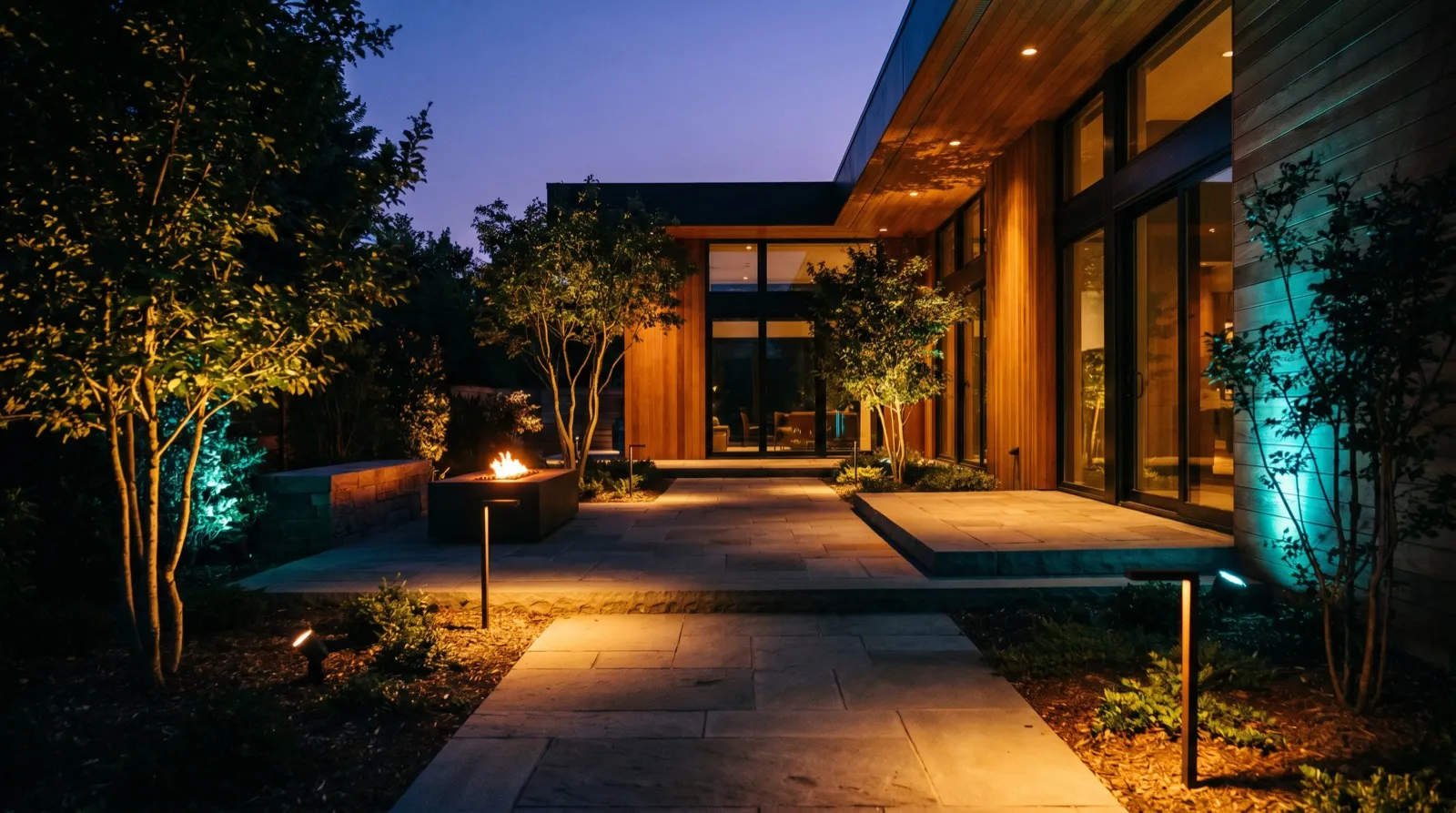
The difference between an outdoor lighting installation that transforms a property and one that simply plugs in a few garden spikes is design intent. Understanding how light behaves at night — where it spills, how far it throws, how it silhouettes a tree or washes a stone wall — requires a different eye than interior lighting. PrismTech Electrical's outdoor lighting work begins with a dusk-time site visit, not a daytime inspection. We look at your property the way a guest arriving after dark will experience it, and we design the scheme from that perspective.
Facade and Architectural Uplighting
Uplighting a building facade is one of the highest-impact investments in exterior lighting. A well-aimed LED uplight positioned at the base of a rendered wall, a stone colonnade, or a feature timber screen transforms a daytime first impression into a dramatic evening presence. We use narrow-beam (8–15°) and medium-beam (25–40°) LED uplights with separate aiming and locking mechanisms so the beam direction can be set precisely and won't shift over time from wind or mowing activity. For rendered or light-coloured facades, we specify warm white (2700K–3000K) sources that complement natural materials. For contemporary architecture with grey concrete, charcoal cladding, or Corten steel, a slightly cooler 3500K or 4000K source makes a cleaner statement.
All facade uplights installed in the ground carry a minimum IP67 ingress protection rating — fully dust-tight and able to withstand temporary immersion in water. In coastal environments with salt-laden air, we specify marine-grade stainless steel bezels or fibreglass housings in lieu of standard aluminium to prevent corrosion and maintain appearance over a 10-year service life. Where an uplight is installed in a lawn or garden bed that is regularly irrigated, we use fittings with an IK08 impact rating to resist lawnmower strikes.
Path, Step, and Safety Lighting
Path lighting performs a functional role — guiding movement, revealing changes in level, and preventing trips on uneven surfaces — but it should do so without overwhelming the overall lighting composition. We typically specify low-profile bollard fixtures at 300–400mm height with an asymmetric beam that directs light downward onto the path surface rather than glaring outward at eye level. Step risers and retaining wall tops are lit with compact recessed brick or step lights that provide clear definition of the edge without creating a runway effect. All path and step lights in domestic installations are supplied via a 12-volt low-voltage transformer with built-in overload protection, which eliminates shock risk in wet garden conditions and simplifies future maintenance.
- IP67 in-ground and surface-mount LED uplights for trees and facades
- 12V low-voltage path and step lighting with transformer protection
- RGBW colour-changing feature lighting for pools, water features, and entertainment areas
- Motion-activated LED floodlights with adjustable sensitivity and hold time
- Smart landscape lighting controllers with app-based scheduling and scene control
- Marine-grade stainless and fibreglass fixtures for coastal properties
Feature, Pool, and Entertainment Area Lighting
Feature lighting for pools, water features, pergolas, and outdoor entertaining areas demands careful integration between the lighting design, the landscape architecture, and the electrical infrastructure. Underwater pool lights must be installed to AS/NZS 3000 safety zone requirements, supplied from an isolating transformer with a maximum output of 12V AC or 50V DC, and protected by an RCD on the supply circuit. We work with pool builders and landscapers to position conduit and junction boxes during construction, avoiding expensive saw-cutting of paving after the fact.
Security and Deterrence Lighting
Security lighting is most effective when it provides consistent baseline illumination rather than relying solely on motion-activated floodlights that can desensitise occupants to triggers. We design a layered approach: low-level perimeter lighting that removes shadow zones where intruders might conceal themselves, combined with PIR-activated high-lumen floodlights at key entry points that create a startle effect and activate recording on IP camera systems. All security floodlights are specified with a colour temperature of 4000K or above, which improves camera image quality compared to warmer sources. Smart-enabled floodlights can be integrated with home automation platforms so you receive a push notification the moment a light activates.
Frequently asked questions
What IP rating do outdoor light fittings need to have?
Australian Standards AS/NZS 60529 defines IP (Ingress Protection) ratings for electrical equipment. In-ground fittings must be rated IP67 as a minimum — dust-tight and resistant to temporary immersion. Wall-mounted exterior fittings in sheltered positions require at least IP44. Fittings in exposed positions subject to direct rain or spray should be IP65 or better. Underwater fittings must comply with additional safety zone requirements under AS/NZS 3000.
Is low-voltage 12V garden lighting safer than 240V?
Yes, significantly. A 12-volt system eliminates the risk of fatal electric shock in wet garden conditions, and the low-voltage wiring is not subject to the same burial depth requirements as mains-voltage cable. The trade-off is that 12V systems are limited in how far the cable can run before voltage drop affects light output — we calculate the maximum cable run for each transformer and luminaire combination to ensure consistent brightness across the installation.
Can my outdoor lights be controlled via a smartphone app?
Yes. We install smart landscape lighting controllers — such as those from the Philips Hue outdoor range, Casambi, or a custom relay-based smart switch — that connect to your home Wi-Fi and allow scheduling, scene selection, and on/off control from a smartphone app. Motion sensor inputs can also be integrated so you receive an alert when security lighting activates.
How do you manage outdoor lighting in coastal salt air environments?
Salt-laden coastal air corrodes standard aluminium and zinc die-cast fittings within a few years. For coastal properties, we specify marine-grade 316 stainless steel bezels, glass lenses rather than polycarbonate diffusers (which yellow under UV), and powder-coated aluminium bodies treated with a sealer. We also recommend annual inspection and cleaning of fixture bodies and terminal connections to maximise service life.