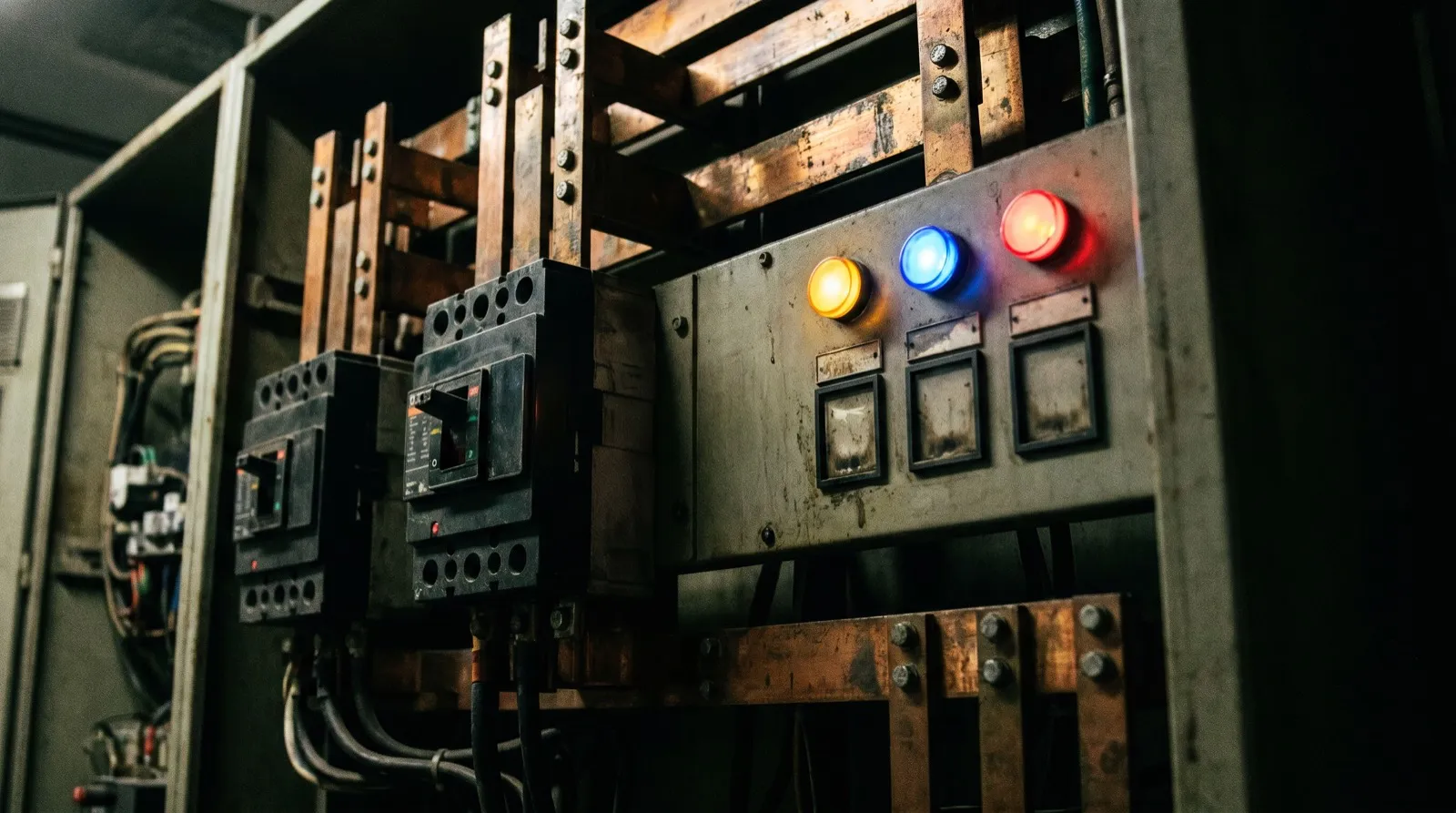
Ask most people what comes out of a power point and they will say 240 volts, and they will be right — for a kettle. But the moment you put a three-phase motor, a CNC machine, a lift, a chiller or a welding bay into a building, single-phase stops being an option. Heavy loads live on three-phase 415V power for reasons that are not marketing — they are physics. This is a field guide to why, written for the people who have to specify, install and stand behind the switchboard.
One phase versus three
A single-phase supply delivers power in pulses — the voltage swings positive, crosses zero, swings negative, and crosses zero again, one hundred times a second. For a heating element that is fine; for a motor it means torque that arrives in lumps. A three-phase supply runs three of those waveforms offset by 120 degrees, so at any instant at least one phase is delivering. The result is continuous, overlapping power delivery: smoother torque, smaller conductors for the same power, and motors that start under load without stalling.
In Australian distribution the three phases sit at 400–415V between phases and around 230–240V from any phase to neutral. That is the same network — a three-phase supply is simply all three legs brought into the building instead of one. A heavy site uses the 415V between phases to drive its plant, and taps single-phase off individual legs for lighting and power circuits.
Why three-phase wins for heavy plant
The advantages compound the larger the load gets, which is exactly why you never see a serious industrial site running on single-phase.
- Higher power in the same copper — three-phase delivers more kilowatts per amp, so cables, switchgear and busbars run smaller and cheaper for the same duty.
- Smooth, self-starting motor torque — three-phase induction motors start under load and run cooler, the workhorse of every factory in the country.
- Balanced loading — spread across three legs, the supply draws evenly from the network instead of hammering one phase.
- Headroom for automation — VSDs, soft starters and motor control centres are all engineered around a three-phase feed.
- Future capacity — once 415V is in the board, adding plant is a breaker and a cable run, not a network upgrade.
Single-phase powers a building. Three-phase powers what the building does for a living.
Where designs go wrong
The failures we are called to fix are rarely about the motor — they are about the infrastructure feeding it. Undersized sub-mains that sag under starting current. Switchboards with a fault rating below the network's available fault level, which means the gear cannot safely clear a short. Phase imbalance from sloppy circuit allocation that overheats one leg while the others idle. Power factor left uncorrected, so the site pays for reactive power it never uses as work. None of these show up on day one. They show up in year three as nuisance trips, failed equipment and a power bill nobody can explain.
Build it for the duty, not the nameplate
A three-phase installation is sized against the worst case the plant will ever throw at it: simultaneous motor starts, harmonic distortion from variable speed drives, future expansion, and the network's prospective fault current. Ironclad designs to AS/NZS 3000 and the relevant equipment standards, verifies fault ratings against the actual supply, and builds switchboards with the headroom a working site needs. Get the infrastructure right and the plant simply runs. Get it wrong and you spend the asset's life paying for the shortcut. If you are putting heavy load into a building, bring us in before the board is specified — that is where the money is won or lost.