Residual-current devices (RCDs), commonly called safety switches in Australia, are arguably the single most effective passive safety technology in an electrical installation. Their operating principle is elegantly simple: they continuously compare the current flowing out on the active conductor with the current returning on the neutral conductor. Under normal conditions these are equal. When a person touches a live conductor and current flows through their body to earth — bypassing the neutral return path — the RCD detects the imbalance and interrupts the circuit within milliseconds. A standard 30 mA Type AC RCD is required in Australian domestic and commercial installations by AS/NZS 3000:2018 and must disconnect within 300 milliseconds at rated differential current, with a hard limit of 40 milliseconds at five times that current (150 mA). Understanding why the 30 mA threshold exists requires a brief excursion into human physiology.
The Physiology of Electric Shock: Why 30 mA Is the Critical Threshold
The International Electrotechnical Commission (IEC) curve IEC 60479-1 maps the physiological effects of AC current (50/60 Hz) on the human body against duration of exposure. Below approximately 0.5 mA, the current is generally imperceptible. Between 0.5 mA and 10 mA, a person experiences a tingling or "let-go" threshold — they can still release the conductor voluntarily. Above approximately 10–15 mA (the "let-go threshold" in IEC 60479), involuntary muscular contraction may prevent the victim from releasing the conductor. At currents above roughly 30 mA and sustained exposures beyond 200–400 milliseconds, the probability of ventricular fibrillation — a chaotic, non-perfusing heart rhythm — increases sharply. Once fibrillation begins, it is almost always fatal without immediate defibrillation. The 30 mA trip threshold and the 300 ms maximum trip time are therefore not arbitrary round numbers; they sit just within the physiological safe zone defined by IEC 60479, providing a margin of safety against the onset of fibrillation.
- Below 10 mA: perception and "let-go" zone — generally survivable, usually no cardiac effect.
- 10–30 mA: muscular contraction, respiratory difficulty possible with sustained exposure.
- 30–300 mA: ventricular fibrillation risk increases with duration — this is the critical zone.
- Above 300 mA (sustained): cardiac standstill, severe burns — survivability depends on immediate resuscitation.
- A 30 mA RCD tripping within 40 ms at 150 mA provides a safety factor that sits well within the IEC 60479 Zone C/D boundary.
Types of RCDs and Their Australian Application
AS/NZS 3000:2018 and the companion device standard AS/NZS 61008 recognise several RCD types with different sensing characteristics. Type AC devices detect sinusoidal AC residual currents only and are the most common type in domestic switchboards, suitable for general-purpose circuits supplying resistive and inductive loads. Type A devices additionally detect pulsating DC residual currents and are required where variable-speed motor drives, switched-mode power supplies, or EV chargers are connected — these loads can generate half-wave rectified fault currents that Type AC devices may not reliably detect. Type F and Type B devices handle more complex waveforms associated with multi-phase inverters and are increasingly relevant as rooftop solar systems with battery storage become ubiquitous. Installing a Type AC device on a circuit feeding a modern EV charger or solar inverter is technically non-compliant and may result in the RCD failing to trip under a genuine fault condition.
- Type AC: sinusoidal AC faults only — general-purpose domestic circuits.
- Type A: AC + pulsating DC — required for EV chargers, variable frequency drives, class-2 appliances with switching supplies.
- Type F: AC + pulsating DC + mixed-frequency — for single-phase frequency converter loads.
- Type B: all of the above plus smooth DC faults — required for three-phase inverter-connected equipment, some large solar inverters.
- Incorrect RCD type selection is a hidden compliance failure that may only reveal itself during an actual fault event.
Regulatory Coverage Requirements in Australian Domestic Installations
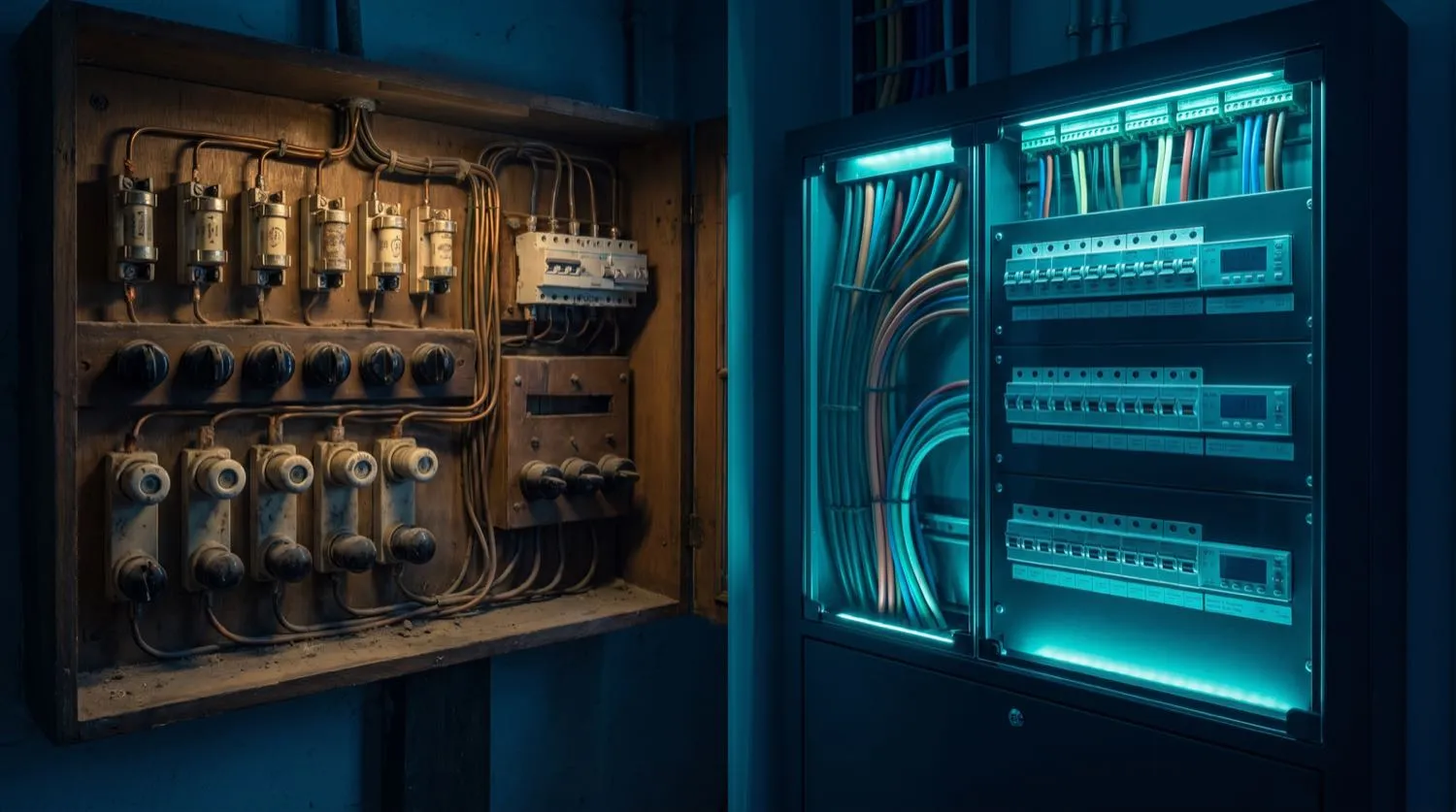
AS/NZS 3000:2018 Clause 2.9.3 mandates RCD protection for all socket-outlet circuits in residential premises and all lighting circuits. In practice, this means a modern house must have RCD protection covering every power point and light circuit — there are no exemptions for "hard-wired" appliances such as ranges, ovens, or hot water systems that are supplied from dedicated final sub-circuits without a socket outlet. State regulators have further tightened these requirements; New South Wales and Queensland, for example, require RCDs on all circuits in new residential construction. Many older properties retain legacy installations where only one or two circuits have RCD protection, a situation that leaves occupants exposed to exactly the class of shock risk that the 30 mA standard is designed to prevent. An electrical audit of pre-2000 residential or commercial premises frequently reveals that switchboard upgrades are needed to bring the installation into alignment with current requirements.
- All socket-outlet circuits in domestic premises must have RCD protection (AS/NZS 3000:2018 Clause 2.9.3).
- All lighting circuits in domestic premises must have RCD protection.
- Switchboard-mounted (meter-box) RCDs protecting multiple circuits are acceptable but create a single point of failure — nuisance tripping interrupts all downstream circuits.
- Individual RCBOs (combined RCD + MCB) per circuit eliminate the nuisance tripping problem and provide selective discrimination.
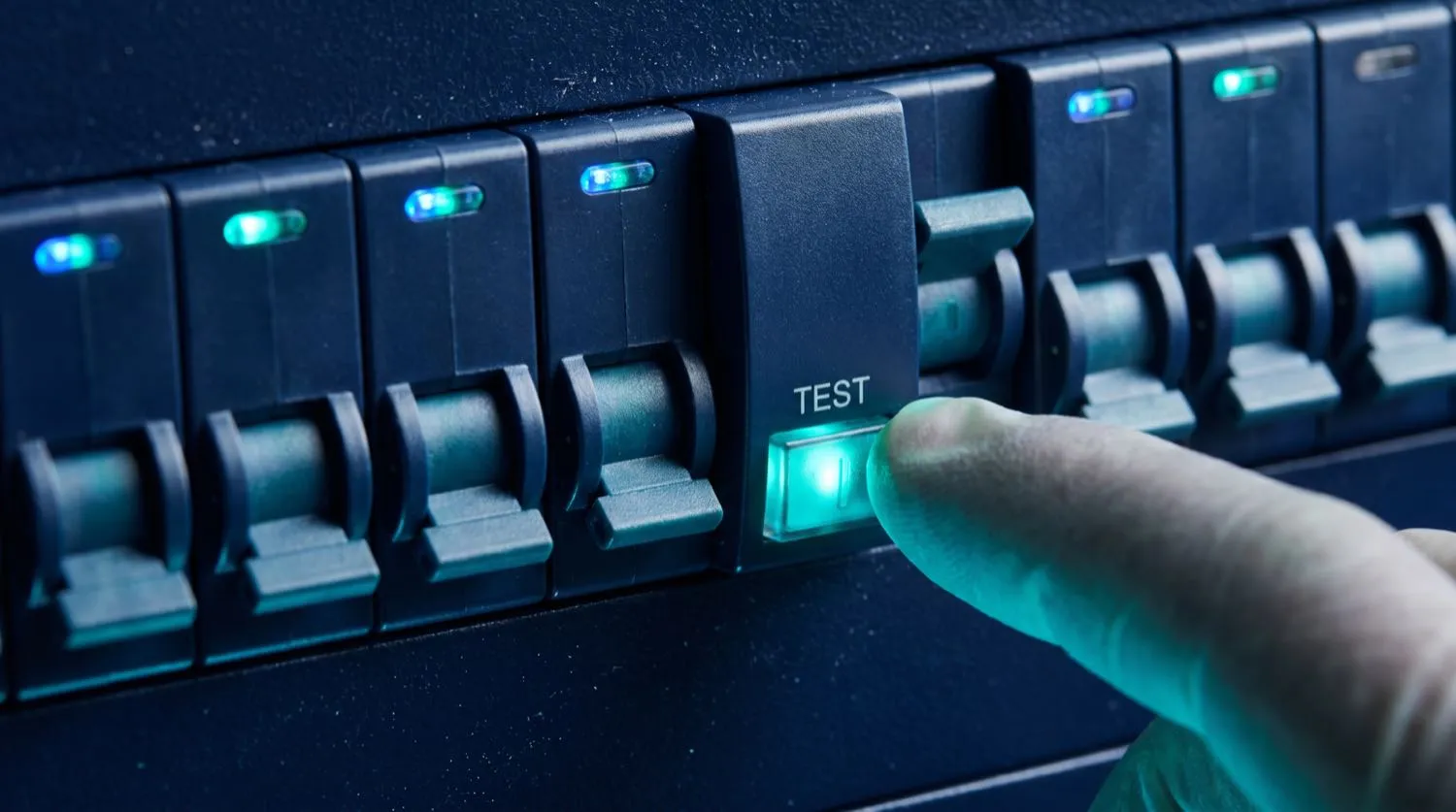
- Test the RCD test button quarterly and have a licensed electrician perform a full timed trip test at each scheduled maintenance inspection.
RCD Testing: AS/NZS 3760 and In-Service Requirements
For RCDs installed in workplaces, the test-and-tag regime under AS/NZS 3760:2022 establishes inspection and testing intervals based on environment and equipment class. However, AS/NZS 3760 is specifically about portable electrical equipment and its associated leads; fixed switchboard-mounted RCDs fall under the installation maintenance provisions of AS/NZS 3000 and any applicable workplace health and safety regulations. In practice, facilities managers should ensure that all fixed RCDs are push-button tested monthly by staff and subject to timed trip verification annually by a licensed electrician using a calibrated RCD tester. The timed trip test measures the actual disconnection time at I∆n (30 mA) and at 5 × I∆n (150 mA) and compares them against the AS/NZS 61008 limits. An RCD that passes the push-button test but fails the timed trip test has a degraded mechanical actuator — a failure mode that is invisible to the casual monthly test and potentially lethal under real fault conditions.
- Monthly push-button functional test: press the TEST button, confirm circuit de-energises, reset.
- Annual timed trip test: use a calibrated RCD tester at 30 mA and 150 mA; record and retain results.
- An RCD that takes more than 300 ms at 30 mA must be replaced immediately.
- RCDs have a mechanical service life — devices more than 10–15 years old should be inspected and tested with heightened scrutiny.
- Portable RCDs (inline safety adaptors) used on construction sites must comply with AS/NZS 3820 and be included in the site test-and-tag program.
Limitations and Complementary Protections
RCDs are essential but not omnipotent. They will not protect against line-to-neutral faults where current returns via the neutral conductor — an overcurrent device (circuit breaker or fuse) is required for that scenario. They provide no protection against a person simultaneously touching both live and neutral conductors, since no earth leakage current flows and the residual sum remains zero. They also cannot substitute for correct cable insulation, proper termination practices, or adequate switchboard fault ratings. An installation with a 10 kA prospective fault current but circuit breakers rated to only 6 kA creates a risk that no RCD can mitigate — a bolted fault can destroy the switchboard before the breaker successfully clears. Comprehensive electrical safety requires layered protection: correct cable selection per AS/NZS 3008, adequately rated overcurrent devices, properly rated and maintained RCDs, and regular professional inspection. Treating the safety switch as the sole line of defence is an engineering misconception that a thorough compliance audit will quickly expose.