Home / Resources / How Solar Panels Actually Work
Basics · 6 min read
How Solar Panels Actually Work
You don't need a physics degree to understand solar. In fact, the basic idea is beautifully simple. Let Photon walk you through what actually happens the moment sunlight lands on your roof — from tiny electrons all the way to your morning cup of tea.
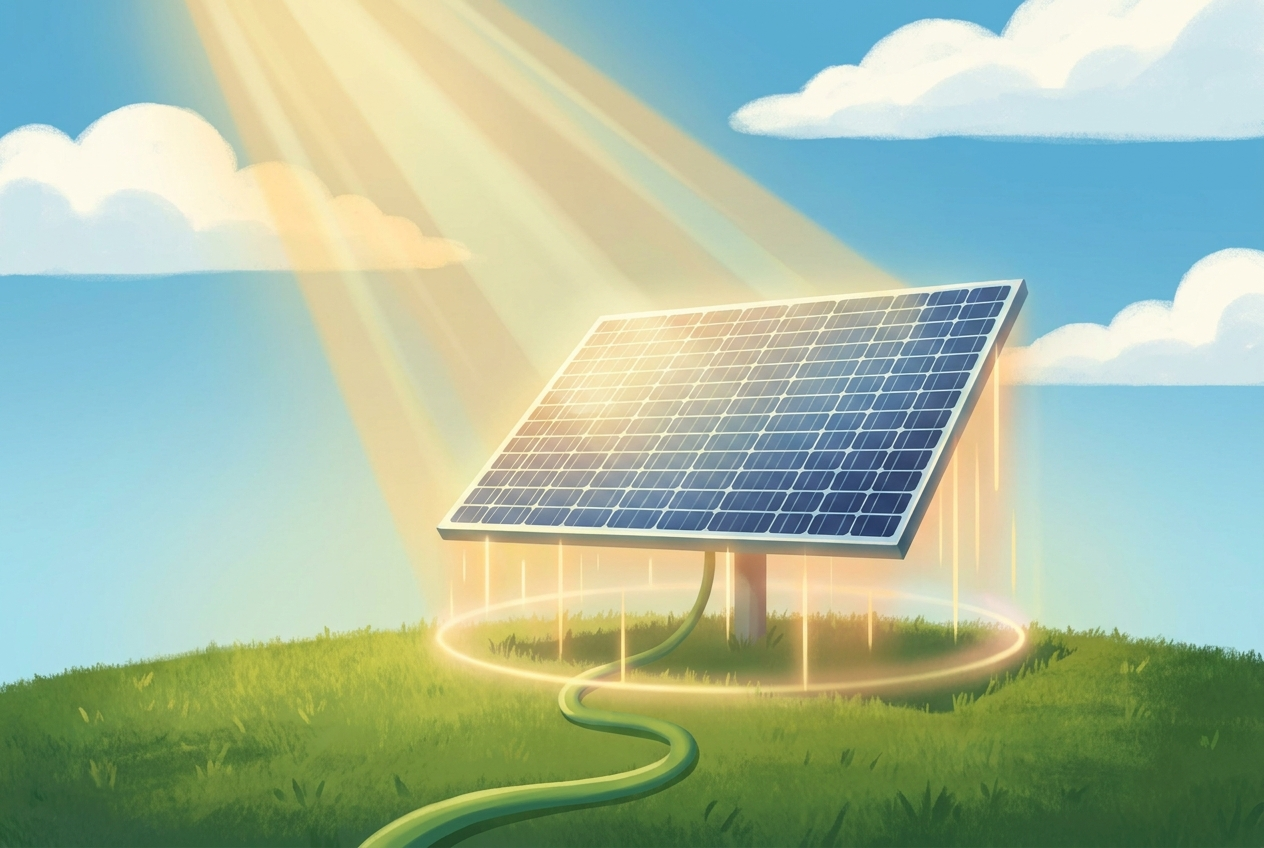
Solar panels look like flat, dark rectangles sitting quietly on a roof — but inside each one, something remarkable is happening. Every panel is made up of dozens of smaller units called solar cells, and each cell is a sandwich of two thin layers of silicon, a material found in ordinary sand. When sunlight (which carries tiny bundles of energy called photons — yes, just like our mascot!) strikes those silicon layers, it knocks electrons loose and sends them flowing in one direction. That flow of electrons is electricity.
The electricity produced inside a solar cell is called direct current, or DC — the same kind of power that flows from a battery. But your home runs on alternating current, or AC. That's where the inverter comes in. The inverter is a box (usually installed on your wall near your switchboard) that converts DC into AC so every appliance in your house can use it seamlessly.
From Sunlight to Switchboard: The Journey
Here's the step-by-step path electricity takes on a sunny afternoon:
- Sunlight strikes the solar cells on your roof panels.
- The cells generate DC electricity and send it down cables into the inverter.
- The inverter converts DC to AC electricity.
- That AC power flows into your home's switchboard and is distributed to your lights, appliances, and devices.
- Any surplus electricity you don't use immediately is exported to the electricity grid — and your retailer may pay you a small rate for it, called a feed-in tariff.
The whole process happens silently, instantly, and continuously whenever the sun is shining. There are no moving parts in a solar panel, which is one big reason they last so long — most quality panels carry a performance warranty of 25 years.
What Is a Kilowatt vs a Kilowatt-Hour?
Two terms you'll hear constantly in the solar world are kW (kilowatt) and kWh (kilowatt-hour). A kilowatt is a measure of power — how much electricity something can produce or consume at any given moment. A kilowatt-hour is a measure of energy — how much electricity is used or produced over time. Think of it like a tap: the kW is how fast the water flows, and the kWh is how many litres came out by the end of the day. When someone says they have a '6.6 kW system,' they mean their panels can produce up to 6.6 kilowatts of power at peak sunshine. Over a sunny day, that system might generate 25–30 kWh of energy.
Does It Work on Cloudy Days?
Yes — though less efficiently. Solar panels don't need direct, blazing sunshine to work; they need daylight. Diffuse light on an overcast day still causes electrons to flow. You'll generate less electricity than on a clear day, but your system will still be producing. In fact, solar panels can sometimes perform better on bright but slightly hazy days because extreme heat reduces efficiency a little. Australia's abundant sunlight means most systems still produce well even accounting for cloudy periods.
The Role of Panel Angle and Direction
In Australia, the sun tracks across the northern part of the sky, so north-facing roof panels catch the most light across the day. East-facing panels capture morning sun, and west-facing panels capture afternoon sun. South-facing panels produce the least, though in many situations they still contribute meaningfully. The angle (tilt) of the roof also matters — somewhere between 10 and 30 degrees suits most Australian locations well, which conveniently is the pitch of a typical residential roof.
How Much of My Home Can Solar Power?
That depends on your system size, how much energy your household uses, and when you use it. A well-sized system for an average Australian home (typically 6–10 kW) can offset a large portion of daytime electricity needs. The key word is 'daytime' — solar generates when the sun shines, and most households use more electricity in the evening. That's where batteries come in (more on those in another article). Using energy-hungry appliances like dishwashers, washing machines, and pool pumps during sunny daylight hours is a simple way to get the most value from your solar.
Photon's tip: Try running your dishwasher or washing machine during the sunniest part of the day — typically 10am to 3pm. That way you're using free solar power instead of buying it from the grid.
Solar technology has been around since the 1950s, but costs have fallen dramatically — by more than 90% over the past two decades. Today, a quality home solar system is one of the most reliable and cost-effective home upgrades available. Now that you understand how the technology works, you're perfectly placed to explore whether it makes financial sense for your household.
Let's go solar
Ready to make friends with the sun?
Get a free, no-pressure quote and a clear plan. Photon will walk you through every step — no jargon, promise.