Home / Services / Off-Grid & Microgrids
Off-Grid & Microgrids
Your own power station — no poles, no lines, no bills.
Going off-grid means generating, storing, and managing all of your own electricity. Whether you are on a rural property kilometres from the nearest line, building a new home where grid connection costs are prohibitive, or simply want complete independence from rising electricity prices, SolBuddy designs off-grid and microgrid systems sized to keep the lights on year-round.
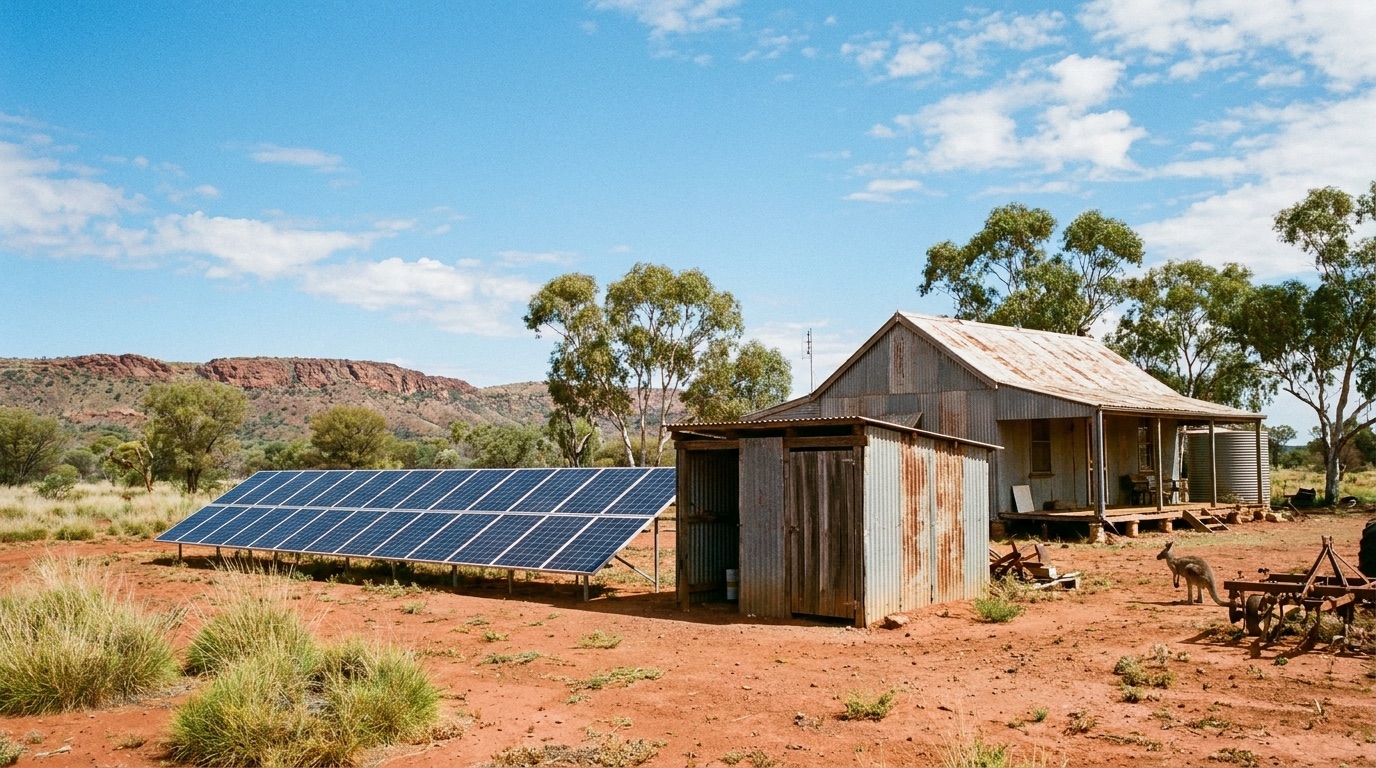
Living off the grid used to mean managing with less. Modern lithium battery storage and high-efficiency solar panels have changed that completely. A well-designed off-grid system today can run a full-size family home — air conditioning, electric cooking, refrigeration, workshop tools, and all — without a grid connection and without compromising on comfort. The key word is well-designed: off-grid systems have less margin for error than grid-tied systems, and the design work matters enormously.
SolBuddy specialises in off-grid design for rural and remote Australian properties. We've designed systems for sheep stations in western Queensland, hobby farms in the Adelaide Hills, coastal holiday homes without grid access, and Aboriginal community microgrids in remote Western Australia. Every system is engineered from first principles based on your actual energy use, your site's solar resource, and the seasonal variation in both.
How an off-grid system works
An off-grid solar system has four core components: the solar array, a battery bank, an off-grid inverter/charger, and (in almost every case) a backup generator. The solar array generates power during the day. The inverter/charger manages the flow between panels, batteries, generator, and your home's circuits. The battery stores energy generated during sunny periods for use at night and on overcast days. The backup generator — typically a propane, diesel, or petrol unit — adds energy on extended low-sun periods so the system never runs completely flat.
The inverter/charger is the brain of the system. Units like the Victron Quattro or SMA Sunny Island manage all of this automatically: they maximise solar absorption, charge the battery intelligently, start the generator when battery state of charge falls below a set threshold, and provide pure sine-wave AC power to your home's circuits at all times. You simply use electricity normally — the system handles the rest.
Sizing an off-grid system correctly
Getting the size right is the most important part of off-grid design. Too small and the system runs flat during bad weather. Too large and you have spent money on capacity you never need. We start with a detailed load assessment: we go through every appliance in your home, its wattage, and how many hours per day you run it. From that we calculate your daily energy demand in kilowatt-hours. We then apply the seasonal solar resource data for your specific location — obtained from the Bureau of Meteorology and the Australian Solar Radiation Data Handbook — to determine the worst-case generation period of the year, typically June–July for most of Australia.
- Solar array sized to generate your full daily demand even in the worst solar month of the year at your latitude
- Battery capacity sufficient for three to five days of autonomy without any solar input — the typical duration of extended overcast weather across most Australian climates
- Backup generator sized to recharge the battery bank within four to six hours and carry critical loads simultaneously
- System voltage (48V DC bus) and cable sizing calculated to Australian Standards AS/NZS 4509 for off-grid systems
- Generator auto-start integration so the battery recharges automatically without you needing to manually start it
Photon's tip: the single biggest mistake in off-grid system design is undersizing the battery bank. People focus on the solar panels but batteries are what get you through the night and the cloudy days. We always build in at least three days of autonomy, and five days for remote properties where generator fuel delivery can be delayed.
Microgrids for communities and developments
A microgrid is an off-grid or weakly-grid-connected power system serving multiple premises — a rural subdivision, a remote community, a tourist resort, an industrial site, or a defence facility. Microgrids use the same core technology as single-property off-grid systems but add a layer of energy management that distributes generation and storage across the network and manages the priorities of multiple consumers. SolBuddy has designed microgrids serving between two and several hundred premises.
Community microgrids often incorporate multiple generation sources beyond solar — wind turbines, small hydro, backup diesel gensets — and advanced battery systems from suppliers like BESS manufacturers using large-format lithium iron phosphate cells. The control systems that manage these installations are more complex, and we engage specialist power engineers for the protection relay design and grid-forming inverter configuration that these projects require.
Battery technology for off-grid: what to choose
Lithium iron phosphate (LFP) chemistry is the go-to choice for off-grid battery banks today. LFP batteries offer 3,000 to 6,000 charge cycles (compared to 500–1,000 for lead-acid), tolerate deep discharge without damage, operate safely in the high temperatures common in Australian plant rooms and sheds, and require no maintenance. The upfront cost is higher than lead-acid but the total cost over the system's life is lower in virtually every scenario we've modelled. We use Pylontech, BYD, Victron, and Alpha-ESS LFP batteries depending on the application and the inverter ecosystem chosen.
Lead-acid batteries — either flooded or AGM — are still used in some off-grid applications where upfront cost is the dominant constraint. We design lead-acid systems conservatively, with deeper autonomy margins and more generous solar capacity, to compensate for their shallower usable depth of discharge. We are transparent about the trade-offs so you can make an informed decision.
What does an off-grid system cost?
A complete off-grid system for a typical three-bedroom rural home — solar array, LFP battery bank, off-grid inverter/charger, backup generator, switchboard, wiring, monitoring — typically sits in the range of $35,000 to $80,000 depending on energy demand, location, and the cost of getting equipment and tradespeople to site. That sounds like a lot until you compare it to the cost of grid connection in remote areas: underground or overhead grid extension can cost $50,000 to $200,000 per kilometre from the nearest pole. For many rural properties, off-grid is not just the greener choice — it is the economically rational one.
Frequently asked questions
What happens during an extended stretch of cloudy weather — will I run out of power?
This is exactly what the backup generator is designed for. When the battery falls below a set state of charge — typically 20 to 30 per cent — the generator starts automatically, recharges the battery, and then shuts itself off. During a genuine week of heavy overcast you might see the generator run for four to six hours a day. We design the system so that this is the exception, not the rule.
Can I run air conditioning on an off-grid system?
Yes, absolutely. We design off-grid systems that run reverse-cycle air conditioning as a normal load. The key is accurate load assessment at the design stage: air conditioning is one of the largest energy draws in an Australian home, and the battery and solar array need to be sized to handle it. Systems designed with air conditioning in mind perform reliably — systems where AC was added as an afterthought often struggle.
Is an off-grid system connected to the internet for monitoring?
The monitoring system uses your property's internet connection to upload data to a cloud dashboard. If you don't have internet at the property, a mobile data SIM can be used with a cellular router. The system operates fully without internet connectivity — the monitoring is informational, not operational.
Do I need council approval to install an off-grid system?
Off-grid solar and battery systems on existing rural residential properties are generally exempt development under state planning laws, but requirements vary by state and local council. We check the relevant planning instrument for your location and advise you before any work starts. Electrical work always requires a licensed electrician and electrical safety certificates.
Can I start with a smaller off-grid system and expand it later?
Yes, but it is more cost-effective to design for your full future load from the start and add capacity in planned stages. The critical infrastructure — wiring, switchboard, inverter sizing, generator connection — should be sized for the final system from day one. Adding solar panels or battery modules later is straightforward; upgrading inverters and wiring mid-project adds cost.
Let's go solar
Ready to make friends with the sun?
Get a free, no-pressure quote and a clear plan. Photon will walk you through every step — no jargon, promise.