Home / Services / Battery Storage
Battery Storage
Keep the lights on after sunset with smart home battery storage
Solar panels are brilliant during the day, but what about evenings, early mornings, and overcast stretches? A home battery storage system lets you bank the surplus electricity your panels generate and use it whenever you need it — reducing your reliance on the grid to near zero for many households and giving you genuine energy independence, including protection against blackouts.
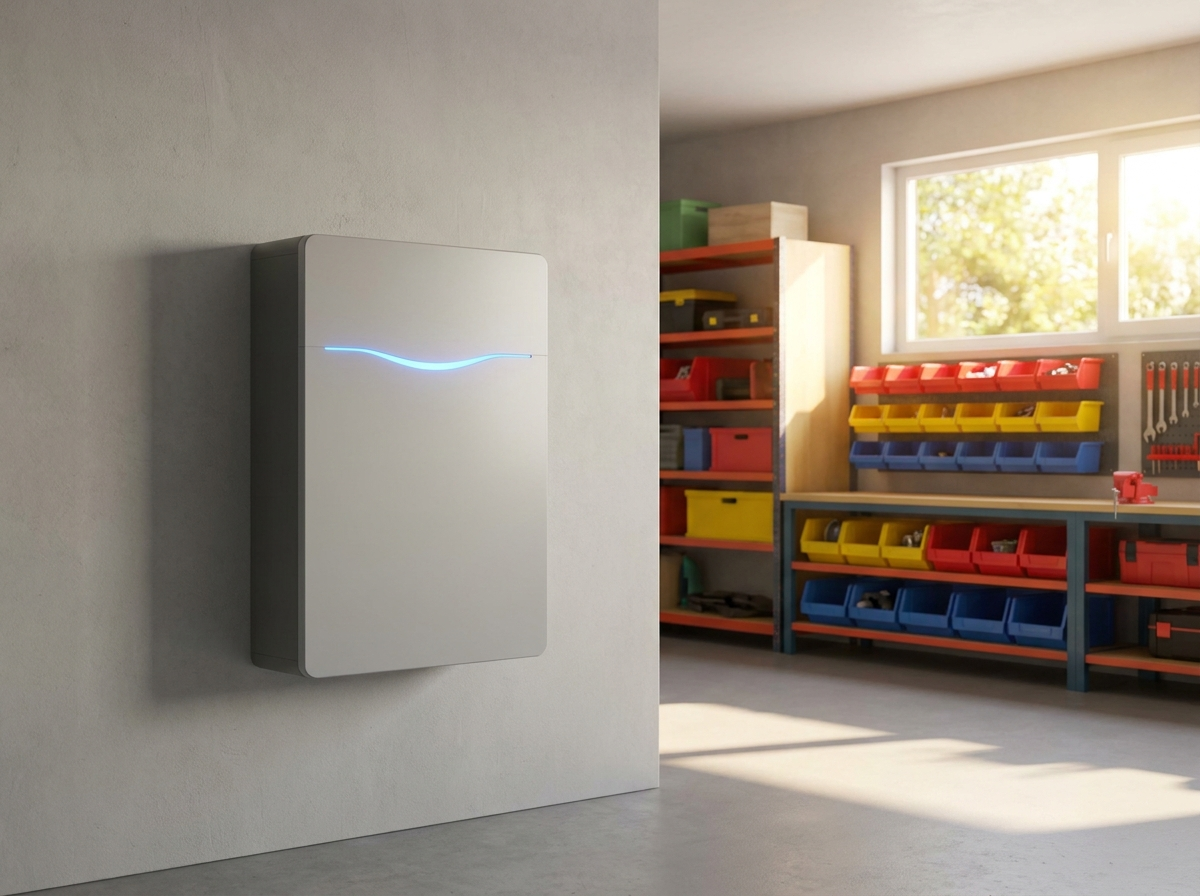
A home battery storage system is essentially a large rechargeable battery — similar in concept to your phone's battery, but the size of a small bar fridge — that sits in your garage, laundry, or on an exterior wall. It charges automatically from your solar panels during the day when generation exceeds your household's demand, and then discharges that stored energy during the evening, overnight, or on cloudy days when your panels aren't producing enough to meet your needs.
The technology at the heart of most residential batteries is lithium iron phosphate (LFP) chemistry — a particularly stable and safe variant of lithium-ion that operates at lower voltages, is highly resistant to thermal runaway (the overheating failure mode associated with older lithium cobalt chemistries), and degrades more slowly over thousands of charge cycles. LFP is now the dominant chemistry for home energy storage and is backed by 10-year performance warranties that guarantee the battery retains at least 70–80% of its original capacity at end of warranty.
What can a home battery actually do for me?
The honest answer depends on your household's usage patterns and the size of your solar system, but here's a framework that works for most Australian homes. During summer months, a 6.6kW solar system on a typical home will generate far more than the household can consume during daylight hours. Without a battery, most of that surplus is exported to the grid for a feed-in credit of 4–10c/kWh. With a 10kWh battery, much of that surplus is stored instead — and you draw it down in the evening at a value of 28–45c/kWh (whatever your retail tariff is), rather than buying it from the grid. That difference — sometimes 35+ cents per kilowatt-hour — is where the financial case is built.
- Energy independence: many battery households achieve 90%+ self-sufficiency, meaning they draw almost nothing from the grid for months at a time during spring and summer.
- Blackout protection: batteries with backup capability keep your nominated circuits — lights, fridge, modem, phone chargers — running during a grid outage. Some batteries can back up your entire home.
- Time-of-use optimisation: if your tariff has a high peak period in the evening (common in Victoria and Queensland), a smart battery will ensure you draw from storage rather than the grid during those expensive hours.
- Virtual Power Plant participation: once enrolled in a VPP, your battery earns additional credits by briefly discharging into the grid during high-demand events (see our Virtual Power Plants service for details).
- Overnight EV charging: a large battery can top up an electric vehicle overnight using stored solar energy rather than grid electricity, making your transport essentially free-to-run.
Photon's tip: A 10kWh battery is right for most Australian homes, but if you have an electric vehicle or ducted air conditioning, consider 15–20kWh from the start. The incremental cost of going larger at installation time is much lower than adding a second battery later.
Key battery specs you actually need to understand
The battery market is full of impressive-sounding numbers. Here are the ones that genuinely matter for comparing products.
- Usable capacity (kWh): the total energy the battery can store and deliver in a single cycle. A 13.5kWh battery (like a Tesla Powerwall 3) can deliver 13.5kWh before it needs recharging. This is the headline number for comparing batteries.
- Continuous power output (kW): how many kilowatts the battery can deliver simultaneously. A battery with 5kW continuous output can run a 2kW oven, a 1.5kW air conditioner, and several lights and devices at once — fine for most homes. Batteries with 7–10kW output can handle almost any household load.
- Round-trip efficiency (%): the percentage of energy put into the battery that comes back out. Modern LFP batteries typically achieve 90–97% round-trip efficiency — meaning almost no energy is wasted in the storage process.
- Cycle life and warranty: most warranties guarantee the battery will retain 70–80% of original capacity after 4,000–6,000 cycles (roughly 10–15 years of daily cycling). The retained capacity figure matters — a battery that degrades to 60% after 10 years delivers far less value in its final years.
AC-coupled versus DC-coupled battery systems
When adding a battery to an existing solar system, you'll encounter two installation architectures. An AC-coupled battery connects to your home's AC wiring independently of the existing solar inverter — it has its own battery inverter and can be added to any existing solar system regardless of brand. This is the most common retrofit approach. A DC-coupled battery, by contrast, integrates directly with the solar panels before the main inverter, which is slightly more efficient because the energy undergoes fewer conversion steps. DC-coupling is most cost-effective when battery and solar are installed simultaneously as a new system.
If you're buying solar and battery together for the first time, a DC-coupled or hybrid inverter system is usually the smarter choice — products like the SolarEdge Energy Hub, Fronius Symo GEN24, or Sungrow SH series combine a solar inverter and battery inverter into a single unit, reducing hardware cost and improving overall efficiency. If you're adding a battery to an existing system, an AC-coupled solution like the Tesla Powerwall or Sonnen eco gives you maximum flexibility without needing to change your existing inverter.
Battery safety, installation, and regulations
Home battery systems must comply with AS/NZS 5139, Australia's standard for the installation of battery energy storage systems. This standard specifies requirements for siting (batteries must be installed in well-ventilated locations away from heat sources and ignition risks), fire separation from habitable spaces, electrical protection, and labelling. All Australian states require that battery installations be carried out by a licensed electrical contractor, and many require a separate permit and inspection.
Modern LFP batteries are genuinely safe when installed correctly. They do not contain cobalt, are not prone to thermal runaway at normal operating temperatures, and include internal battery management systems (BMS) that monitor cell voltage, temperature, and state of charge, automatically disconnecting the battery if any parameter falls outside safe limits. SolBuddy only works with batteries that have been independently tested and certified to IEC 62619 and carry the relevant product approval marks for the Australian market.
Frequently asked questions
Do I need solar panels already, or can I install a battery on its own?
A battery works best paired with solar, but it can be installed as a standalone unit and charged from the grid on off-peak tariffs — a practice called grid arbitrage. You charge when electricity is cheap (overnight off-peak) and discharge when it's expensive (evening peak). However, the financial returns are more modest than when the battery is primarily charged by free solar generation, and you don't gain the same independence benefits.
Will a battery keep my home powered during a blackout?
That depends on the battery model and how it's configured. Not all batteries include backup capability — some are 'grid-tied' only and shut down during an outage just like a standard solar inverter. Batteries with backup mode, like the Tesla Powerwall 3, Sonnen eco, or certain Sungrow hybrid systems, can island your home during a blackout and keep nominated circuits running. Make sure you specify backup capability when getting quotes if this is important to you.
How many times can I charge and discharge the battery before it wears out?
Most modern LFP batteries are rated for 4,000–6,000 cycles at which point they retain 70–80% of their original capacity. If you cycle the battery once per day (which most home storage systems do), that's 11–16 years of daily use before you hit the warranty cycle limit. In practice, many batteries will last longer than their warranty because real-world cycling is rarely as aggressive as the rated conditions.
Can I get a government rebate on a home battery?
Federal rebates for standalone batteries don't currently exist (as at mid-2026), but several states offer support. Victoria's Solar Homes Program includes a battery rebate of up to $2,950 for eligible households. South Australia's Home Battery Scheme has provided subsidised loans in the past. Queensland, NSW, and WA have various virtual power plant incentive programmes that offer bill credits or rebates in exchange for VPP participation. We'll brief you on what's available in your state at the time of your assessment.
Let's go solar
Ready to make friends with the sun?
Get a free, no-pressure quote and a clear plan. Photon will walk you through every step — no jargon, promise.