Home / Services / Solar Carports
Solar Carports
Turn your car park into a power station
A solar carport is exactly what it sounds like — a shading structure built over your parking area, with solar panels on top instead of a plain roof. You get useful shade for your vehicles and free electricity from the same piece of land. It is one of the smartest dual-purpose upgrades an Australian home or business can make.
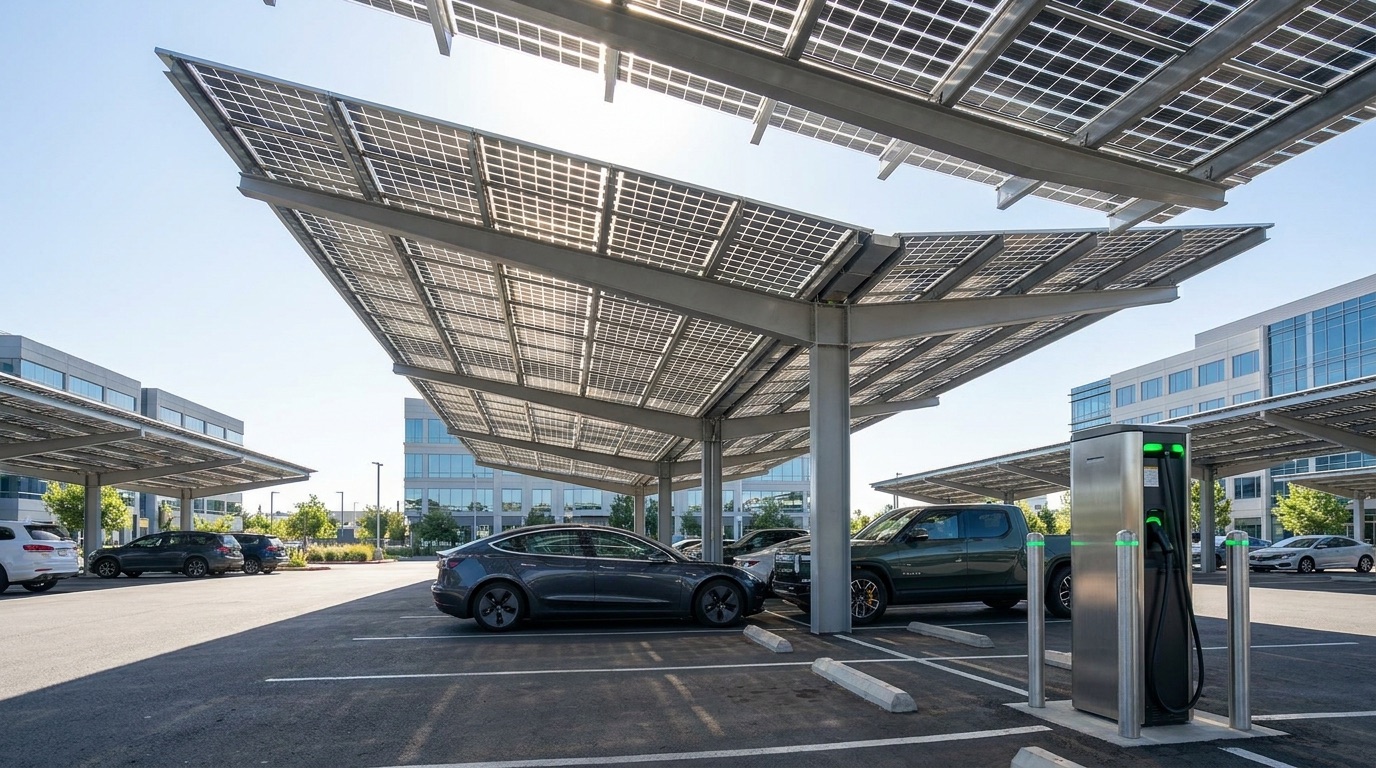
Most Australian homes already have a driveway or carport space sitting idle under the blazing sun. A solar carport captures all that wasted sunshine and converts it into electricity you can use directly in your home or business. The panels form the roof of the structure, so you are not adding a separate footprint — you are upgrading space you already own.
Solar carports suit everyone from suburban homeowners with a double garage to shopping centres, council car parks, schools, and industrial sites with dozens of bays. The principles are the same at every scale: a sturdy aluminium or steel frame, weather-rated solar modules, and a proper inverter connection to your switchboard. SolBuddy handles the design, council permits, and installation so you do not have to worry about a single bolt.
Why a carport beats a rooftop in some situations
Rooftop solar is fantastic, but not every roof is ideal — some face the wrong direction, have too much shade from trees or neighbouring buildings, or simply do not have the structural rating to carry extra weight. A carport gives you a fresh canvas. You choose the orientation to maximise north-facing panel exposure, and the open-air design keeps panels cooler than a roof-mounted system, which means slightly better efficiency on hot summer days.
If you are planning to charge an electric vehicle now or in the future, a solar carport is an especially tidy solution. The power generated directly above your parked car flows down into a charger installed on the post, so you are refuelling from sunlight rather than the grid. The economics are compelling: daytime solar generation coincides almost perfectly with the hours your car sits parked at home or at the office.
What goes into a solar carport
- Engineered frame — galvanised steel or anodised aluminium rated to Australian wind and snow loads for your region.
- High-efficiency solar modules — usually monocrystalline panels chosen to suit the tilt angle of the canopy roof.
- Micro-inverters or a string inverter — converting DC panel output to usable 240 V AC for your home or business.
- Optional EV charging post — a Mode 2 or Mode 3 charger mounted to the carport column, fed directly by solar.
- Integrated LED lighting — downlights powered by the panels, so the carport stays useful after sundown.
- Rain gutters and drainage — because a well-designed carport is also simply a better carport.
Photon's tip: face your carport panels true north and tilt them between 20 and 30 degrees for maximum year-round output across most of Australia — even a slight adjustment from due north costs less than 5 percent in annual generation.
Permits and approvals — we handle them
Solar carports are classified as structures, which means they require a building permit in most Australian states. This sounds daunting but it is very manageable. SolBuddy prepares all engineering drawings, submits the development application to your local council, and coordinates the grid connection paperwork with your network distributor. We have done this many times and we will keep you informed at every step without drowning you in jargon.
Financial benefits and payback
A residential solar carport with a 10 kW system can offset $2,000 to $3,500 per year in electricity bills depending on your usage patterns and feed-in tariff. Add EV charging savings and the payback period typically sits between five and eight years — after which the system generates effectively free power for another fifteen to twenty years. Commercial carports over 100 kW qualify for Large-scale Generation Certificates (LGCs), adding a further revenue stream. SolBuddy can walk you through both the household and commercial incentive landscape.
Whether you have a single-bay home carport or a 200-space car park, SolBuddy will design a solution that makes financial and practical sense. Let Photon run the numbers for your site — there is no cost and no pressure, just honest advice from people who love solar.
Frequently asked questions
Does a solar carport need council approval?
In most states, yes — because it is a new structure, not just panel brackets on an existing roof. The good news is SolBuddy prepares and submits all the paperwork for you. Approvals typically take two to six weeks depending on your council.
Can I add EV charging to a solar carport later?
Absolutely. We future-proof carport wiring during installation so adding a charger later is straightforward and inexpensive. Many of our clients start with the solar canopy and add EV charging once they buy an electric vehicle.
Will the panels survive hail and high winds?
Solar carport frames are engineered to local wind and load ratings, and the panels carry an IEC 61215 hail rating covering impacts up to 25 mm hailstones. We select modules suited to your specific climate zone, whether that is tropical cyclone territory or alpine snowfall country.
How many cars can I shade with a standard residential carport system?
A typical two-bay residential carport measures roughly 5 m wide by 6 m deep, which accommodates about 12 to 16 standard panels — enough for a 5 kW to 6 kW system and comfortable shade for two vehicles. Larger multi-bay designs simply scale up from there.
Let's go solar
Ready to make friends with the sun?
Get a free, no-pressure quote and a clear plan. Photon will walk you through every step — no jargon, promise.