Home / Services / Floating Solar
Floating Solar
Turn your water into a clean energy powerhouse
Floating solar — or 'floatovoltaics' as engineers call it — places solar panels on pontoon systems anchored to dams, irrigation reservoirs, lakes, and retention ponds. It is one of the fastest-growing segments in renewable energy worldwide, and for good reason: water keeps panels cool, cool panels produce more power, and floating arrays free up land for agriculture or conservation. Australia's abundance of irrigation reservoirs and farm dams makes it an ideal fit.
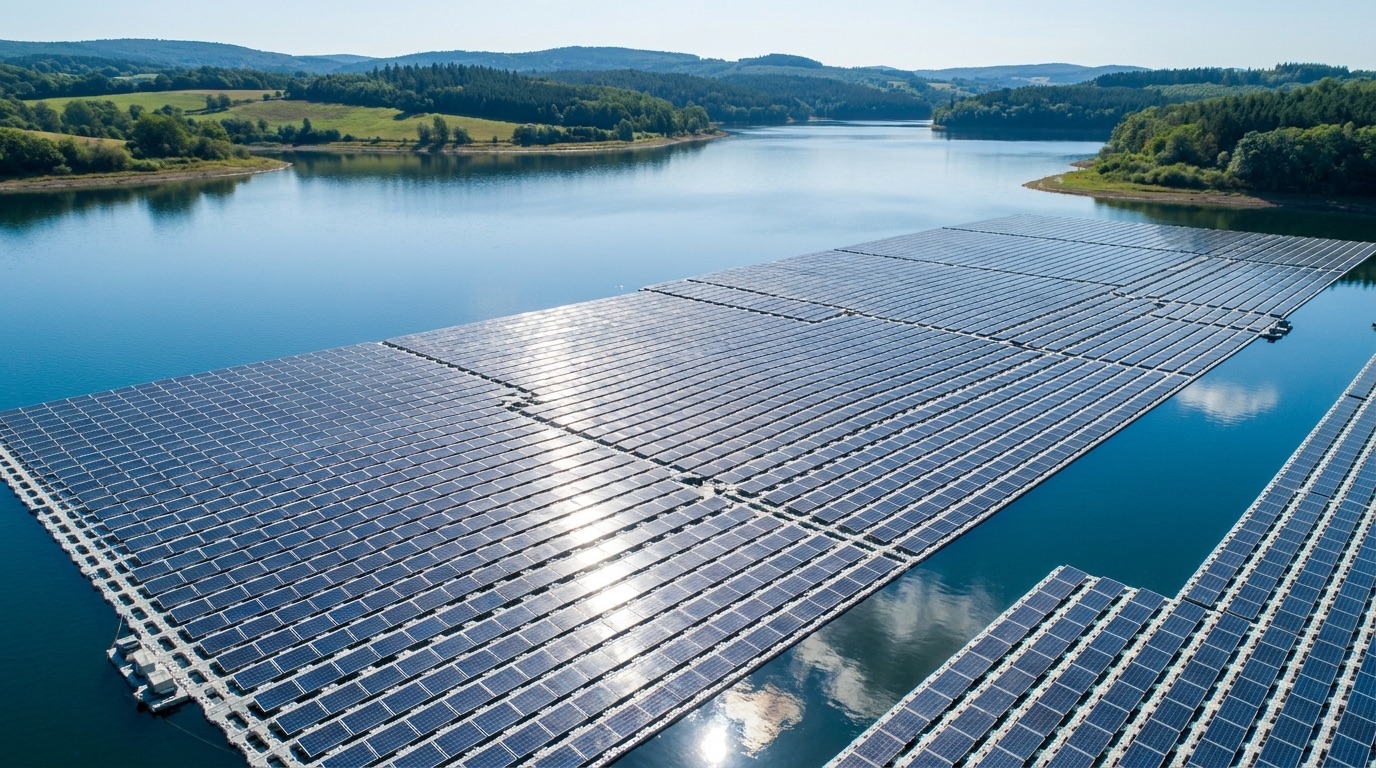
The concept is elegantly simple: instead of mounting panels on ground-mounted frames or rooftops, you attach them to a floating structure — typically high-density polyethylene (HDPE) pontoons — that sits on the surface of a still or slow-moving water body. Cables run underwater to an inverter on the shore, and from there the system connects to the grid or to on-site loads just like any other solar installation.
Australia has hundreds of thousands of farm dams, irrigation reservoirs, municipal water storage ponds, and mine-water treatment lakes. Many of these sit in high-solar-radiation zones with no competing land use on their surface. Floating solar unlocks that resource without displacing anything.
Why does water make panels perform better?
Solar panels are, counterintuitively, less efficient when they get hot. Standard crystalline silicon panels lose roughly 0.4% of their rated output for every degree Celsius above 25°C. On a hot summer day in outback Queensland, a roof-mounted panel might reach 65 or 70°C — that is a performance loss of 16 to 18% compared to its nameplate rating.
A floating panel, by contrast, is cooled continuously by the water beneath it and by the evaporative effect at the panel surface. Real-world data from floating installations consistently shows a 5 to 15% improvement in energy yield per kilowatt-peak installed compared to equivalent ground-mounted systems in the same location. In a hot climate, that gap is even more significant.
The water-saving bonus
Perhaps the most compelling secondary benefit of floating solar, particularly for agricultural and municipal operators, is water conservation. Open water bodies lose an enormous amount of water to evaporation — in a dry Australian summer, an unshaded irrigation reservoir can lose 2,000 to 3,000 litres per square metre per year to the atmosphere.
Floating panels shade a significant portion of the water surface, dramatically reducing that evaporative loss. Studies from comparable climates have shown evaporation reductions of 60 to 80% under floating arrays. For a rural property relying on a dam for stock and crop irrigation, that retained water has real dollar value — in some cases enough to justify the floating solar investment on water savings alone, before electricity savings are counted.
- A 100-panel floating array covering roughly 250 square metres of dam surface could save 150,000 to 250,000 litres of water per year in a hot dry region.
- Reduced evaporation means more reliable water availability through drought periods.
- Shading also reduces algae growth and the need for chemical treatment of irrigation water.
- Lower water temperatures under the array can benefit fish populations in aquaculture settings.
What kinds of water bodies are suitable?
Not every body of water is a good candidate for floating solar, and a proper feasibility assessment is essential before committing. The ideal water body is calm (not subject to large wave action), has stable water levels year-round, is large enough to justify the pontoon system, and is located near existing electrical infrastructure.
- Farm and irrigation dams: typically the most straightforward candidate — calm water, no public access concerns, close to existing farm loads.
- Municipal water storage reservoirs: excellent candidate with the added benefit of reduced contamination risk (less organic matter reaches the water surface under shading).
- Mining and industrial water treatment ponds: floating solar can power the treatment equipment directly, with the panel covering also reducing evaporation of treated water.
- Aquaculture ponds: panels provide shade that reduces algae and maintains more stable water temperatures, benefiting fish health.
- Water not suitable: open ocean, large lakes with significant wind and wave action, rivers with strong currents, or reservoirs with highly variable water levels that would stress anchor systems.
Photon's tip: before any floating solar assessment, check your local council or state water authority about any licencing or planning requirements for structures on water bodies — it varies by state and the type of water body, and SolBuddy's team can help navigate the paperwork.
The floating solar installation process
Installing a floating array requires more planning than a standard rooftop job, but the process is well-established. SolBuddy partners with specialist floating solar engineers who have completed projects on Australian and international water bodies. A typical project timeline runs eight to sixteen weeks from feasibility sign-off to commissioning.
The pontoon system arrives as a modular kit that is assembled on the shoreline and then floated into position. Panels are mounted to the pontoons on shore before the whole array is floated out — this reduces work-at-height risk and speeds installation. Anchoring is typically done with concrete deadweights on the water floor or with driven piles on the perimeter, and the design accounts for water level variation of plus or minus two metres as standard.
Regulatory and environmental considerations
Floating solar is regulated at state and local level, and requirements vary. Most small agricultural installations require only a standard development application. Larger commercial projects on licensed water storage or navigable waterways may need additional approvals from state water authorities. An environmental assessment is typically required for projects over 100 kilowatts to evaluate any impacts on aquatic ecology.
The ecological record for floating solar is broadly positive. The reduction in algae growth is beneficial in most contexts, and the structure provides attachment points for beneficial aquatic organisms. Projects in sensitive ecological areas require site-specific assessment, which SolBuddy can commission through our environmental consultancy partners.
Frequently asked questions
Do floating panels damage water quality?
Properly designed and maintained systems do not. The HDPE pontoons are inert and certified food-safe for use in potable water storage. Electrical components are fully sealed to IP68 standard. The shading effect from panels actually tends to improve water quality by reducing algae blooms and UV-driven degradation of organic matter.
What happens if a panel cracks and falls into the water?
Modern floating systems include a containment frame around every panel that prevents fragments from entering the water in the event of cracking. Broken panels are identified by the monitoring system and scheduled for replacement as part of routine maintenance — the array continues operating from the remaining panels in the meantime.
Can a floating system power an entire farm?
Often yes, depending on the size of the dam and the farm's energy demand. A 1-hectare reservoir can typically support a 200 to 400 kilowatt floating array, which would comfortably supply the annual electricity needs of a large broad-acre farm or a medium-scale irrigation operation.
How does the system handle periods of very high or very low water levels?
The anchor and mooring system is designed for the full water-level variation expected at your site. Flexible submarine cables between the shore and the array accommodate changes in cable length as water levels rise and fall. We engineer for the site's historical extremes, not just the average.
What is the maintenance requirement for a floating system?
Floating systems require quarterly inspections of pontoon integrity, anchor points, and underwater cabling, plus the same inverter and electrical maintenance as any solar installation. The panels themselves often need less cleaning than roof-mounted systems because dew and light rain tend to wash them more effectively over still water.
Let's go solar
Ready to make friends with the sun?
Get a free, no-pressure quote and a clear plan. Photon will walk you through every step — no jargon, promise.