Home / Services / Virtual Power Plants
Virtual Power Plants
Your battery earns money while it helps power the grid
A Virtual Power Plant — or VPP — connects thousands of home and business batteries into a single coordinated energy network that acts like one large power station. When the grid is under stress and electricity prices spike, your battery briefly discharges into the network, earning you credits or payments. When the grid has surplus energy and prices drop, your battery charges up cheaply. You get paid to help balance the grid, and the grid gets a clean, flexible resource it desperately needs.
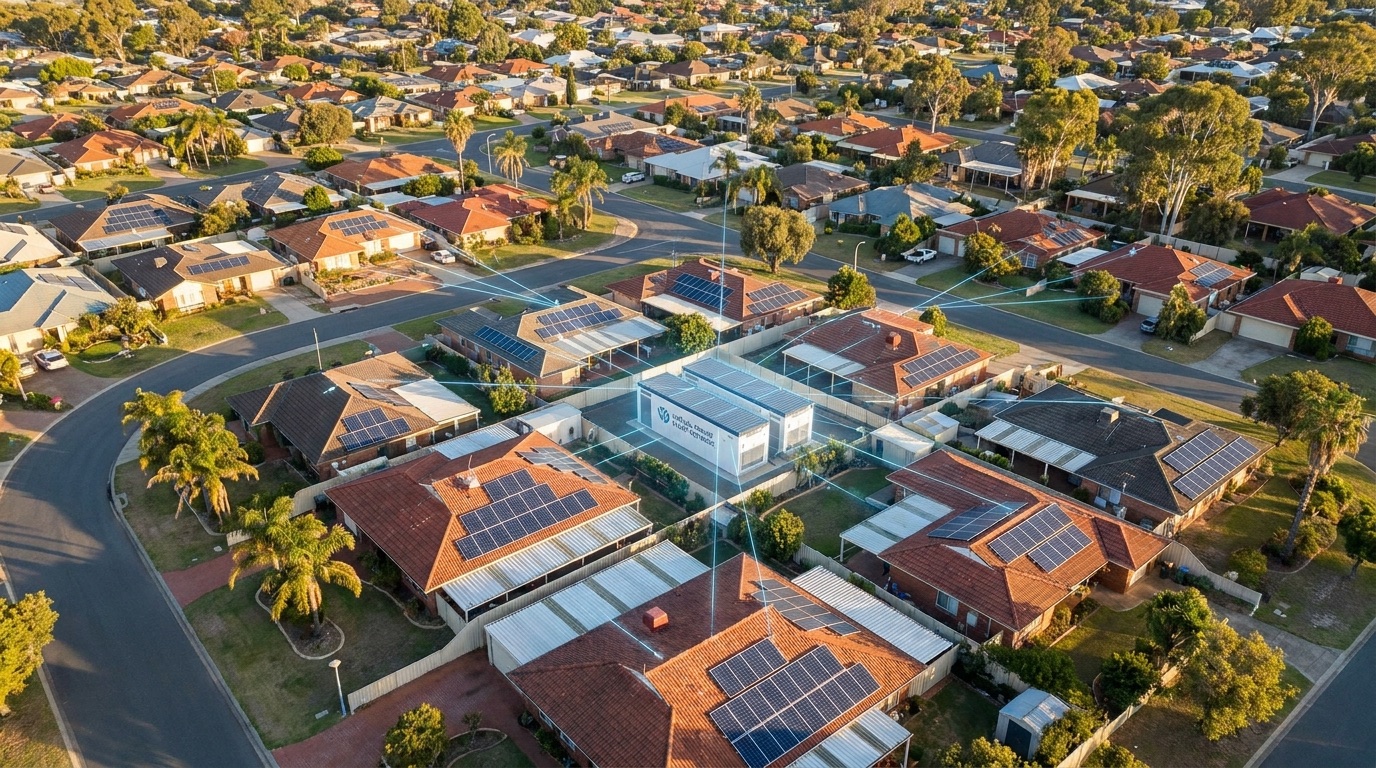
To understand what a Virtual Power Plant (VPP) is, it helps to first understand what problem it's solving. The electricity grid works by constantly balancing supply and demand in real time — if too much electricity is being generated, frequency rises above 50Hz; if too little, it drops. Traditionally, large coal or gas peaker plants have provided the flexibility to manage these imbalances. As those plants retire and are replaced by solar and wind — which generate when the sun shines and the wind blows, not necessarily when demand peaks — the grid needs new sources of flexibility.
Home and business batteries are a perfect answer to this challenge. Individually, a single 10kWh home battery is tiny compared to a 200MW gas peaker plant. But aggregate 20,000 home batteries — each capable of discharging 5kW — and you have a coordinated resource of 100MW that can respond faster than any gas turbine, with zero emissions and no fuel cost. That aggregated network, managed by software that dispatches each battery in response to real-time grid signals and market prices, is a Virtual Power Plant.
How a VPP actually works for you
When you enrol your battery in a VPP, you give the VPP operator limited control over a portion of your battery's charge and discharge behaviour. In practice, this means the operator can instruct your battery to discharge into the grid for short periods (typically 15 minutes to a few hours) during high-demand events, or to charge at times when grid electricity is cheap and clean. The key word is 'limited' — well-designed VPP programmes always reserve a portion of your battery's capacity for your own household needs and allow you to set minimum state-of-charge thresholds.
- Frequency Control Ancillary Services (FCAS): batteries respond in milliseconds to frequency deviations, and FCAS is one of the most valuable services batteries can provide to the grid. FCAS revenues are shared with participating VPP members.
- Peak demand response: during summer afternoons when air conditioning loads spike and spot prices soar, VPP operators dispatch batteries to inject power, earning premium spot market revenues that are shared as bill credits or direct payments.
- Scheduled dispatch: the VPP operator may bid your battery's capacity into the NEM's day-ahead and real-time markets, optimising dispatch for maximum revenue across a portfolio of batteries.
- Cheap overnight charging: VPP operators often automatically charge member batteries during low-price overnight periods, effectively providing you with cheaper stored energy for the following day.
What you actually earn — and what it costs you
VPP earnings vary considerably depending on the programme structure, market conditions, and how frequently your battery is dispatched. Most Australian residential VPP programmes currently deliver participating households between $150 and $600 per year in additional value — either as direct bill credits, cash payments, or as discounts on their electricity tariff. This is on top of the savings already generated by using your stored solar energy instead of buying grid electricity.
The cost to you is primarily opportunity cost — on VPP dispatch events, some of your stored solar energy is redirected to the grid rather than used in your home. A well-designed VPP programme ensures this never leaves you short of power for your own needs: your minimum charge reserve (typically 20–30% of battery capacity) is always protected, and dispatch events during evening peak periods are brief and targeted. You should never notice any difference in your home's power supply during a VPP dispatch.
Photon's tip: When comparing VPP programmes, look at the minimum state-of-charge protection they offer — this is the percentage of your battery the operator must always leave available for your own use. A programme that protects 20–30% is far more homeowner-friendly than one that can draw your battery all the way to empty.
Compatible batteries and how to enrol
Not every battery on the market supports VPP participation. The battery must have internet connectivity, a publicly accessible API or communication protocol that the VPP operator can integrate with, and a battery management system that supports remote dispatch commands. Currently compatible batteries in major Australian VPP programmes include the Tesla Powerwall (2 and 3), Sonnen eco, Sungrow SH hybrid series, Fronius Symo GEN24 with BYD battery, and several others. Compatibility is expanding rapidly as VPP operators develop new integrations.
Enrolment in most programmes is straightforward. You sign up with the VPP operator (which may be your electricity retailer or a specialist aggregator), agree to the programme terms, and the operator configures your battery's communication settings remotely. In many cases the entire process takes less than an hour and can be done without anyone visiting your property. SolBuddy partners with multiple VPP operators and can recommend the best programme for your battery make and model, usage profile, and location.
The bigger picture: why VPPs matter for Australia's energy future
Australia's electricity grid is undergoing the fastest transformation of any comparable grid in the world. By 2030, AEMO projects that rooftop solar alone will supply more than 50% of Australia's electricity demand during spring and autumn midday periods. Managing that volume of distributed, variable generation without the flexibility of large synchronous generators requires an entirely new set of grid services — services that distributed batteries, aggregated into VPPs, are uniquely positioned to provide.
When you join a VPP, you're not just earning a few hundred dollars in credits. You're participating in the architecture of Australia's clean energy future — helping to smooth the integration of ever-greater volumes of solar and wind generation, reducing the need for expensive gas peaker plants to be kept on standby, and demonstrating that a decentralised, community-owned energy system can deliver the reliability and security that Australians expect from their electricity supply. Photon would say that's something to feel genuinely good about.
Regulatory and market framework
VPPs in Australia operate under a regulatory framework that has evolved rapidly since the first pilots in 2018. VPP aggregators must be registered with AEMO as Market Customers or Market Ancillary Service Providers, and must comply with the National Electricity Rules governing bidding, dispatch, and metering. The Australian Energy Market Commission (AEMC) published its Distributed Energy Integration Program (DEIP) roadmap that established a pathway for VPPs to participate in all NEM markets, including FCAS, energy, and the emerging Demand Response Mechanism (DRM). This regulatory maturity means the VPP market is now stable, growing, and safe for residential participation — quite different from the earlier experimental stage where programme terms were less transparent and consumer protections less clear.
Frequently asked questions
Will VPP participation ever leave me without power or with a flat battery?
No — every reputable VPP programme includes a minimum state-of-charge protection that the operator cannot breach. This is typically set at 20–30% of battery capacity, meaning the operator must always leave you at least that much reserve. Additionally, dispatch events are brief and targeted, not extended discharges, so your battery rebounds quickly after any grid support event.
Can I opt out of VPP dispatch if I'm about to need my battery?
Most VPP programmes offer an opt-out mechanism, either via a smartphone app or by setting your battery to 'home backup' mode. Some programmes allow you to schedule opt-out periods in advance — for example, if you know you'll be running your air conditioner all day on Saturday. Opt-out rates are tracked and excessively frequent opt-outs may affect your eligibility for higher-tier reward programmes, but reasonable use of the opt-out function is expected and supported.
Is a VPP the same as selling electricity back to the grid (feed-in tariff)?
Not exactly. A standard feed-in tariff is a simple arrangement where surplus solar generation is exported to the grid at a fixed rate, handled by your electricity retailer with no active coordination. A VPP is an actively managed programme where your battery's charge and discharge behaviour is coordinated by an aggregator to maximise value in the wholesale market. VPPs typically deliver higher returns per kilowatt-hour dispatched than a standard feed-in tariff, particularly through FCAS markets that pay premium prices for fast-responding resources.
What happens to my VPP earnings if I switch electricity retailers?
This depends on the programme structure. Some VPP programmes are retailer-operated and require you to be on that retailer's tariff — switching retailers would mean exiting the VPP. Others are operated by independent aggregators and are retailer-agnostic, meaning you can participate regardless of who your electricity retailer is. When you enrol through SolBuddy, we'll make sure you understand exactly how any programme interacts with your retail energy contract before you commit.
Let's go solar
Ready to make friends with the sun?
Get a free, no-pressure quote and a clear plan. Photon will walk you through every step — no jargon, promise.