Home / Services / Utility-Scale Solar Farms
Utility-Scale Solar Farms
Grid-scale solar generation powering communities with clean energy
Utility-scale solar farms are the powerhouses of the clean energy transition — large arrays of panels covering tens or hundreds of hectares, generating dozens or hundreds of megawatts of electricity that feeds directly into the national grid. Developing, financing, and connecting a solar farm requires deep expertise across multiple disciplines, and SolBuddy partners with landowners, developers, and investors to make projects viable from paddock to powerline.
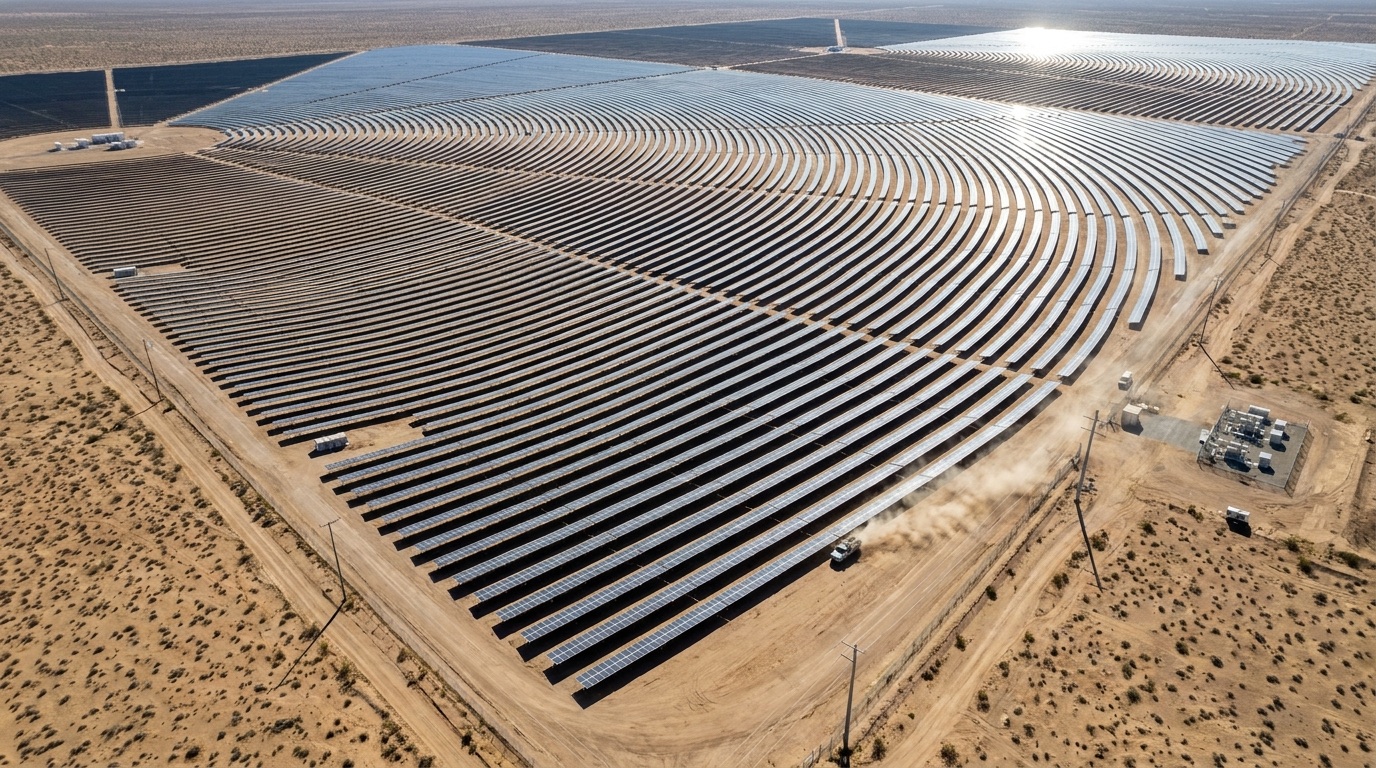
Australia is home to some of the most ambitious utility-scale solar projects in the world, and with good reason — our continent has abundant flat land, high solar irradiance, and a national electricity market that is actively transitioning away from coal. A utility-scale solar farm is typically defined as a system with a generating capacity of 10 megawatts (MW) or more, though the term is often used for anything above 5MW that sells electricity wholesale into the grid rather than behind-the-meter to a single customer.
The economics of utility-scale solar are driven by entirely different factors to rooftop solar. Rather than saving on a retail electricity bill, a solar farm generates revenue by selling electricity into the spot market of the National Electricity Market (NEM) or through long-term Power Purchase Agreements (PPAs) with large corporate or government buyers. The wholesale price of electricity fluctuates significantly — from near zero at midday when the grid is saturated with solar, to several hundred dollars per megawatt-hour during evening peaks. Battery co-location is rapidly changing this dynamic, allowing solar farms to shift generation into higher-value periods.
The development process: from feasibility to financial close
Bringing a utility-scale solar farm to life is a multi-year, multi-disciplinary process. It begins with a site feasibility study that assesses solar resource (using satellite irradiance data and on-site measurement), grid connection capacity at nearby substations, land suitability, environmental constraints, and planning overlaps. This study determines whether a site is commercially viable before any significant capital is committed.
- Grid connection: the most critical and often most time-consuming step. The Australian Energy Market Operator (AEMO) and the relevant DNSP assess the grid's capacity to absorb the project's generation. Connection costs range from modest to tens of millions of dollars depending on whether new transmission infrastructure is required.
- Development approvals: state-level planning approvals, environmental impact statements, flora and fauna surveys, and community consultation are required in most jurisdictions. Timelines vary from 12 months in streamlined states to over three years in complex cases.
- Power Purchase Agreements: most projects are financed against a PPA — a long-term contract (typically 10–20 years) with a creditworthy off-taker such as a large corporation, a retailer, or a government entity — which provides the revenue certainty lenders require.
- EPC contract: once financing is secured, an Engineering, Procurement, and Construction (EPC) contractor is engaged to build the project to a fixed price and schedule. The EPC contractor takes construction risk on behalf of the project company.
Technology choices at utility scale
Utility-scale solar farms predominantly use monocrystalline silicon panels mounted on single-axis tracking systems — large motorised frames that rotate the panels to follow the sun from east to west throughout the day. Tracking increases generation by 20–35% compared to fixed-tilt mounting and is now standard for ground-mounted utility projects where the additional cost is easily justified by the generation uplift.
String inverters have largely given way to central inverters or, increasingly, string inverters at utility scale — a shift driven by the granular monitoring and fault isolation that distributed inverter architectures provide. Most modern utility projects incorporate SCADA (Supervisory Control and Data Acquisition) systems that monitor every inverter block in real time and allow remote control of curtailment, reactive power output, and other grid support functions required by AEMO's technical standards for connecting large generators.
Photon's tip: The biggest variable in utility-scale project economics isn't the panel price — it's the grid connection cost and the achieved PPA price. A site that needs a new 66kV switching station to connect will carry $15–30M in additional cost that dramatically changes the project's viability. Always get an indicative connection study before investing heavily in other development work.
Battery co-location and the changing value stack
Pairing a utility-scale solar farm with a large battery energy storage system (BESS) — commonly called a hybrid or co-located project — is transforming the economics of solar development. A battery allows the project to capture electricity generated at low-value midday periods and discharge it during high-value evening peaks, dramatically improving revenue per megawatt of solar capacity. It also allows the project to provide Frequency Control Ancillary Services (FCAS) and other grid support services that carry premium pricing in the NEM.
BESS sizing for utility solar projects is typically expressed as a ratio of power to energy — for example, a 100MW solar farm might be co-located with a 50MW/200MWh battery (two hours of storage at full discharge rate). The optimal ratio depends on the project's revenue strategy: arbitrage-focused projects favour larger energy capacity, while FCAS-focused projects favour high power relative to energy. SolBuddy's modelling team uses historical NEM dispatch data and forward price curves to optimise this ratio for each specific project.
Opportunities for landowners and investors
Australian landowners — particularly sheep and grain farmers in the solar belt running from central Queensland through New South Wales and into Victoria and South Australia — are increasingly entering long-term land lease agreements with solar developers. Typical lease rates range from $800 to $2,000 per hectare per year, with annual CPI escalation, for a term of 30–40 years. For a 300-hectare farm site, that represents $240,000–$600,000 in annual passive income — income that is entirely compatible with continuing to graze sheep between the panel rows, a practice known as agrivoltaics.
For institutional and infrastructure investors, utility-scale solar projects with long-term PPAs offer inflation-linked, predictable cash flows with a risk profile comparable to regulated infrastructure — attractive in a portfolio context. SolBuddy connects project developers with both strategic equity partners and infrastructure debt providers, structuring transactions that work for all parties.
Frequently asked questions
How much land does a utility-scale solar farm require?
A useful rule of thumb is approximately 1 hectare per 1MW of installed capacity for a single-axis tracking system, though site-specific factors like slope, setback requirements from boundaries and residences, and substation positioning can change this. A 100MW solar farm therefore typically occupies 100–130 hectares of usable panel area, with additional land for access tracks, switching stations, and perimeter fencing.
What is the role of AEMO in utility-scale solar development?
The Australian Energy Market Operator (AEMO) is the body that operates the National Electricity Market and manages grid security. Any generator above 5MW must register with AEMO and comply with its technical standards for power system security. AEMO also publishes the Integrated System Plan (ISP), a roadmap for transmission investment, which identifies the regions where new generation is most needed and most likely to receive connection support.
How do solar farms affect the local community and landscape?
Well-designed solar farms can coexist comfortably with local communities. They generate no noise or emissions during operation, and careful landscaping, vegetated buffers, and setbacks from residences minimise visual impact. Community benefit funds — contributions to local projects and organisations — are now a common feature of project development approvals. At end of life, panels, inverters, and mounting hardware are removed and the land returned to agricultural use, or the asset is repowered with newer technology.
Let's go solar
Ready to make friends with the sun?
Get a free, no-pressure quote and a clear plan. Photon will walk you through every step — no jargon, promise.