Home / Services / Building-Integrated Solar
Building-Integrated Solar
Solar that disappears into the architecture.
Building-Integrated Photovoltaics — BIPV — replaces conventional building materials with solar-generating surfaces. Roof tiles, facade cladding, skylights, and windows can all generate clean electricity while doing their primary job of keeping the weather out. It is the choice for architects, design-led homeowners, and commercial developers who want solar performance without the visual compromise.
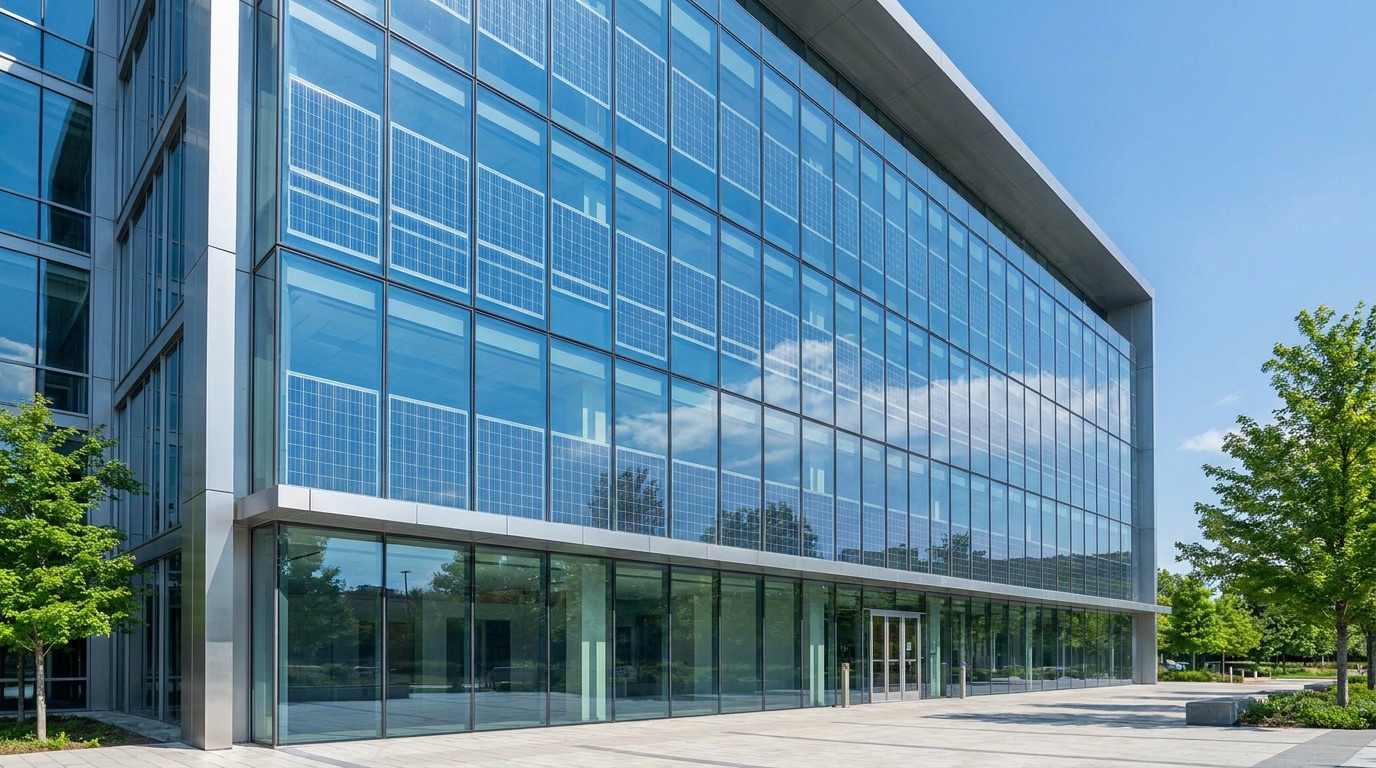
Most people picture solar panels as a rack of blue or black rectangles mounted on brackets above a tiled roof. BIPV turns that model on its head. Instead of adding solar as an afterthought, BIPV integrates photovoltaic cells directly into the building envelope — the roof, the walls, the windows — so the solar element is the building material. The result is a structure that generates electricity while looking exactly as the architect intended.
This is not a niche technology. Tesla Solar Roof tiles, SunRoof integrated roof tiles, and photovoltaic facade panels from European manufacturers like Onyx Solar and Solarwatt are all available in Australia today. SolBuddy works with these suppliers and with local architects and builders to design BIPV systems that meet both the energy performance brief and the visual design intent.
Types of BIPV products available in Australia
The BIPV category has grown significantly in recent years. Today's products cover the full building envelope and suit a wide range of design styles, from contemporary minimalism to heritage-sensitive restoration.
- Solar roof tiles: replace conventional roofing material entirely, with photovoltaic cells embedded in durable tempered glass tiles that carry the same warranty as a quality traditional roof
- In-roof solar systems: sleek panels that sit flush with the roofline rather than on a raised frame, maintaining the roofline profile while generating full panel-level output
- Photovoltaic facades: cladding panels that generate electricity from vertical or tilted wall surfaces — particularly effective on south-facing commercial buildings with large wall areas
- Solar glazing and skylights: semi-transparent photovoltaic glass that admits controlled daylight while generating power from the absorbed portion of the solar spectrum
- Canopy and pergola-integrated panels: frameless bifacial panels designed as architectural shade structures over car parks, walkways, and outdoor living areas
Photon's tip: BIPV works best when you involve the solar designer at the concept stage of a build, not after the architect has finalised the design. The orientation, pitch, and shading of every surface affects how much energy it can generate — getting this right from the start is much easier than retrofitting later.
How does BIPV compare to conventional solar on efficiency and cost?
Standard rooftop solar panels are hard to beat on pure cost-per-watt because the technology is mature and the installation is straightforward. BIPV products typically cost more per watt installed — sometimes two to four times more, depending on the product. The value proposition is not purely financial: it is the combination of energy generation and the elimination of a separate building material cost, plus the design outcome that a conventional panel array cannot deliver.
On a new build, the calculation changes meaningfully. If you were going to use premium roof tiles or architectural cladding anyway, the marginal cost of choosing a solar-generating version of that material is much lower than comparing BIPV to a budget tiled roof plus conventional panels. We model this properly for every project, so you get a clear picture of the actual incremental investment and the payback timeline.
BIPV for commercial and multi-residential projects
Commercial buildings, apartment complexes, schools, and community facilities are some of the strongest candidates for BIPV. Large roof areas and significant facade space mean generous generation capacity, while the design-integration benefit is especially valued in prominent locations where aesthetics are part of the brief. BIPV systems on commercial buildings also contribute toward Green Star, NABERS, and other sustainability rating tool credits.
We manage BIPV projects end to end — from early design collaboration with architects and engineers, through to system design, product procurement, installation management, commissioning, and monitoring setup. We also handle the grid connection paperwork with your local distributor, which for larger commercial systems can involve an embedded network application.
Warranties and long-term performance
Quality BIPV products carry product warranties of 10 to 15 years and power output warranties of 25 to 30 years — comparable to standard solar panels. Because the modules are also structural building elements, they are engineered to significantly higher wind uplift and impact resistance standards than conventional panels mounted on a rack. We source only products that have been independently tested to Australian wind and cyclone zone standards relevant to your project location.
Monitoring is built into every BIPV system we install. You'll have panel-level or string-level visibility into generation performance through a web dashboard and mobile app. If any section of the system underperforms, we can identify it quickly and attend to it before it affects your long-term energy yield.
Frequently asked questions
Can BIPV be added to an existing building, or is it only for new builds?
Both are possible, though new builds give the most design flexibility. For existing buildings, in-roof flush-mount systems and facade panels are the most common retrofit option. A full solar tile roof replacement is also possible if the existing roof is due for replacement anyway — that is often when the economics align best.
Are solar roof tiles as durable as conventional tiles?
The leading solar tile products use tempered glass construction that is actually more impact-resistant than clay or concrete tiles. They are rated to the same cyclone and hail standards as conventional premium roofing. Most carry a 25-year product warranty that covers both the structural and electrical functions simultaneously.
How much electricity does a BIPV roof generate compared to a conventional panel system?
It depends on the product and installation angle. Solar tiles on an ideal north-facing 22-degree pitch typically generate 15 to 20 per cent less per square metre than an equivalent high-efficiency panel on an optimised rack, because the tile profile is fixed to the roofline. On a well-oriented roof the difference is modest. We model generation for your specific roof geometry during the design phase so you have real numbers to work with.
Does BIPV qualify for the same solar rebates as conventional panels?
Yes. BIPV modules that use certified photovoltaic cells qualify for the Small-scale Renewable Energy Scheme (SRES) under the same rules as conventional panels, provided they are installed by a Clean Energy Council accredited installer. We handle the STC paperwork as part of every installation.
Let's go solar
Ready to make friends with the sun?
Get a free, no-pressure quote and a clear plan. Photon will walk you through every step — no jargon, promise.