Home / Services / Commercial & Industrial Solar
Commercial & Industrial Solar
Reduce your biggest operating cost with commercial solar that pays its way
Electricity is one of the top three operating costs for most Australian businesses — and unlike wages or rent, it's one you can actually do something significant about. A well-designed commercial or industrial solar system can slash your daytime energy bill by 50–80%, deliver a return on investment in under four years, and free up capital that belongs back in your business.
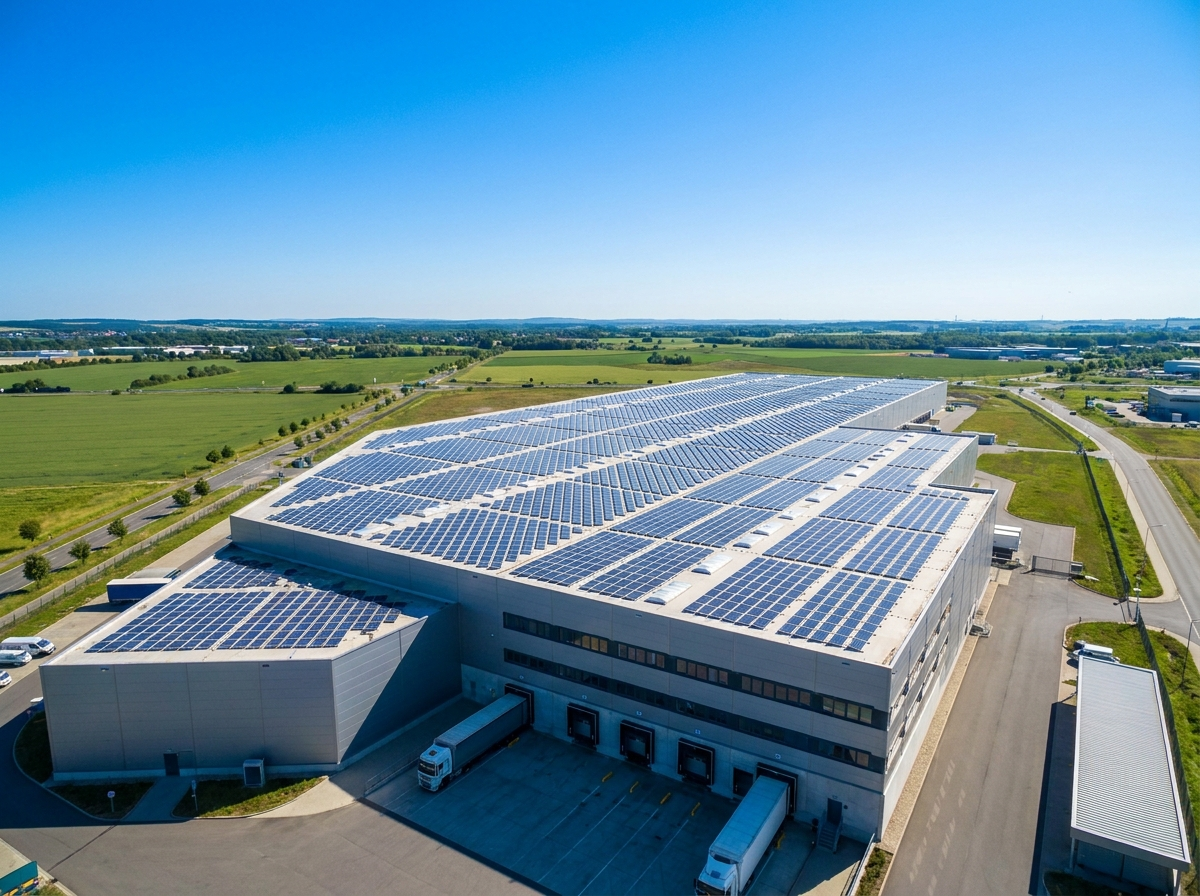
Commercial and industrial solar operates on the same fundamental principles as residential solar — photovoltaic panels convert sunlight to electricity — but the scale, engineering complexity, and financial structure are quite different. A business might install anywhere from 30 kilowatts (enough for a small office or café) to several megawatts for a manufacturing facility or logistics centre. The design must account for three-phase power, demand tariffs, structural engineering of commercial rooftops, and sometimes ground-mount or carpark canopy configurations.
The financial case for commercial solar is compelling precisely because businesses typically consume most of their electricity during daylight hours — the exact same window when solar panels are generating at their peak. That alignment between generation and consumption means self-consumption rates of 70–95% are routinely achievable, which is far higher than a typical home where occupants are often away during the day.
Understanding your commercial electricity tariff
Before designing a system, we always start with a deep dive into your electricity bills. Commercial tariffs are more complex than residential ones. Most businesses are on time-of-use rates, where you pay different prices depending on when you consume electricity — peak rates (often 35–50c/kWh) typically apply from 7am to 10pm on weekdays, which is precisely when solar is generating. Many commercial customers also face demand charges — a separate fee based on your single highest 15-or-30-minute consumption peak in the billing period. Solar can reduce demand charges significantly when the system is sized and managed correctly.
- Time-of-use savings: consuming your own solar generation during peak-rate windows means every kilowatt-hour produced is worth the full peak tariff — typically 35–50c/kWh.
- Demand charge reduction: solar generation directly reduces your consumption peak during daylight hours, which can knock hundreds of dollars off your monthly demand charge.
- Feed-in credits: surplus generation exported to the grid earns a feed-in credit, though commercial feed-in tariffs are modest (2–8c/kWh), so maximising self-consumption is the priority.
- Network tariff reclassification: some businesses generate enough solar to qualify for a lower network tariff category, delivering further ongoing savings.
Large-scale Generation Certificates and commercial rebates
Commercial systems under 100kW still qualify for the Small-scale Technology Certificate (STC) federal rebate, applied as a point-of-sale discount just like residential systems. Systems above 100kW instead generate Large-scale Generation Certificates (LGCs) over time as electricity is produced — these are sold on the market or surrendered to meet renewable energy targets, creating an additional revenue stream that improves your system's financial return. State-based business incentives also exist: Victoria's Business Energy Upgrades, NSW's Energy Savings Scheme, and various network rebates add further layers of support.
For businesses that prefer not to use capital for an upfront purchase, Power Purchase Agreements (PPAs) are an increasingly popular structure. Under a PPA, a solar finance company installs the system on your property at no upfront cost, and you purchase the electricity it generates at a fixed, below-market rate for a contracted term (typically 10–20 years). You get immediate savings without the capital outlay; the financier earns a return through the electricity payments. It's a legitimate structure used by some of Australia's largest companies.
Photon's tip: If your business runs Monday to Friday during daylight hours, your load profile is almost perfectly aligned with solar generation. Even without battery storage, a well-sized commercial system can achieve self-consumption rates above 80% — meaning most of what you generate, you actually use.
Engineering considerations for commercial installations
Commercial rooftops present different engineering challenges to residential ones. Flat roofs — common on warehouses, factories, and retail centres — require ballasted or penetrating tilt-frame mounting systems designed to withstand wind loads specific to the building's location. The structural engineer of record must sign off on the additional load, and for older buildings a roof survey is essential. Three-phase inverters are standard at commercial scale, and switchboard upgrades or additional protection equipment may be required to meet AS/NZS 4777 grid connection standards.
- Rooftop systems: most cost-effective for buildings with large, unshaded roof areas. Minimum viable roof is roughly 150 square metres for a 30kW system.
- Carpark canopies: solar carport structures generate electricity while providing vehicle shade — ideal for retail centres, hospitals, and large commercial sites with expansive car parks.
- Ground-mount arrays: where roof space is limited or structurally challenged, ground arrays in adjacent land can be cost-competitive, particularly for industrial sites.
- Monitoring and SCADA: commercial systems benefit from advanced monitoring platforms that track performance at the string or panel level, flag underperformance early, and provide data for your accountants' depreciation schedules.
Tax incentives and depreciation
Beyond the direct energy savings, commercial solar delivers meaningful tax benefits. The Australian Taxation Office allows businesses to depreciate solar assets, and the instant asset write-off provisions (thresholds vary by year and business size — check with your accountant for the current rules) have allowed many businesses to write off a significant portion of the system cost in the year of installation. This effectively brings forward your tax saving, improving the net present value of the investment considerably.
SolBuddy works alongside your financial advisers to structure the investment correctly. We provide detailed asset registers, installation certificates, and performance documentation to support your depreciation claims. Our commercial proposals always include a detailed financial model showing after-tax, after-rebate payback period, internal rate of return (IRR), and net present value (NPV) over the system's 25-year life — the same metrics your finance team will use to evaluate any capital expenditure.
Frequently asked questions
How long does a commercial solar installation take from quote to switch-on?
For systems up to 100kW, allow four to eight weeks from signed contract to energisation. This includes engineering design, council or body corporate approval (if required), equipment procurement, installation, and network connection approval from your DNSP. Larger systems above 100kW, or those requiring significant switchboard upgrades, typically take three to six months. We manage the entire process and keep you informed at each stage.
Will solar panels interfere with our business operations during installation?
Experienced commercial installers schedule work to minimise disruption — often completing roof work over a weekend or staging the install in sections. The actual switchover from your existing supply to the solar-plus-grid arrangement typically requires a brief planned outage of 30–60 minutes at the switchboard, which we coordinate with your operations team to find the least disruptive time.
What happens if we expand our premises or our energy use grows?
A well-designed commercial system is modular. Additional inverters and panel strings can be added as your energy demand grows, provided the original design accounted for expansion (which ours always does). If you move premises, commercial solar systems on leased buildings are typically an asset of the building owner — this is one reason PPAs are sometimes preferred for tenants, as the system remains with the building regardless of who occupies it.
Let's go solar
Ready to make friends with the sun?
Get a free, no-pressure quote and a clear plan. Photon will walk you through every step — no jargon, promise.