Home / Services / Community Solar
Community Solar
Renters and apartment dwellers deserve solar too
About one-third of Australians rent, and millions more live in apartments or strata buildings where putting solar on your own roof simply is not possible. Community solar is the answer: a large solar installation shared by many subscribers, each of whom receives a credit on their electricity bill for their portion of the power generated. You get the financial and environmental benefits of solar without needing a roof at all.
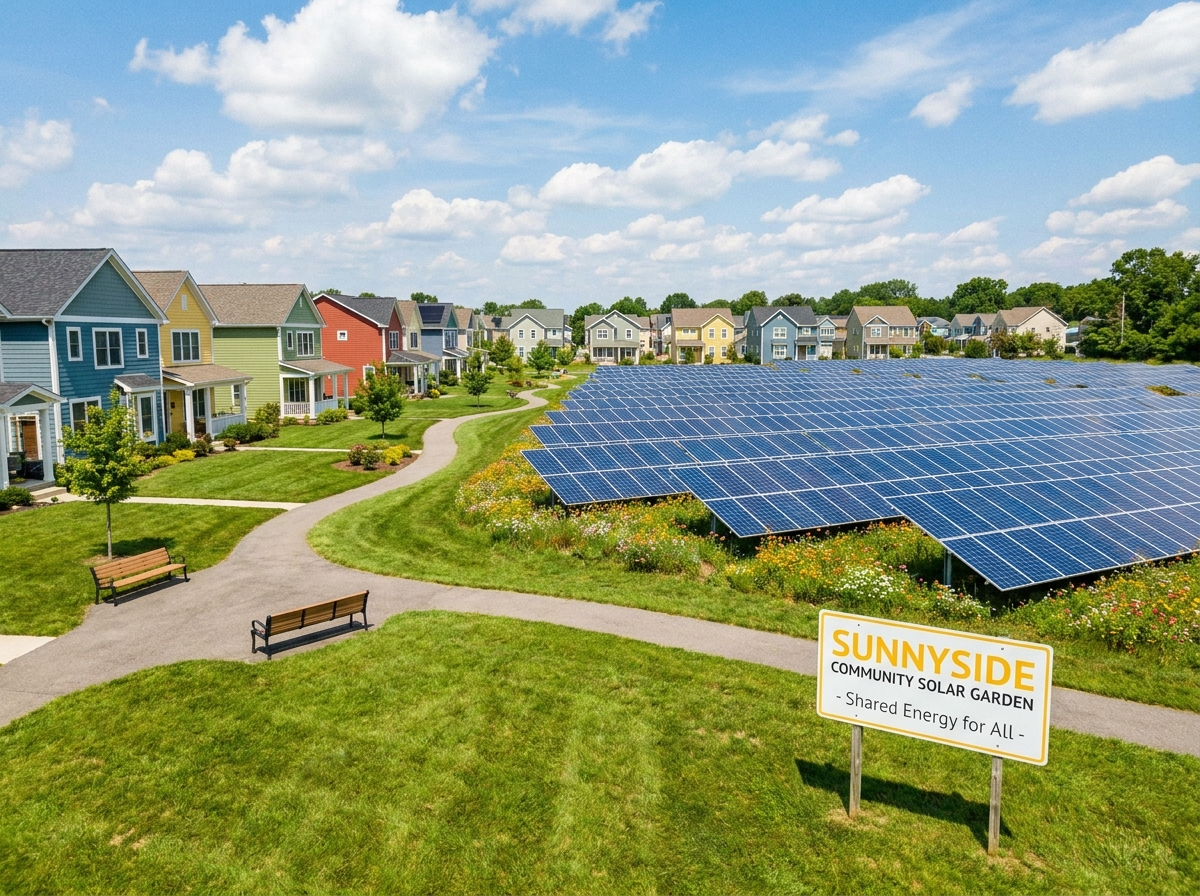
Community solar — sometimes called a 'solar garden' or 'shared solar' — works like this: a large solar array is built on a suitable site (a school roof, a council building, a rural property, or a purpose-built ground mount) and the electricity it generates is fed into the local grid. Subscribers sign up for a share of that output — say 2 kilowatts of the total array — and receive a credit on their energy bill each billing period that reflects what their share produced.
You do not need to own property. You do not need to live anywhere near the array. You do not need to change your electricity retailer in many cases — just subscribe, and the savings appear on your next bill. It is the most accessible form of solar there is.
How the billing credit actually works
The mechanics vary slightly between programmes, but the most common model works as follows. The community solar operator generates power and sells it to the grid or to a retail partner. Your subscription entitles you to a fixed volume of that generation, credited to your account at a rate that is lower than the standard retail tariff — typically 10 to 30% below what you currently pay for grid electricity.
So if you currently pay 30 cents per kilowatt-hour and your community solar subscription is credited at 22 cents per kilowatt-hour, every unit generated by your share of the array saves you 8 cents compared to buying that power from the grid. Your bill shows the generation credit as a line item, reducing your total amount payable.
- No installation required — no tradesperson visit, no rooftop assessment, no strata approval needed.
- Works in rental properties, apartments, and heritage-listed buildings where rooftop solar is not possible.
- You can typically subscribe to a share that matches your average monthly consumption, or start smaller and scale up.
- If you move, you can either transfer the subscription to your new address (within the same network area) or cancel with notice — most programmes offer no lock-in options.
Who community solar is designed for
Community solar was specifically designed to fill the gap left by rooftop solar — to make clean energy accessible to people who currently have no path to participation. The main groups who benefit are:
- Renters in houses or townhouses who cannot get landlord permission for rooftop panels.
- Apartment residents where the roof is either too small, already in use, or managed by a strata scheme that has not yet voted to add solar.
- People in heritage or character-listed homes where rooftop panels are not permitted by local planning rules.
- Households with heavily shaded roofs (from large trees or nearby buildings) where rooftop solar would be inefficient.
- Low-income households who want to reduce their bills but cannot access a loan or fund an upfront purchase.
- Environmentally motivated individuals who want to directly support new solar generation in their community, even if they already have rooftop solar.
The community benefits beyond your bill
Community solar programmes are often structured to deliver broader benefits beyond individual bill savings. Many projects are located on public or institutional buildings — schools, hospitals, community centres — and the revenue generated supports the host organisation as well as subscribers. In some models, a portion of the array is reserved for low-income households at a subsidised rate, making clean energy access genuinely equitable.
There is also a civic dimension to community solar. When residents of a neighbourhood collectively subscribe to a local solar installation, it builds community ownership of the energy transition in a very tangible way. People become stakeholders in clean energy infrastructure rather than passive consumers of it.
Photon's tip: if you live in a strata building, community solar and a rooftop strata solar system are not mutually exclusive — you could subscribe to a community project now while also advocating for a shared rooftop system at your next owners corporation meeting. We can help you make the case to strata with a simple cost-benefit summary.
Strata buildings — a related option worth knowing
If you live in an apartment building with a shared roof, there is a growing ecosystem of solutions for embedded strata solar networks. Under an embedded network arrangement, a solar system on the common roof generates power that is shared across all units via the building's internal wiring. Residents pay below-market rates to the embedded network operator for that solar power.
Strata solar requires a body corporate vote and is more complex to set up than community solar subscription, but the savings can be deeper because the power never touches the grid — it goes directly from roof to apartment. SolBuddy's team can present to your strata committee and provide the documentation needed to put a proposal to a vote.
How to choose a community solar programme
Not all community solar programmes are structured the same way, and the differences matter. When evaluating options, ask these questions before you subscribe:
- What is the credit rate per kilowatt-hour, and is it fixed or does it vary with spot prices? Fixed rates give you predictable savings; variable rates give you potential upside but less certainty.
- Is there a lock-in period? Flexibility to cancel with 30 to 90 days notice is the standard to look for.
- What happens if the array underperforms — due to fault or weather — in a given period? You should only be credited for energy actually generated.
- Is the programme accredited under GreenPower or another recognised standard, giving you confidence the generation is genuine and audited?
- How is the project funded and who operates it long-term? Look for programmes backed by established operators with a track record.
SolBuddy works with a curated network of community solar operators across Queensland, New South Wales, Victoria, and South Australia. We vet each programme for financial stability, contract fairness, and actual billing outcomes before recommending it to subscribers. Tell us your postcode and current retailer and we will find the best match for your situation — at no cost to you.
Frequently asked questions
Do I need to change my electricity retailer to join a community solar programme?
It depends on the programme. Some community solar schemes are retailer-agnostic and the credit appears on your existing bill. Others are operated by specific retailers and require you to switch. We will clarify this for any programme we recommend before you commit.
Can my landlord stop me from subscribing to community solar?
No. Community solar is a service you subscribe to as an individual energy consumer — it is no different from choosing a different electricity plan. Your landlord has no say in which energy retailer or product you sign up for, provided you continue to pay your electricity bills.
How much can I realistically save?
Savings depend on your subscription size, your current tariff, and the credit rate offered by the programme. As a rough guide, subscribing to cover your full household consumption at a 20% discount would save a typical Australian household $300 to $500 per year. We can model this precisely once we know your average quarterly bill.
What if I move interstate?
Most community solar subscriptions are limited to the state's electricity network, so an interstate move typically means cancelling your subscription. Most programmes allow cancellation with 30 to 90 days notice and will help you find an equivalent programme in your new location.
Is community solar environmentally equivalent to having rooftop solar?
In terms of CO2 abatement per kilowatt-hour subscribed, yes — you are supporting the same volume of clean generation. The key difference is that a rooftop system adds new capacity directly to your property and to the grid, while community solar relies on an existing shared installation. Both are meaningful contributions to the energy transition.
Let's go solar
Ready to make friends with the sun?
Get a free, no-pressure quote and a clear plan. Photon will walk you through every step — no jargon, promise.