Home / Services / Residential Solar
Residential Solar
Power your home with sunshine and watch your bills shrink
Installing solar panels on your home is one of the smartest financial decisions an Australian household can make right now. With electricity prices continuing to climb, generating your own clean energy means you rely less on the grid and more on the free, abundant sunshine above your roof — and Photon is here to walk you through every step.
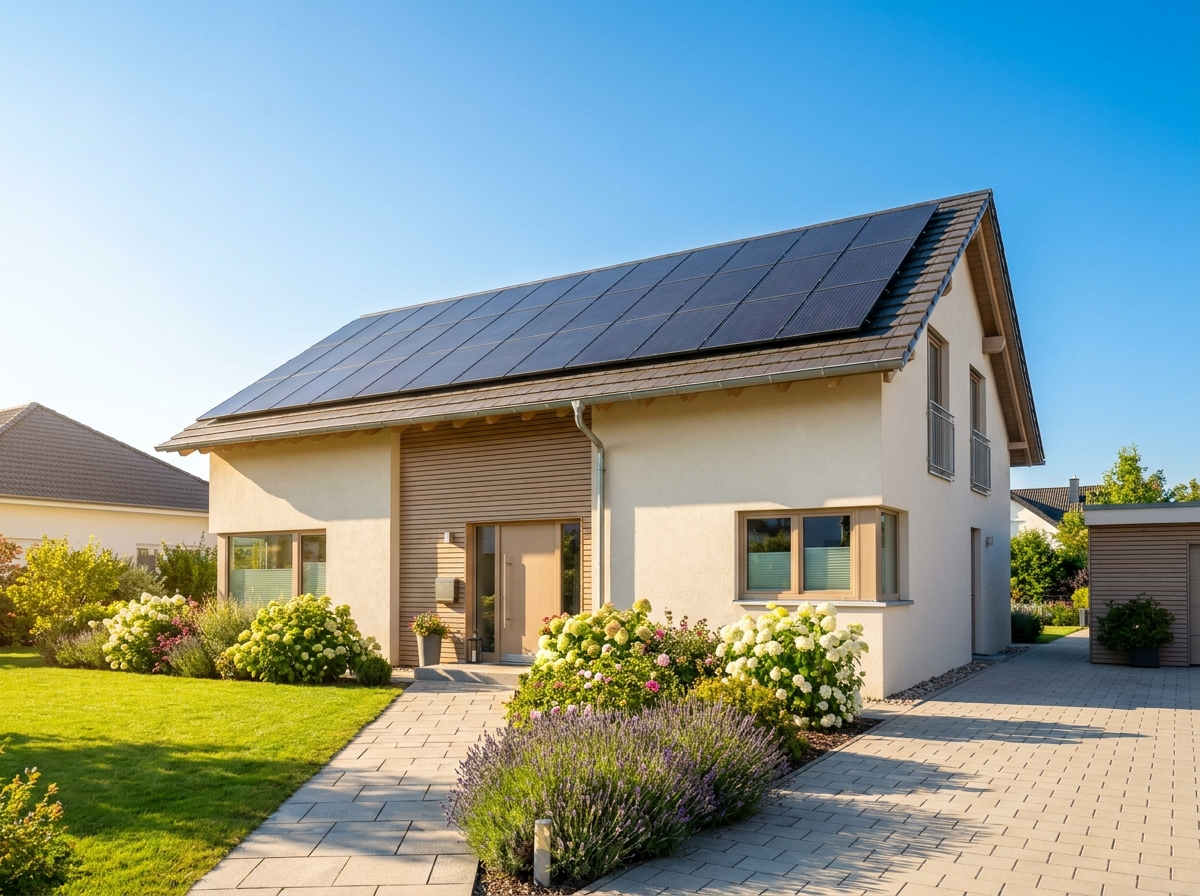
Australian homes are perfectly positioned to benefit from solar power. We receive some of the highest solar irradiance (that's the scientific term for 'how much sunshine hits a surface') in the world, which means even a modest rooftop system can generate a meaningful chunk of your household's electricity needs. A well-sized system for a typical Australian home will cover 60–90% of your daily usage, dramatically cutting what you pay to the grid.
The good news is that residential solar technology has improved enormously over the past decade while costs have dropped just as sharply. What cost $30,000 in 2010 can now be delivered for under $8,000 after government incentives — and the quality is far superior. Today's panels are more efficient, tougher, and backed by warranties that last a quarter of a century.
How does a home solar system actually work?
Your solar panels are made up of photovoltaic (PV) cells — tiny layers of silicon that release electrons when sunlight hits them, creating a flow of direct current (DC) electricity. That current travels to an inverter, a box usually mounted on your garage or utility-room wall, which converts DC into alternating current (AC) — the type your appliances, lights, and devices actually use. From the inverter it flows into your home's switchboard, ready to power whatever you have running.
Any electricity you generate but don't immediately use gets exported to the grid, and your energy retailer pays you a feed-in tariff (FIT) for it — a small credit per kilowatt-hour. Pairing your system with a battery storage solution means you can store that surplus for evenings and cloudy days instead of selling it cheaply, which tends to improve your financial return significantly.
What size system does my home need?
Sizing depends on three things: how much electricity you currently use, when you use it, and how much roof space you have facing north, north-east, or north-west (those orientations capture the most sun in Australia). Most households sit in the 6.6kW to 13.3kW range. A 6.6kW system generates roughly 26–28 kWh on a good sunny day, which covers the average Australian household's daily consumption with room to spare.
- Small households or apartments: 3kW – 5kW is usually adequate, keeping costs low while delivering solid savings.
- Average family homes: 6.6kW is the sweet spot — it's the most popular size and typically qualifies for the maximum Small-scale Technology Certificate (STC) rebate.
- Larger homes or those with electric vehicles: 10kW – 13.3kW captures more energy, charges an EV overnight via stored battery power, and maximises your return.
- Homes with pools or ducted air conditioning: upsizing slightly pays off fast because heavy loads that run during the day are virtually free to run once you're generating.
Photon's tip: Before accepting any quote, ask the installer to show you a shading analysis of your roof. Even a small chimney or tree casting a shadow across a few panels can reduce your whole system's output if it's not accounted for in the design.
Understanding the government rebate — STCs explained
Australia's federal government supports residential solar through the Small-scale Renewable Energy Scheme, which creates Small-scale Technology Certificates (STCs) for every megawatt-hour of electricity your system is expected to generate over its lifetime (up to 15 years). Installers almost universally apply the STC value as a point-of-sale discount, meaning you never handle the certificates — you just pay a lower price. The rebate amount varies by your postcode's solar zone rating and the size of your system, but for a typical 6.6kW system in Brisbane or Sydney it currently reduces the installed cost by $2,000–$3,500.
Some states layer additional incentives on top — Victoria's Solar Homes Program offers a separate rebate of up to $1,400, while the ACT, NSW, and Queensland all have varying support schemes. Feed-in tariffs, where you're paid for surplus electricity exported to the grid, sit between 4 and 10 cents per kWh depending on your retailer and state.
The money side: payback periods and long-term returns
Here's how the numbers tend to work for a mid-size Australian household. Suppose you install a 6.6kW system for a net cost (after STCs) of $7,000. Your annual electricity savings from self-consumption, combined with modest feed-in tariff credits, typically total $1,500–$2,500 per year depending on your usage patterns and electricity tariff. That puts your payback period at roughly three to five years. With panels carrying a 25-year product and performance warranty, you're looking at 20-plus years of essentially free electricity after payback — a return on investment that most managed funds would envy.
- Self-consumption is king: every kilowatt-hour you generate and use yourself saves you the full retail electricity rate (currently 28–45c/kWh), which is far better than the 4–10c/kWh feed-in credit.
- Shift your loads: run your dishwasher, washing machine, and pool pump during peak sun hours (10am–3pm) to maximise self-consumption.
- Add a battery later: your inverter and switchboard can be battery-ready from day one, so adding storage in future is straightforward.
- Monitor your system: a good monitoring app lets you see generation versus consumption in real time, so you can spot any performance issues early.
Choosing the right installer
Quality of installation matters as much as quality of equipment. Always choose a Clean Energy Council (CEC) Accredited Installer — this is a federal government requirement for any rebate-eligible installation, and it means the installer has been trained and assessed to industry standards. Ask for references, check that the design comes with a shading analysis, and make sure your contract specifies the exact panels, inverter, and mounting hardware being used — not vague placeholders. A reputable installer will also handle your grid connection paperwork with your Distribution Network Service Provider (DNSP), which is the company that owns the poles and wires.
SolBuddy partners exclusively with CEC-accredited installation teams, and every system we design comes with a 12-month installation workmanship warranty on top of the manufacturer warranties. We're a no-pressure, education-first company — if solar isn't the right fit for your situation right now, we'll tell you honestly rather than push a sale.
Frequently asked questions
Will solar panels still work on cloudy days?
Yes, though at reduced output. Solar panels generate electricity from daylight, not just direct sunshine, so they still produce on overcast days — typically at 10–25% of their rated capacity. Australia's average of over 2,500 sunshine hours per year means cloudy stretches are the exception, and a well-sized battery can bridge those gaps easily.
Do I need to replace my roof before installing solar?
Not necessarily, but it's worth a check. A CEC-accredited installer will inspect your roof's condition, age, and structure before committing to an installation. If your roof has fewer than 10 years of life left, it makes sense to address that first — removing and reinstalling panels later adds cost. Tile, metal, and Colorbond roofs are all compatible with solar mounting systems.
What happens during a blackout — will my solar keep the lights on?
A standard grid-tied inverter will shut down during a blackout for safety reasons (to protect linespeople working on the network). To keep power flowing during an outage, you need a battery storage system with a backup or 'islanding' capability. This is one of the most common reasons homeowners choose to add battery storage alongside their panels.
How much maintenance do solar panels need?
Very little. Panels are designed to be self-cleaning in most Australian climates — rain does most of the work. An annual check to clear any accumulated dust, bird droppings, or leaf debris from particularly dry areas is recommended. Most installers offer a periodic health check that includes cleaning, inspection of mounting hardware, and a review of your monitoring data to confirm everything is performing as expected.
Let's go solar
Ready to make friends with the sun?
Get a free, no-pressure quote and a clear plan. Photon will walk you through every step — no jargon, promise.